
Explore the question
Enlarge image
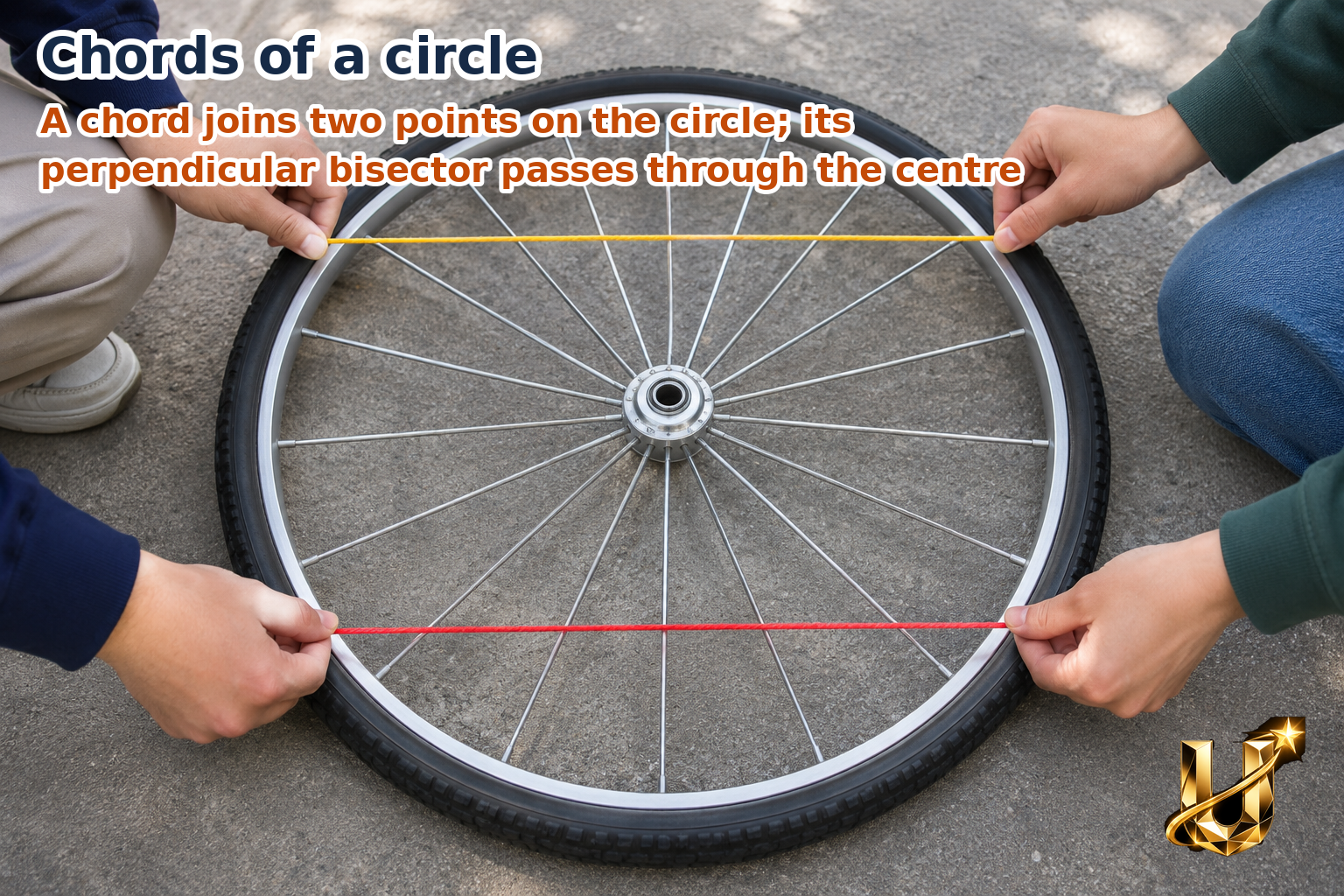
Aarav draws two equal chords in a circle. What can the centre tell him about their angles and distances?
Chapter 5: I’m Up and Down, and Round and Round
Aarav draws two equal chords in a circle. What can the centre tell him about their angles and distances?
A line segment joining two points on a circle.
Review lesson not available yet.
Aarav draws two equal chords in a circle. What can the centre tell him about their angles and distances?
A circle is the set of points in a plane at a fixed distance, the radius, from its centre. A diameter is a chord through the centre and has length twice the radius. A chord joins two circle points; an arc is part of the circumference. A sector is bounded by two radii and an arc, while a segment is bounded by a chord and an arc. The diameter is the longest chord.
A circle has radius 5 cm and a chord 8 cm long. Find the perpendicular distance from the centre to the chord.
In the same circle or congruent circles, equal chords subtend equal angles at the centre, and the converse holds. Join each chord's endpoints to the centre: equal radii and equal chords make congruent triangles by SSS. A line from the centre to a chord's midpoint is perpendicular to the chord; conversely a perpendicular from the centre bisects the chord. The right triangles formed give equal-chord/equal-distance results; among unequal chords, the longer is nearer the centre.
Two chords of the same radius-5 circle are 6 cm and 8 cm long. Which is closer to the centre?
Radius is 7 cm. Diameter?
Two chords in the same circle subtend central angles of 70 degrees each. Compare their lengths and justify.
A perpendicular from the centre meets a 12 cm chord. The two parts have length:
Name the circle parts; use radii, triangle congruence and chord midpoints to justify circle relationships.