
A question from life
Enlarge image
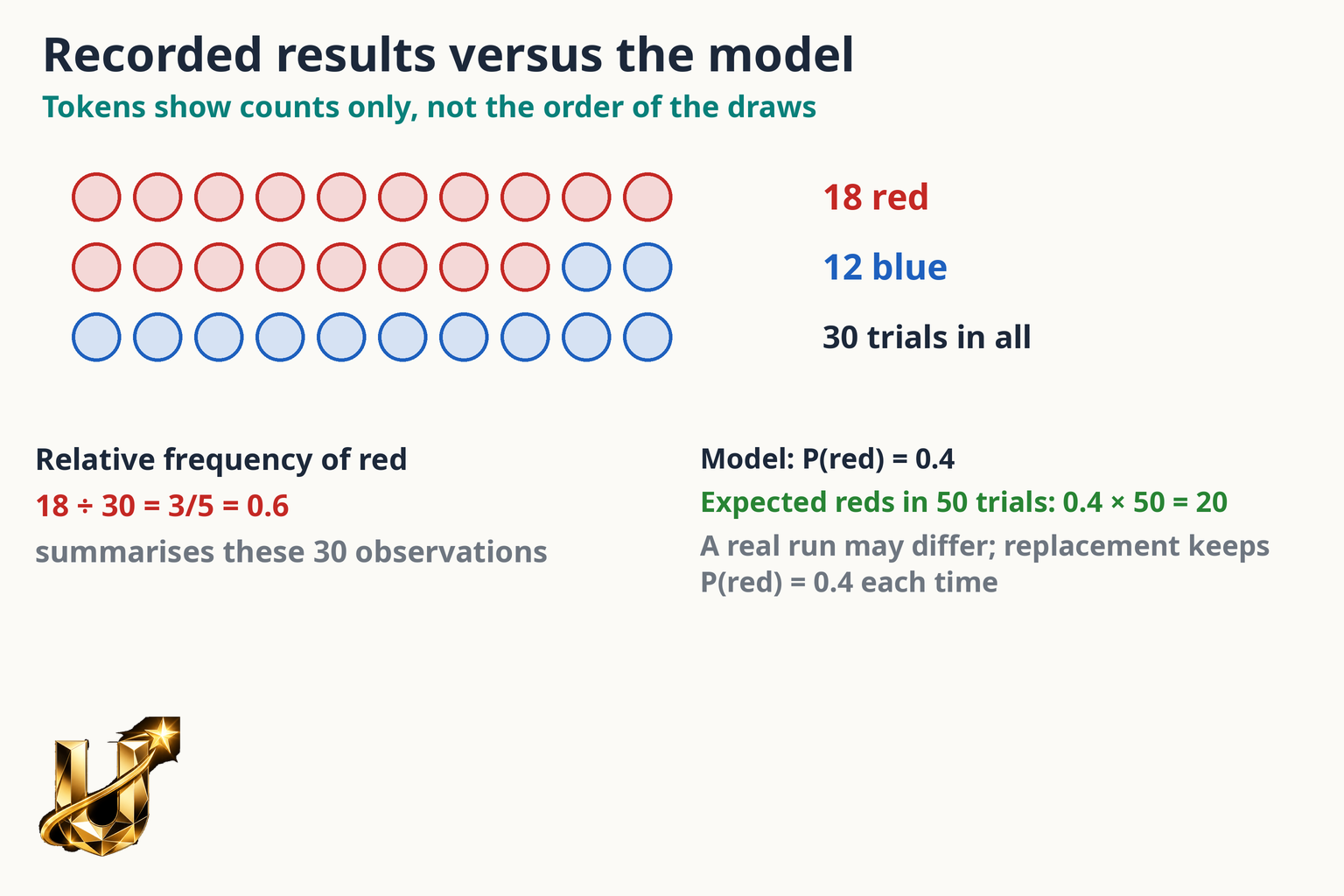
Meera records 18 red draws in 30 independent trials with replacement. Does that prove the next draw will be red?
Chapter 7: The Mathematics of Maybe: Introduction to Probability
Meera records 18 red draws in 30 independent trials with replacement. Does that prove the next draw will be red?
The observed count of an event divided by the total number of trials.
Review lesson not available yet.
Meera records 18 red draws in 30 independent trials with replacement. Does that prove the next draw will be red?
Experimental relative frequency is observed successes divided by trial count. Theoretical probability follows a stated model. They can differ in a finite sample.
Find the recorded red relative frequency.
For independent repeated trials with the same success probability p, the expected count is p times the number of trials. It is an average prediction, not a guaranteed result. Larger samples often give more stable frequencies, but improvement is not monotonic or guaranteed for every added trial.
The model gives red probability 0.4. Find expected reds in 50 trials.
12 successes in 40 trials gives relative frequency?
Does a long run of blue guarantee red next under independent replacement?
Probability 1/4 over 80 independent trials gives expected count?
Separate observed frequency, model probability and expected counts. Avoid guarantees about random runs.