
A question from life
Enlarge image
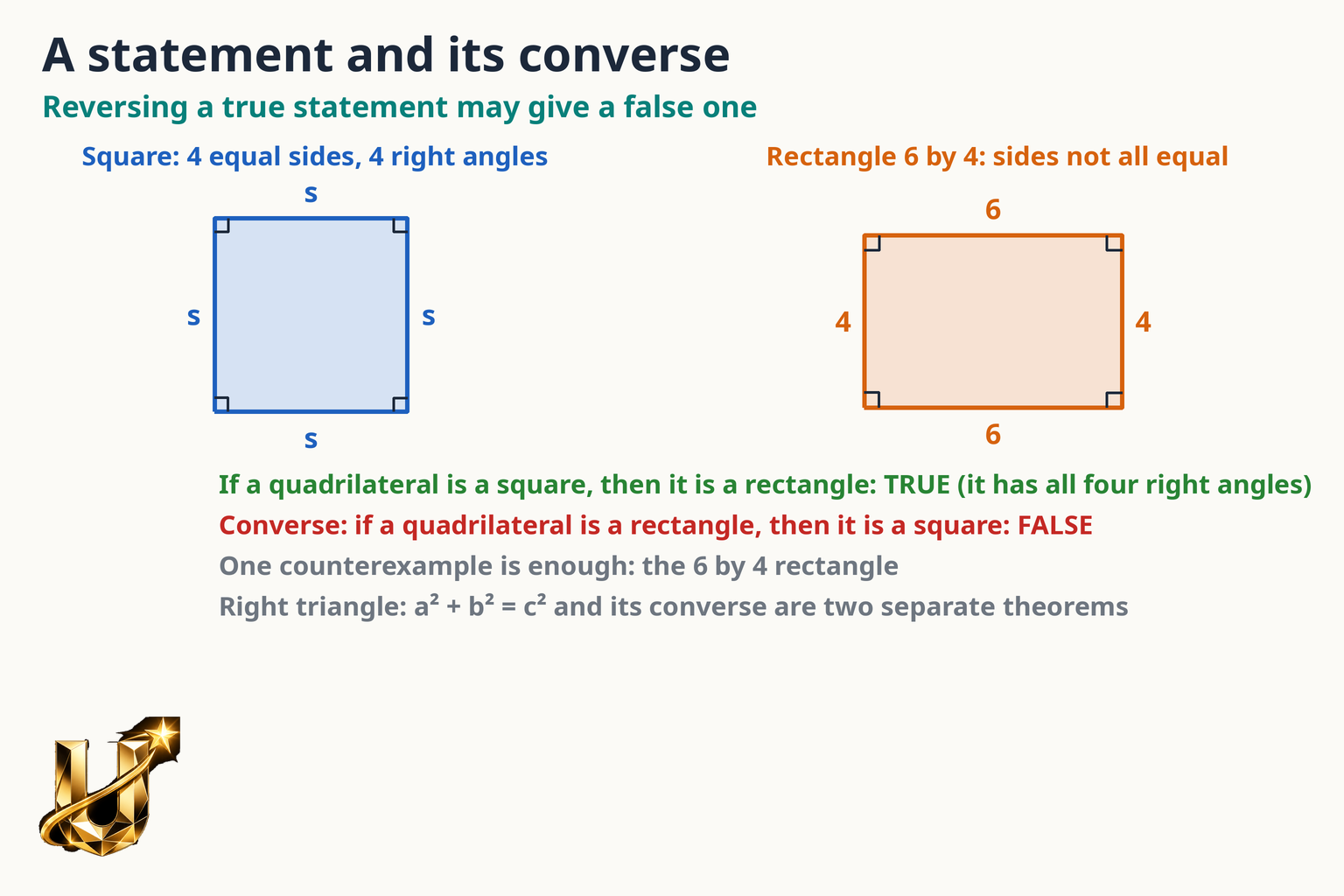
Meera says, 'If a shape is a square, it is a rectangle.' Does reversing that sentence keep it true?
Chapter 9: Propositions and their Converses
Meera says, 'If a shape is a square, it is a rectangle.' Does reversing that sentence keep it true?
The statement formed by swapping an implication's hypothesis and conclusion.
Review lesson not available yet.
Meera says, 'If a shape is a square, it is a rectangle.' Does reversing that sentence keep it true?
A mathematical proposition is a statement with a definite truth value in its specified setting. In an if-then statement, the hypothesis gives the condition and the conclusion gives what follows.
Examine: if a quadrilateral is a square, then it is a rectangle.
The converse swaps hypothesis and conclusion. A true proposition need not have a true converse. One valid counterexample disproves a universal claim; many matching examples alone do not prove it.
Test its converse: if a quadrilateral is a rectangle, then it is a square.
What does a converse do?
Consider a right triangle with legs a and b and hypotenuse c.
One counterexample to a universal claim is enough to?
State the conditions and distinguish a theorem from its converse. Use counterexamples precisely.