
A question from life
Enlarge image
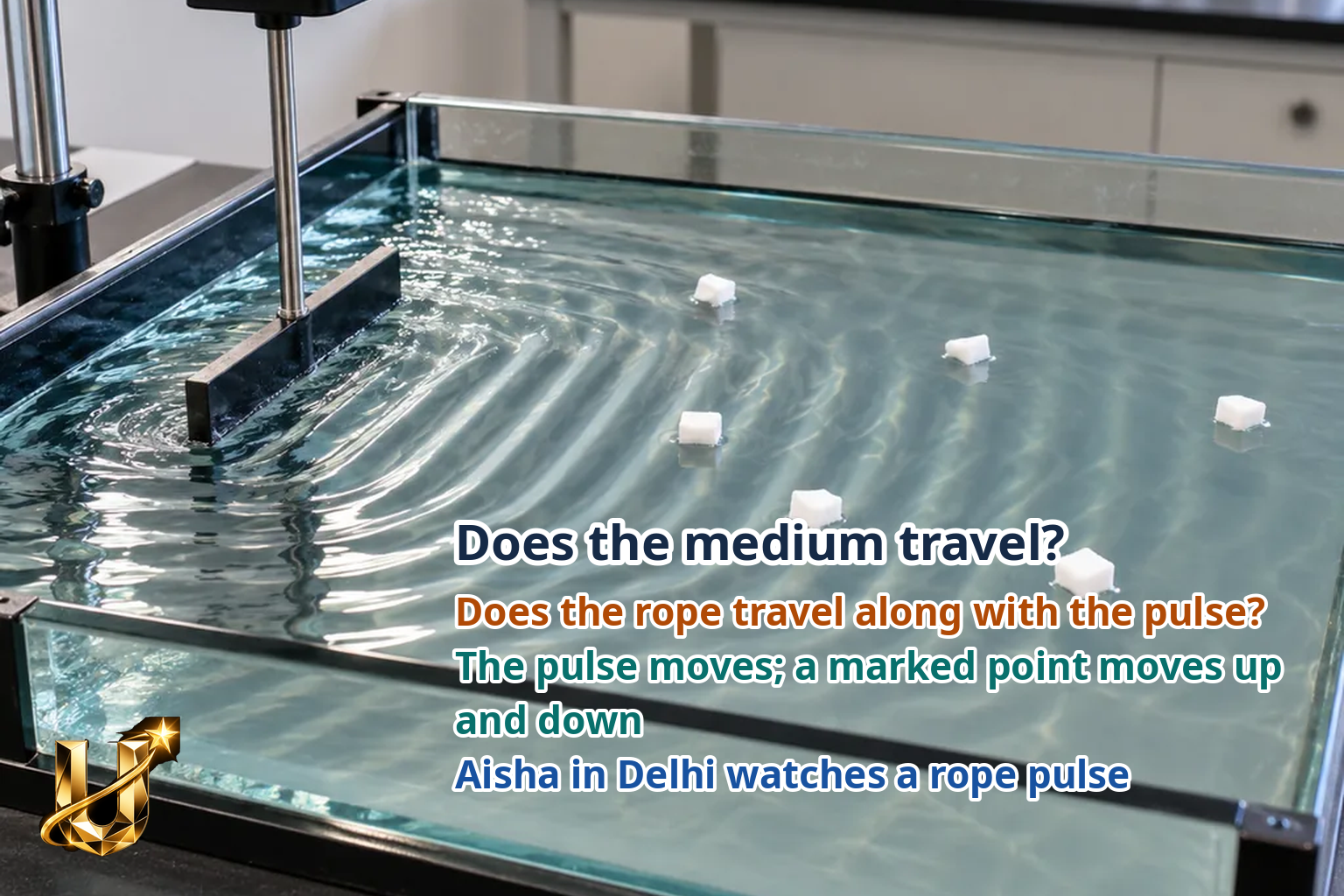
Aisha in Delhi watches a simulated rope pulse move right while one marked point moves up and down. Does the rope material travel along with the pulse?
Working review group 7; official unit label pending
Aisha in Delhi watches a simulated rope pulse move right while one marked point moves up and down. Does the rope material travel along with the pulse?
Addition of disturbances at a point in a linear wave model.
Review lesson not available yet.
Aisha in Delhi watches a simulated rope pulse move right while one marked point moves up and down. Does the rope material travel along with the pulse?
A mechanical wave transfers a disturbance and energy through a medium. Individual material points oscillate around local positions in the small-wave model rather than travelling the full propagation distance. Transverse and longitudinal refer to oscillation direction relative to propagation.
y = 0.02 sin(4πx−20πt) m in SI units.
What does transverse mean?
For y(x,t) = A sin(kx−ωt+φ), the pattern travels in positive x; k = 2π/λ and ω = 2πf. Phase differences depend on position and time. Wave speed v = ω/k = fλ is distinct from a particle's transverse speed.
Tension quadruples while linear density is fixed.
For f = 8 Hz and λ = 0.25 m, what is wave speed?
For a small transverse wave on an ideal taut string, v = √(tension/linear mass density). In a simple fluid sound model v = √(bulk modulus/density). Frequency is usually set by the source, while wavelength adjusts when propagation speed changes at a boundary.
Two points are separated by λ/2 at the same time.
Interpret recorded rope and compression animations. Label particle motion separately from propagation, then read A, k and ω from supplied equations.
Travelling waves combine local oscillation with propagation. Phase encodes wavelength and frequency; speed depends on medium conditions and differs from particle speed.