
A question from life
Enlarge image
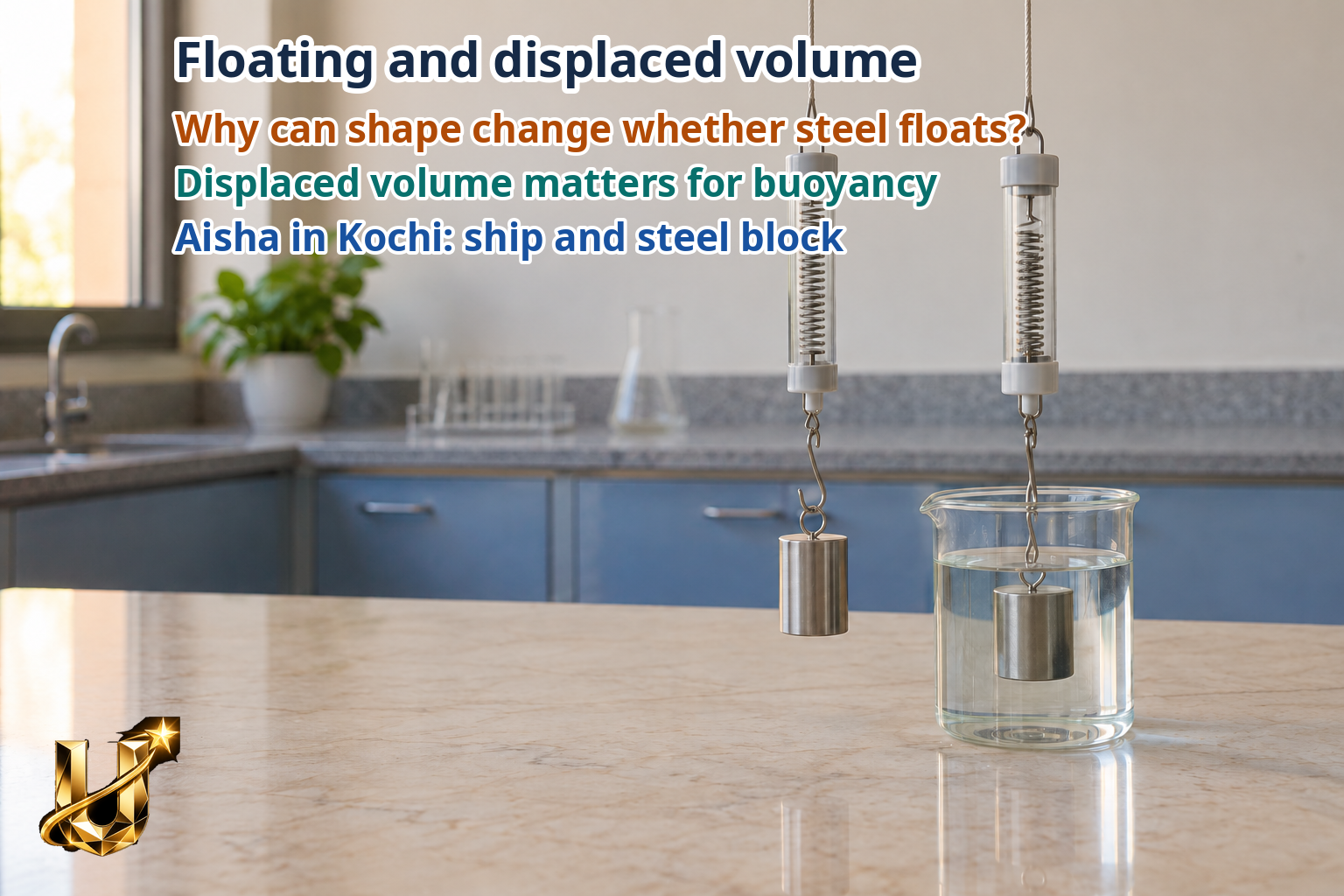
Aisha in Kochi studies a hollow steel ship and a small steel block. Why can shape and displaced volume change whether they float?
Working review group 5; official unit label pending
Aisha in Kochi studies a hollow steel ship and a small steel block. Why can shape and displaced volume change whether they float?
A measure of resistance to relative shear flow in a fluid.
Review lesson not available yet.
Aisha in Kochi studies a hollow steel ship and a small steel block. Why can shape and displaced volume change whether they float?
For a uniform-density incompressible liquid at rest, pressure rise with depth is ρgh. Absolute pressure is surface pressure plus this rise. Points at the same level in a connected resting liquid have equal pressure under the stated conditions; container shape alone does not determine it.
Use ρ = 1,000 kg/m³, depth 2 m and g = 10 m/s².
What must be added to ρgh to get absolute pressure in an open vessel?
Pascal's principle states that an applied pressure change in an enclosed fluid is transmitted through it. An ideal hydraulic model gives F₁/A₁ = F₂/A₂. Force multiplication is accompanied by a distance trade-off, not extra energy creation.
Areas are 2 cm² and 20 cm²; the small piston force is 30 N.
What is pressure rise at 3 m with ρ = 1,000 and g = 10?
Buoyant force equals weight of displaced fluid: Fb = ρfluid gVdisplaced for uniform density. In static floating with no other vertical forces, Fb equals weight. A hollow object's average density includes its enclosed space; submerged fraction depends on average object and fluid densities.
Average object density is 600 kg/m³ in water of 1,000 kg/m³.
Compare hydrostatic, hydraulic and floating-model cards. Distinguish gauge from absolute pressure and identify displaced volume, without pressurised equipment or liquids containing mercury.
Hydrostatic pressure depends on depth and density. Pascal's principle supports hydraulic force trade-offs, and buoyancy equals displaced-fluid weight.