
A question from life
Enlarge image
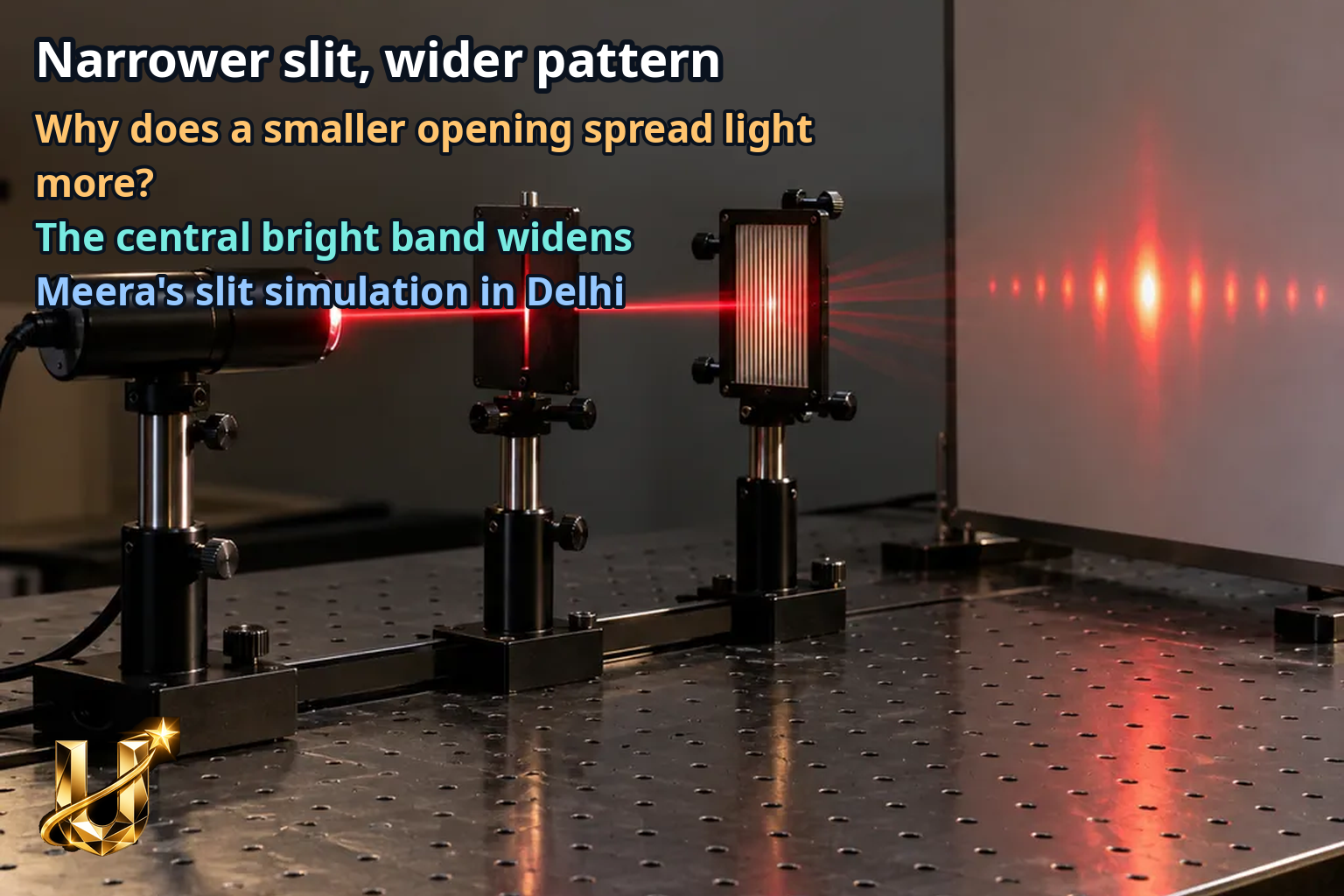
Meera narrows a simulated slit in Delhi and sees its central bright band widen. Why does making the opening smaller make the light pattern spread more?
Working review group 5; official unit label pending
Meera narrows a simulated slit in Delhi and sees its central bright band widen. Why does making the opening smaller make the light pattern spread more?
A stable relative phase relationship that supports sustained interference.
Review lesson not available yet.
Meera narrows a simulated slit in Delhi and sees its central bright band widen. Why does making the opening smaller make the light pattern spread more?
A finite aperture spreads a wave. In far-field single-slit diffraction at normal incidence, minima satisfy a sinθ=mλ form=±1,±2,...; m=0 is the central maximum, not a minimum. At small angles, the central width between first minima isW≈2λD/a. A narrower slit broadens the central band.
λ=450nm, a=0.10mm, D=1.0m in the small-angle far field.
For a single slit, whichm is excluded from the minima condition?
Single-slit diffraction results from superposition across different parts of the same aperture. The central maximum is broad and strongest, with weaker side maxima. Ideal double-slit interference has near-uniform fine fringe spacing but real finite slit widths impose a diffraction envelope. Ray optics is an approximation that misses this wave spreading.
Use the same diffraction arrangement.
Narrowing a slit at fixed wavelength generally makes the central diffraction band?
Contextual enrichment beyond the current listed wave-optics assessment scope. Light's transverse electric field can have selected oscillation directions. An ideal polariser transmits half the intensity of initially unpolarised light. For already linearly polarised light incident on an ideal analyser at angleθ, I=I0 cos²θ. Brewster's law tan iB=n2/n1 describes the incidence where reflected light is completely linearly polarised for ideal nonabsorbing dielectric media. Polarisation supports light's transverse nature.
Unpolarised light has intensity80 units. It crosses an ideal polariser then an analyser at60° to the first.
Compare prepared slit-pattern images with different widths. Mark first minima and full central width. Then rotate two drawn polarisation-axis cards and predict relative intensity, without direct Sun or laser viewing.
Diffraction spreads light at finite apertures. A narrow slit has a broad central maximum. Polarisation selects transverse-field directions, and ideal-analyser intensity followscos²θ.