
A question from life
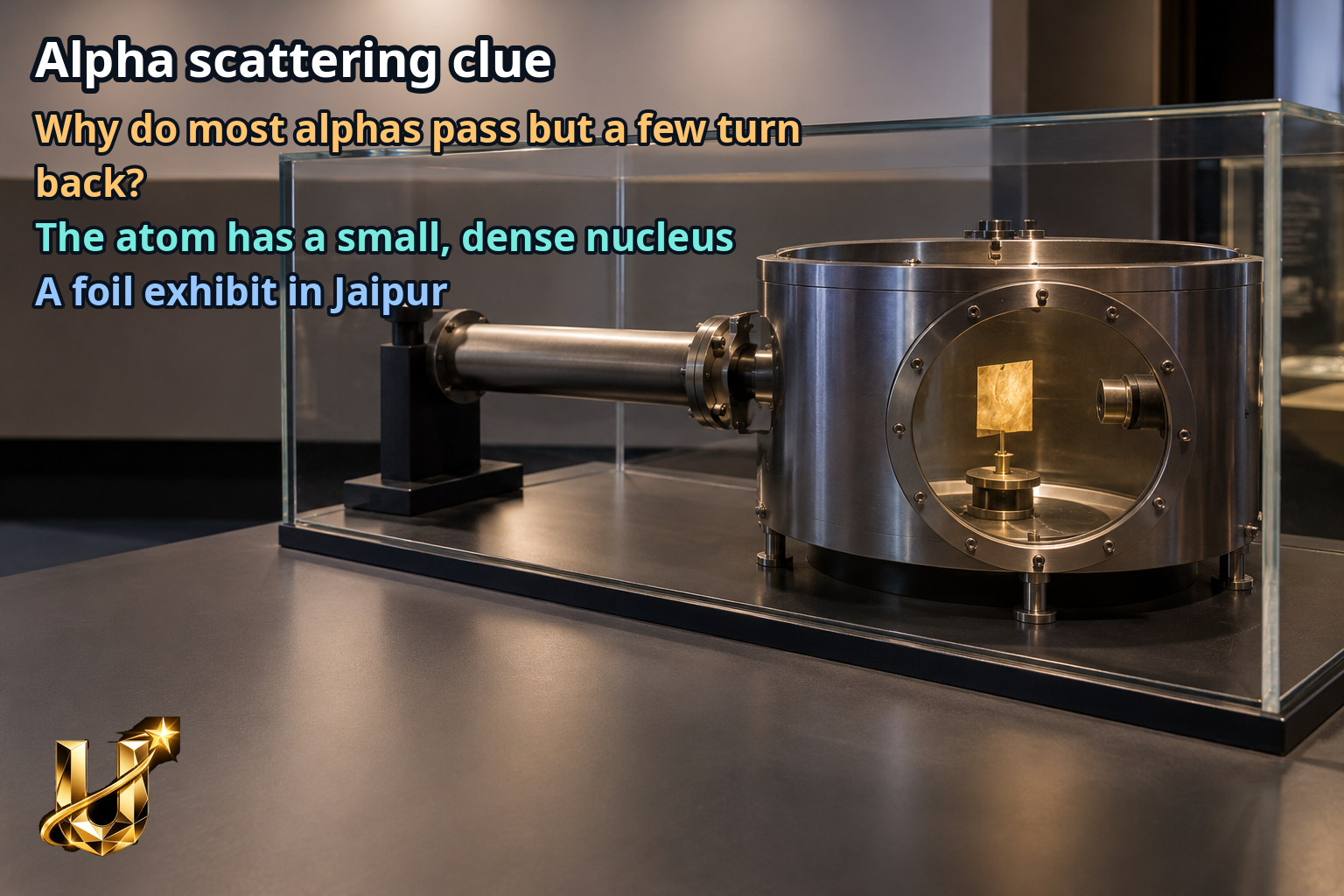
Enlarge image
At a Jaipur exhibit, most simulated alpha particles pass through a thin foil, but a few turn through large angles. What feature of the atom explains both observations?
Working review group 6; official unit label pending
At a Jaipur exhibit, most simulated alpha particles pass through a thin foil, but a few turn through large angles. What feature of the atom explains both observations?
An allowed stationary-state energy in the quantum model.
Review lesson not available yet.
At a Jaipur exhibit, most simulated alpha particles pass through a thin foil, but a few turn through large angles. What feature of the atom explains both observations?
Thomson's early model spread positive charge through the atom with embedded electrons. Rutherford's scattering evidence instead supported a very small, dense, positively charged nucleus containing most atomic mass. Most atomic volume is outside that nucleus; this does not mean it contains no electron probability or fields.
A prepared plot shows many small-angle detections and a tiny number at large angles.
Rutherford evidence placed most positive charge where?
Most alpha particles pass with small deflection because the nucleus occupies a tiny fraction of atomic dimensions. Rare close approaches produce large repulsive deflections. In a simple unscreened Coulomb model, smaller impact parameter can produce larger scattering angles; a head-on approach can reverse direction. The thin foil limits multiple scattering.
A model atom radius is10^-10m and its nuclear radius10^-15m.
Why did most alpha particles have small deflection?
The nuclear model explained concentrated positive charge but classical orbiting electrons would radiate and lose energy. It did not explain stable atoms or discrete spectra. Later quantum models address these issues. A drawing of planets orbiting a nucleus is a limited historical model, not a literal modern atomic picture.
A head-on ideal model alpha has initial kinetic energy8.0 × 10^-13J against a fixed heavy nucleus withZ=50. Usek=9.0 × 10^9 ande=1.6 × 10^-19C.
Interpret a prepared scattering-angle chart. Match each observation to a model claim and identify what remains unexplained. Use simulation records only; do not handle radioactive sources.
Scattering supports a tiny dense positive nucleus. A successful model must explain both observations and limits; classical nuclear orbits left stability and spectra unresolved.