
A question from life
Enlarge image
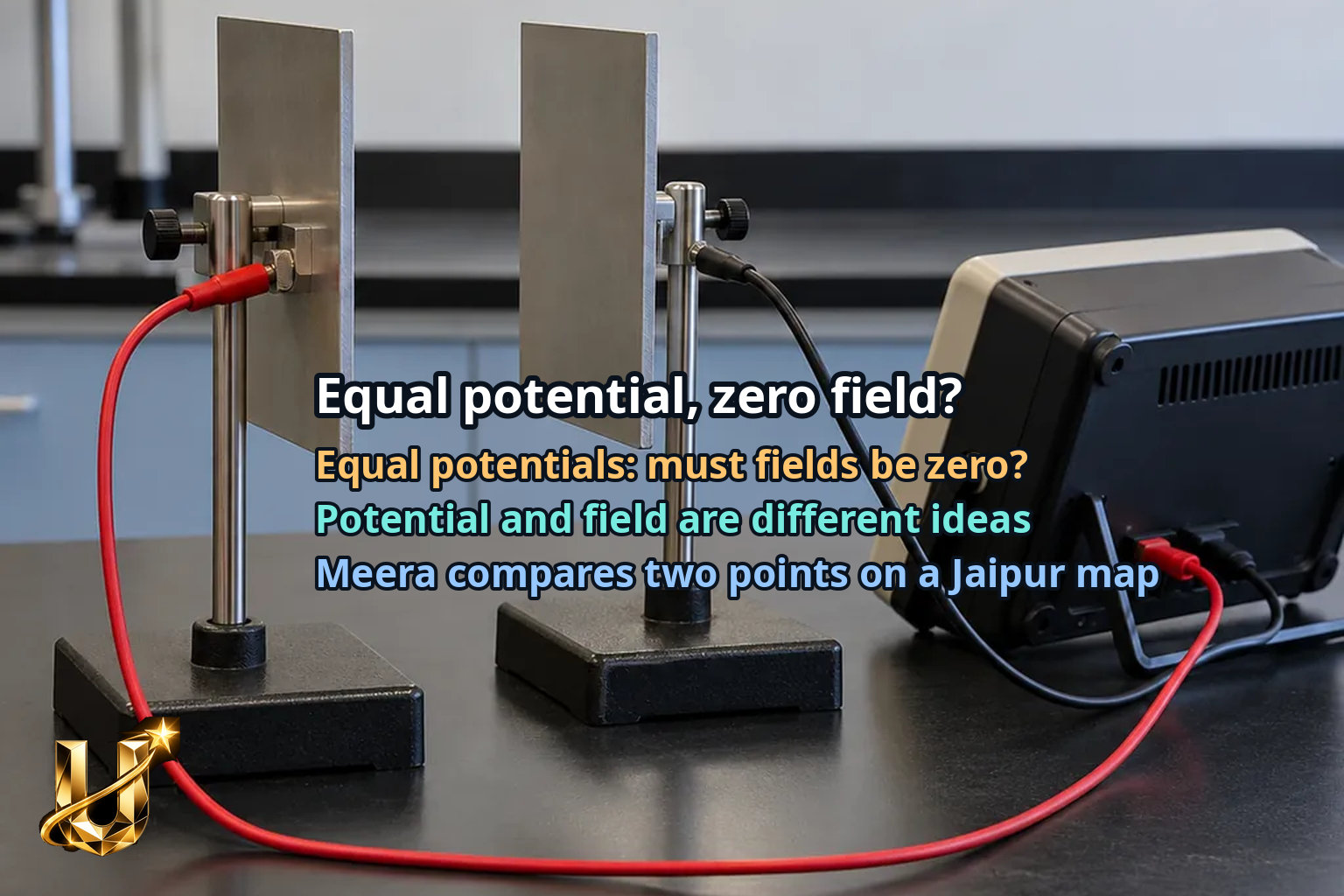
Meera compares two points on a Jaipur field map. If their potentials are equal, must their electric fields both be zero?
Working review group 1; official unit label pending
Meera compares two points on a Jaipur field map. If their potentials are equal, must their electric fields both be zero?
Change of electric potential energy per unit test charge.
Review lesson not available yet.
Meera compares two points on a Jaipur field map. If their potentials are equal, must their electric fields both be zero?
Potential difference ΔV is change in potential energy per unit test charge: ΔU = qΔV. For a point source with zero at infinity, V = kQ/r. Add signed scalar potentials from sources; fields instead add as vectors. A dipole has V = kq(1/r+ − 1/r−); far away, V ≈ kp cosθ/r².
An external agent slowly supplies 6 mJ to move a positive 2 mC test charge between points, with no kinetic-energy change.
Potential is added using what rule?
Electrostatic field work from i to f is Wfield = q(Vi − Vf) = −ΔU, independent of the path. For slow motion with negligible kinetic-energy change, external work equals ΔU. For a pair of point charges, interaction energy U = kq1q2/r relative to infinite separation; count each pair once.
A +2 μC charge moves from 120 V to20 V. Find work by the field.
Field work along an equipotential is?
No field work is done along an equipotential. Where the field is nonzero it is perpendicular to an equipotential surface, pointing towards decreasing potential: Ex = −dV/dx. An electrostatic conductor has zero field inside its material and constant potential throughout, but that constant need not be zero. Excess free charge resides on its surface.
At the midpoint of equal +q and −q point charges, compare potential and field.
Compare two paper maps: equal positive/negative source potentials and the corresponding field arrows. Explain aloud how scalar cancellation can coexist with a nonzero vector field. Trace an equipotential without using electrical equipment.
Potential is a signed scalar. ΔU=qΔV and Wfield=−ΔU. Equal potential does not ensure zero field; electrostatic conductors have constant potential.
In a uniform electric field,a permanent ideal dipole has potential energy minus the dot product of dipole moment and field. Its energy is lowest when aligned and highest when opposed. The field torque tends to reduce the angle. Far from a small dipole in vacuum,the axial field magnitude is twice k times dipole moment divided by distance cubed; the equatorial magnitude is k times dipole moment divided by distance cubed and points opposite the moment. These are far-field approximations with distance much larger than charge separation.
An ideal dipole changes from perpendicular to aligned with a uniform field. What happens to its potential energy?
An electric dipole has minimum uniform-field potential energy when its moment is: