
A question from life
Enlarge image
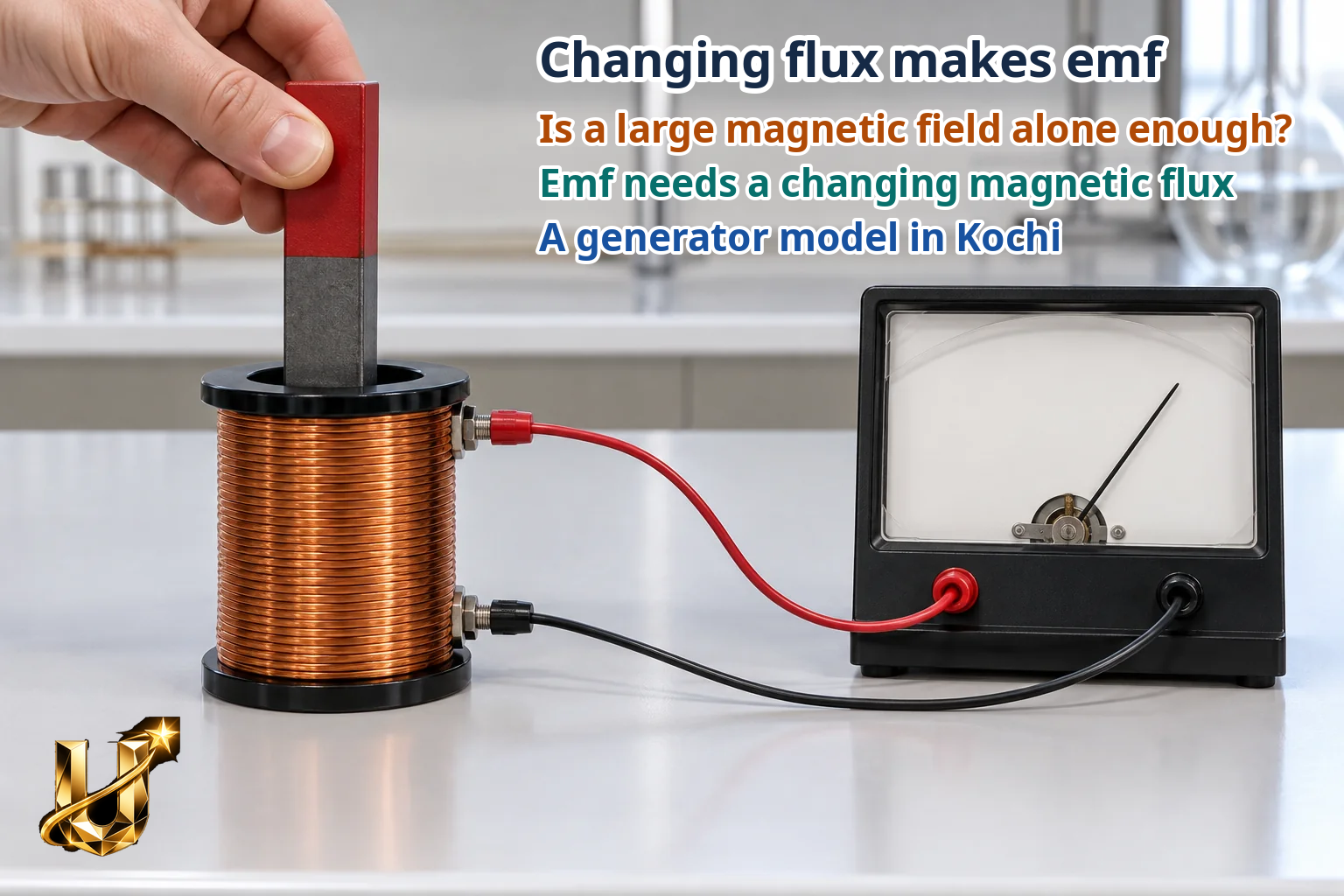
In a Kochi generator model, a stationary coil can develop emf while a nearby magnet moves. Is a large magnetic field alone enough?
Working review group 3; official unit label pending
In a Kochi generator model, a stationary coil can develop emf while a nearby magnet moves. Is a large magnetic field alone enough?
The sum of magnetic flux through the turns of a coil.
Review lesson not available yet.
In a Kochi generator model, a stationary coil can develop emf while a nearby magnet moves. Is a large magnetic field alone enough?
Magnetic flux through a flat turn in uniform B is Φ=BA cosθ, with θ to its normal. Faraday's law gives ε=−d(NΦ)/dt, or average ε=−NΔΦ/Δt when each turn shares the same flux. Change may come from field, area or orientation. A constant flux gives no induction emf even if it is large.
A20-turn coil has per-turn flux rising from0.010Wb to0.030Wb in0.20s.
A coil with constant magnetic flux has induced emf from that flux of?
The induced effect opposes the change of flux that causes it, not necessarily the original field. Choose the surface normal and positive circuit sense consistently by the right-hand rule. An induced emf can exist in an open circuit, but continuous current needs a closed path. For a resistive loop with negligible self-inductance, I=ε/R.
Into-page flux and clockwise current are positive. A30-turn,5Ω resistive loop has flux rising0.010 to0.040Wb per turn in0.10s; neglect self-inductance.
If into-page flux decreases, the induced loop field tends to point?
For a straight conducting rod of lengthℓ moving perpendicular to itself and a uniform B, in the standard mutually perpendicular arrangement, motional emf magnitude is Bℓv. Magnetic force separates charges. If it closes a resistive circuit, an external agent must do work to maintain motion; mechanical input becomes electrical energy and heating. Lenz's rule is consistent with energy conservation.
A0.20m rod moves at3.0m/s in0.50T with rod, velocity and field mutually perpendicular.
Use magnet-and-coil drawings with arrows showing increasing or decreasing flux. State a consistent normal/current convention and predict induced direction aloud. Compare open and closed loop diagrams without handling electrical generators.
Induction depends on changing flux linkage. Lenz's sign opposes the change and preserves energy accounting. Emf can exist without current; motional emf needs stated geometry.