
A question from life
Enlarge image
Enlarge image
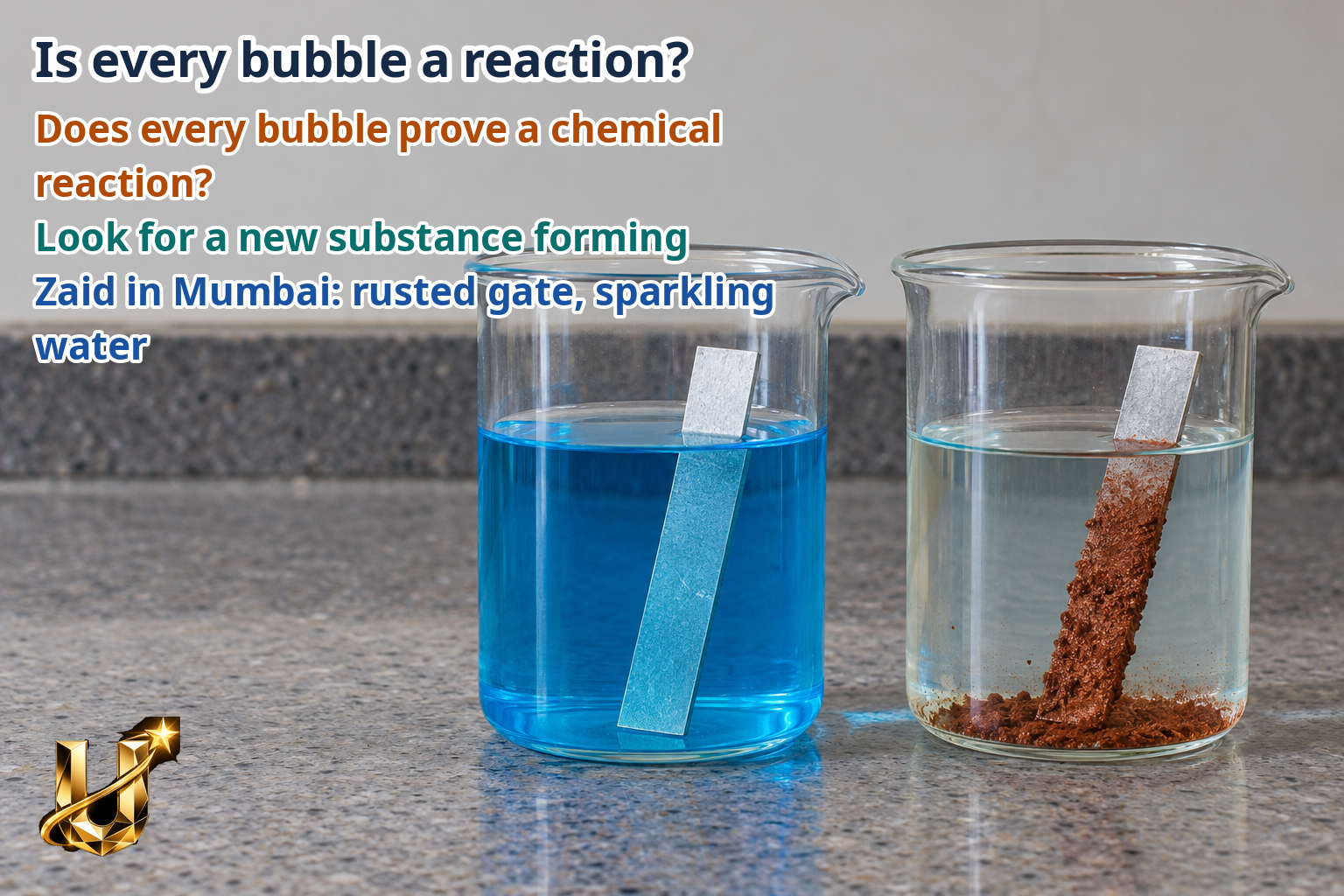
Zaid in Mumbai notices a rusted iron gate and bubbles from sparkling water. Does every bubble prove a chemical reaction?
Working review group 1; official unit label pending
Zaid in Mumbai notices a rusted iron gate and bubbles from sparkling water. Does every bubble prove a chemical reaction?
A number before a chemical formula that multiplies the amount of the entire formula.
Review lesson not available yet.
Zaid in Mumbai notices a rusted iron gate and bubbles from sparkling water. Does every bubble prove a chemical reaction?
A chemical reaction forms new substances. Colour changes, gas, precipitates or temperature changes can provide evidence, but none alone proves a reaction: boiling also forms bubbles. Interpret the full situation and the identities before and after.
Bubbles appear in hot water and in a gas-forming reaction.
What defines a chemical reaction?
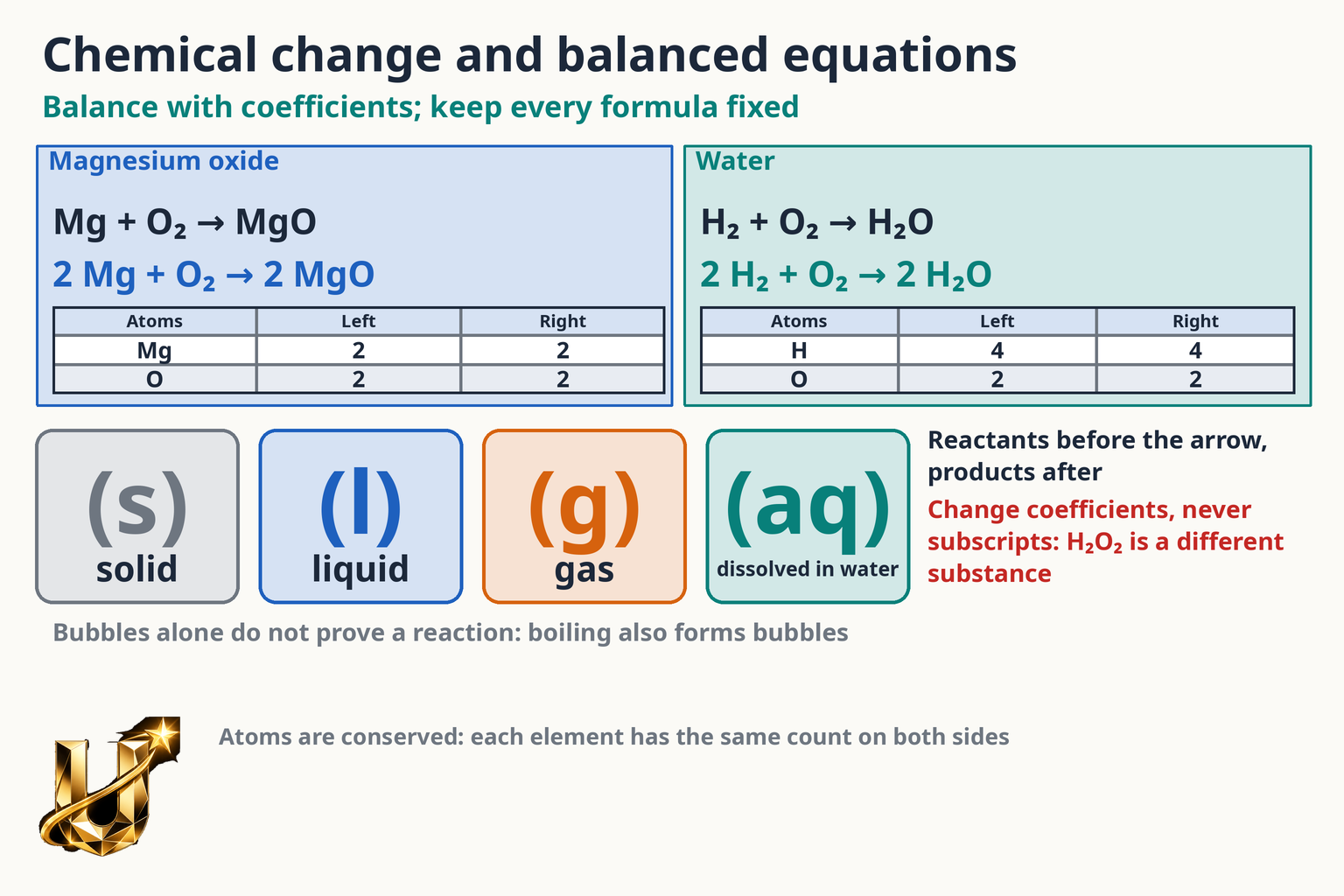
A chemical equation places reactants before an arrow and products after it. Formulas preserve the identity of each substance. State symbols such as (s), (l), (g) and (aq) distinguish solid, liquid, gas and dissolved aqueous substances.
Balance Mg + O₂ → MgO on paper.
What must remain equal in a balanced ordinary chemical equation?
Ordinary chemical reactions conserve the number of atoms of each element. Change coefficients before formulas to balance an equation; do not change subscripts because that changes the substances. Use the smallest whole-number ratio when appropriate.
Consider 2 H₂ + O₂ → 2 H₂O.
Balance prepared equation cards using atom counters. Keep formulas fixed and change only coefficients. Use recorded demonstrations rather than making gases or burning substances.
Chemical reactions form new substances. Equations represent them, and balanced coefficients conserve atoms without changing formulas.