
A question from life
Enlarge image
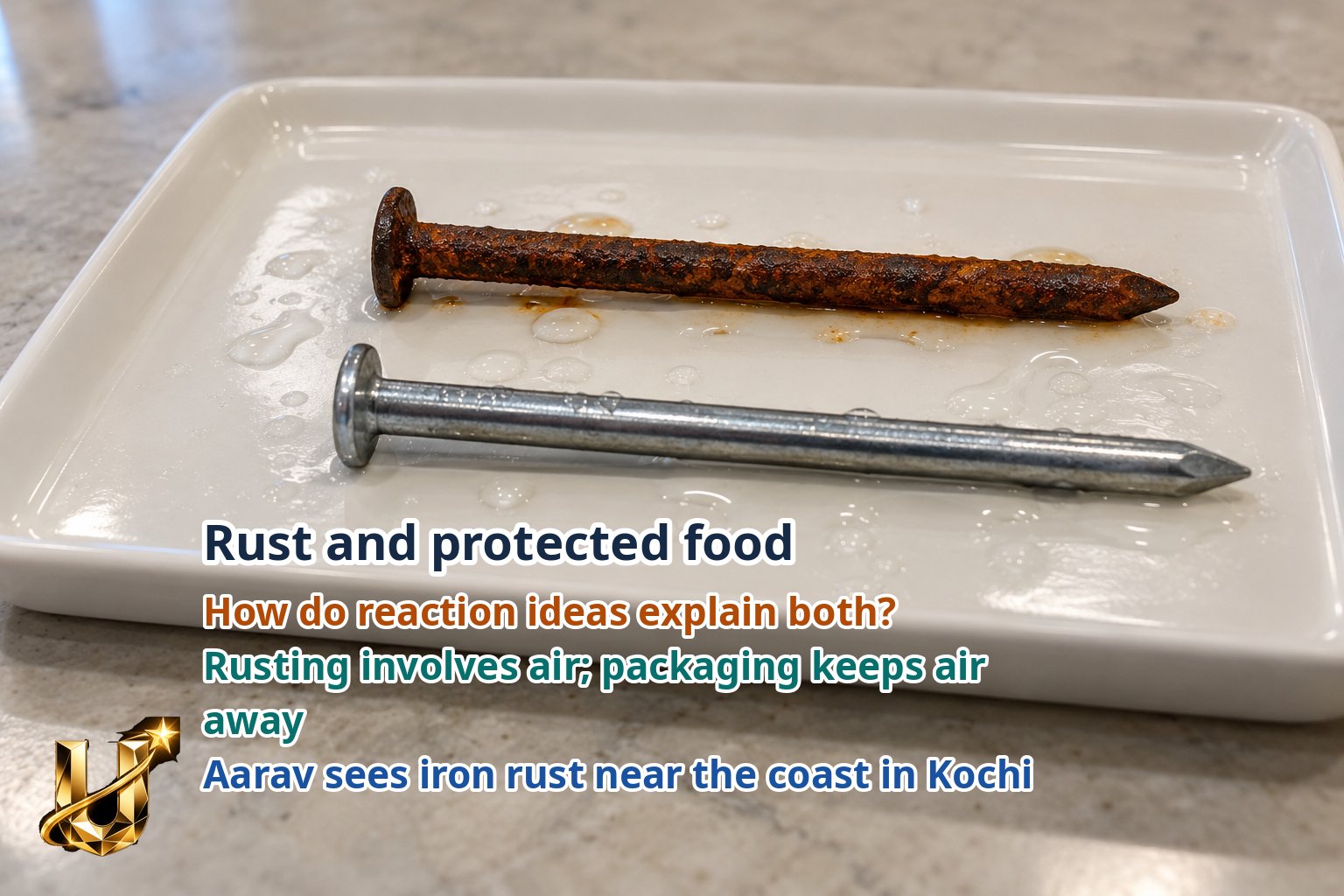
Aarav in Kochi sees iron rust near the coast and notices packaged food is protected from air. How can reaction ideas explain such different changes?
Working review group 1; official unit label pending
Aarav in Kochi sees iron rust near the coast and notices packaged food is protected from air. How can reaction ideas explain such different changes?
A number before a chemical formula that multiplies the amount of the entire formula.
Review lesson not available yet.
Aarav in Kochi sees iron rust near the coast and notices packaged food is protected from air. How can reaction ideas explain such different changes?
Combination joins reactants into a product; decomposition breaks a compound into simpler products. Displacement replaces an element in a compound under suitable conditions. Double displacement exchanges ions and can produce a precipitate, gas or water. Categories may overlap.
CaCO₃ → CaO + CO₂ is supplied as a reaction card.
Which is a decomposition pattern?
At this level oxidation can be recognised as oxygen gain and reduction as oxygen loss in suitable reactions. The broader definition uses electron loss and gain. In CuO + H₂ → Cu + H₂O, CuO is reduced and hydrogen is oxidised.
A prepared record gives Zn + CuSO₄ → ZnSO₄ + Cu.
In CuO + H₂ → Cu + H₂O, what is reduced?
Exothermic reactions transfer energy to surroundings; endothermic reactions absorb energy from them. Corrosion gradually changes metals through environmental reactions. Oxidation of food fats can contribute to rancidity; limiting oxygen, light or unsuitable conditions can help, but no single packaging feature guarantees safety.
Use CuO + H₂ → Cu + H₂O.
Sort supplied equations by reaction patterns and mark oxygen gain/loss where the description applies. Discuss corrosion prevention from pictures; no flames, gas tests or food tasting.
Reaction patterns help organise chemical changes. Oxidation and reduction accompany one another, and environmental reactions explain corrosion and some food deterioration.