
A question from life
Enlarge image
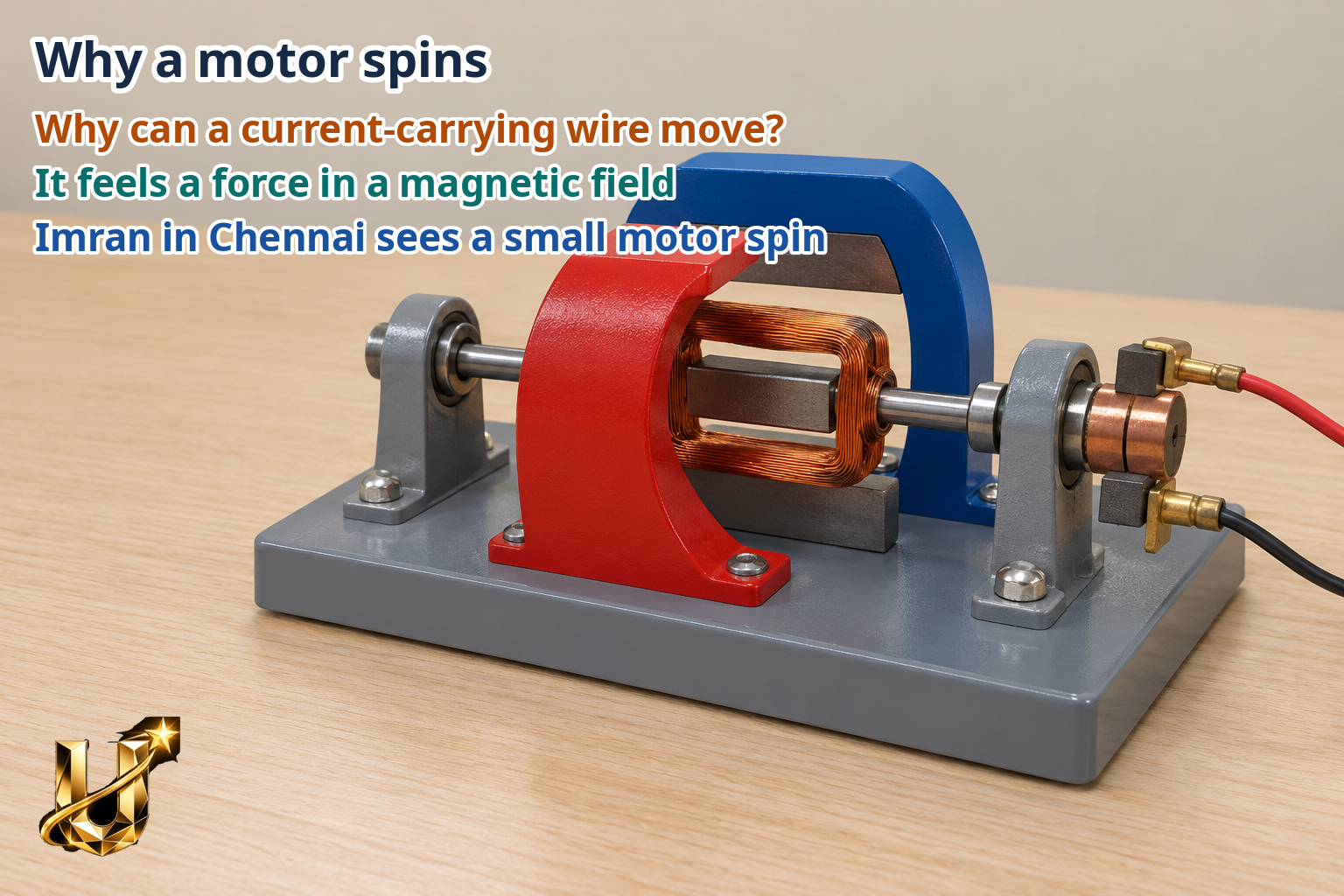
Imran in Chennai sees a small motor spin when switched on. Why can a current-carrying conductor move in a magnetic field?
Working review group 6; official unit label pending
Imran in Chennai sees a small motor spin when switched on. Why can a current-carrying conductor move in a magnetic field?
A field that determines magnetic effects on magnets, moving charges and currents.
Review lesson not available yet.
Imran in Chennai sees a small motor spin when switched on. Why can a current-carrying conductor move in a magnetic field?
A current-carrying conductor in an external magnetic field can experience a force. The force depends on current, field and orientation; it is greatest for perpendicular current and field in the simple model and zero for parallel alignment.
A prepared motor-force diagram reverses current while keeping field fixed.
When is the simple straight-wire magnetic force greatest for fixed current and field?
Fleming's left-hand rule relates field, conventional current and force: first finger gives field, second current and thumb force. A motor uses magnetic forces to turn a coil, converting electrical energy into mechanical motion, with some energy transferred as heat and sound.
A wire segment is parallel to the external field.
What energy conversion occurs in a motor?
DC has a fixed current direction; AC reverses direction periodically. Household circuits use protective devices and earthing where required. Earthing provides a designed low-resistance fault path, while a suitable fuse or breaker interrupts excessive current. Do not bypass protection, overload sockets or handle damaged equipment; adults arrange qualified repair.
A protected appliance develops a live-to-case fault in a supplied diagram.
Use force-direction cards and a conceptual protection diagram. Explain functions without drawing practical household wiring or testing faults.
A magnetic field can exert force on current and drive motors. Direction rules need clear conventions, and electrical protection must remain intact.
Formative extension: electromagnetic induction occurs when changing magnetic flux linked with a circuit induces an electromotive force; current requires a closed suitable path. A generator converts mechanical input into electrical output using this effect. A motor converts electrical input into mechanical output. Neither creates energy. AC frequency counts complete cycles per second, not the number of direction reversals. Transformers can change AC voltage, making high-voltage transmission practical: for equal transmitted power a lower current reduces resistive heating. Real systems require designed insulation and protection.
A model turns a generator and lights a suitable lamp. Where does the electrical energy come from?
A generator primarily converts: