
A question from life
Enlarge image
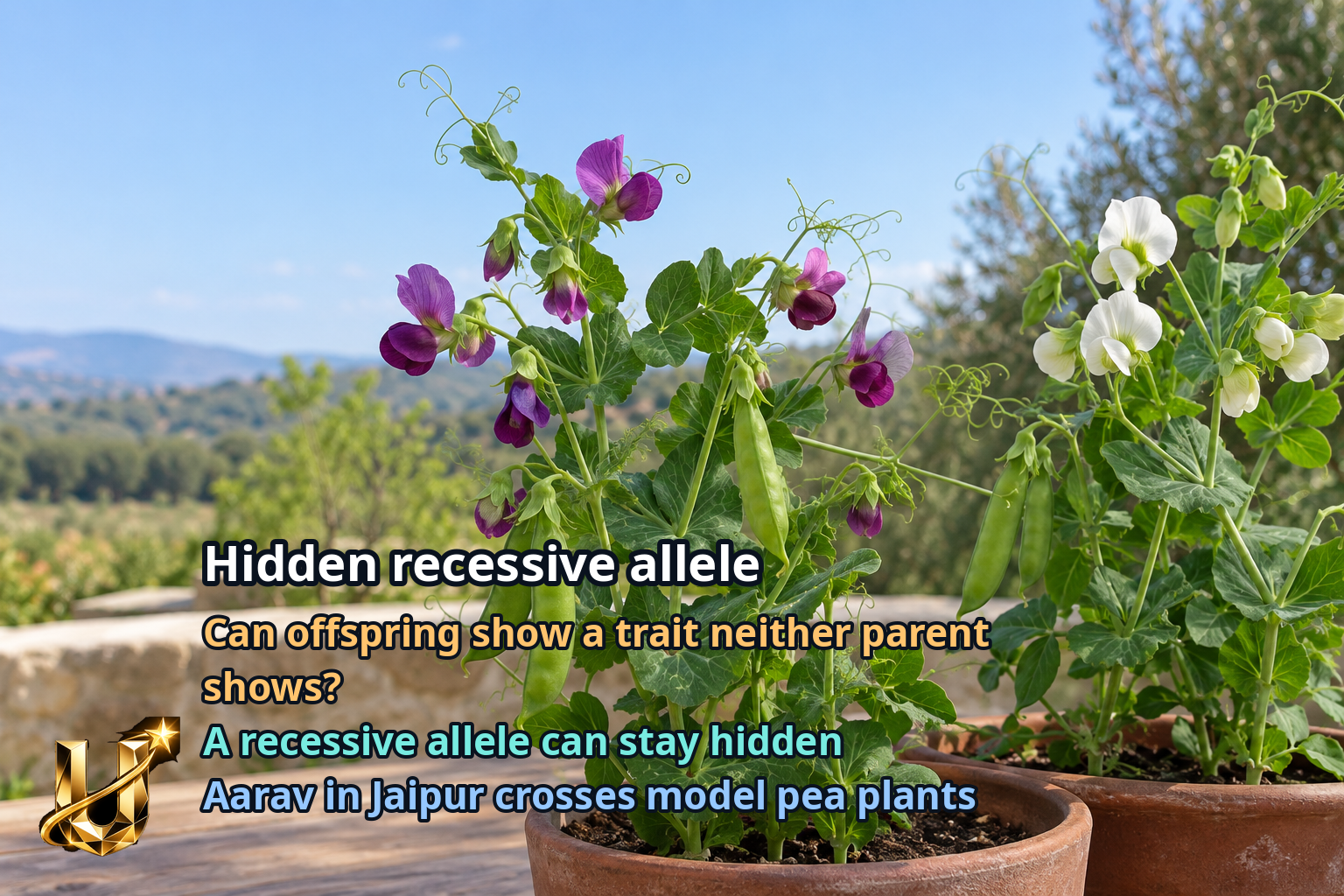
Aarav in Jaipur crosses two model pea plants that carry a hidden recessive allele. Can their offspring show a trait neither parent visibly shows?
Working review group 4; official unit label pending
Aarav in Jaipur crosses two model pea plants that carry a hidden recessive allele. Can their offspring show a trait neither parent visibly shows?
An alternative form of a gene at a particular locus.
Review lesson not available yet.
Aarav in Jaipur crosses two model pea plants that carry a hidden recessive allele. Can their offspring show a trait neither parent visibly shows?
A gene is a DNA region contributing to a functional product; alleles are alternative forms. In a simple complete-dominance model, TT and Tt share the dominant phenotype, while tt shows the recessive phenotype. Dominant does not mean common, stronger or better.
Each Tt parent contributes T or t.
What is a genotype?
In the simple diploid model, a parent carries two alleles at a locus and each gamete receives one. A Punnett square combines possible gametes to predict probabilities. It is a model of possible outcomes, not a schedule for the next four offspring.
The model predicts ¼ recessive offspring among 80 plants.
What is the recessive-phenotype probability in Tt × Tt?
Tt × Tt predicts genotype probabilities ¼ TT, ½ Tt and ¼ tt under the stated assumptions. The phenotype ratio is 3:1 with complete dominance. Real sample counts vary, and many traits involve several genes or environmental influences.
Tt is crossed with tt in the simple model.
Build Punnett squares using supplied pea-model cards. State the complete-dominance assumption and compare expected versus observed fictional counts.
Alleles combine to form genotypes; their expression gives phenotypes. Mendelian crosses predict probabilities under explicit assumptions, not guaranteed individual outcomes.