
A question from life
Enlarge image
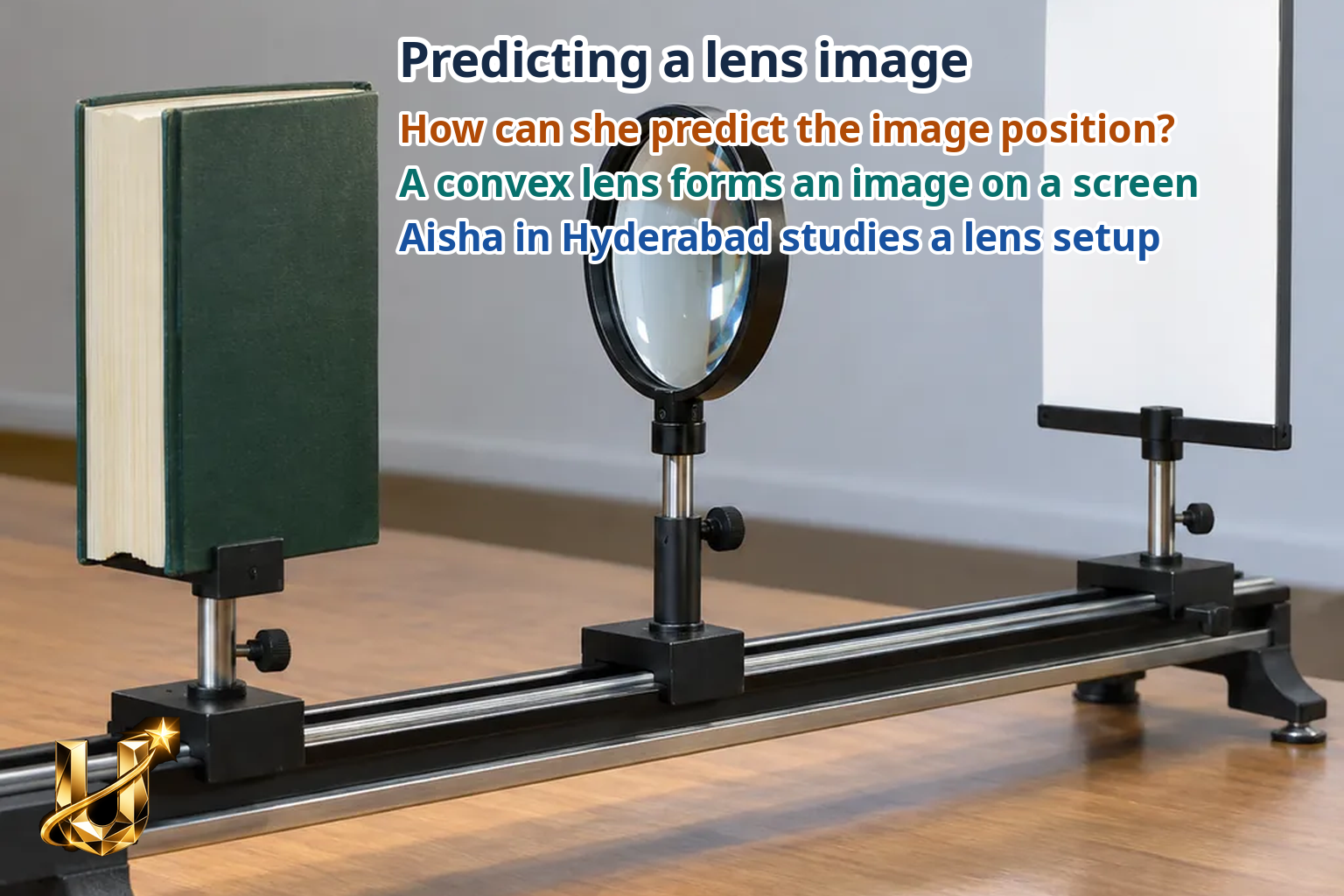
Aisha in Hyderabad studies a convex-lens image on a screen. How can she predict its position without using the Sun as a light source?
Working review group 5; official unit label pending
Aisha in Hyderabad studies a convex-lens image on a screen. How can she predict its position without using the Sun as a light source?
The signed distance from the optical centre or mirror pole to the principal focus in the stated model.
Review lesson not available yet.
Aisha in Hyderabad studies a convex-lens image on a screen. How can she predict its position without using the Sun as a light source?
Light speed changes between media; oblique rays usually change direction. Refractive index relative to vacuum is n = c/v. For appropriate rays between two media, Snell's law relates refractive indices and angles measured from the normal. Along the normal, speed can change without bending.
A converging lens has f = +10 cm and u = −30 cm.
What is refractive index n relative to vacuum?
In the thin-lens Cartesian model take incident light left to right, with the optical centre at zero. A real object left has u < 0; a converging lens in air has f > 0 and a diverging lens f < 0. Use 1/f = 1/v − 1/u and m = v/u.
A lens has f = +25 cm.
What sign does a converging lens focal length have here?
Lens power P = 1/f with f in metres, measured in dioptres. Converging power is positive and diverging negative under this convention. Lens image type depends on object position; a convex lens does not always give a magnified or a real image.
A diverging lens has f = −50 cm.
Choose signs before using supplied lens values. Convert centimetres to metres for power and interpret the image from v and m. Use diagrams or safe teacher optics equipment.
Refraction and lens calculations depend on geometry and conventions. Use the thin-lens equation, interpret magnification, and convert focal length to metres for power.