
A question from everyday life
Enlarge image
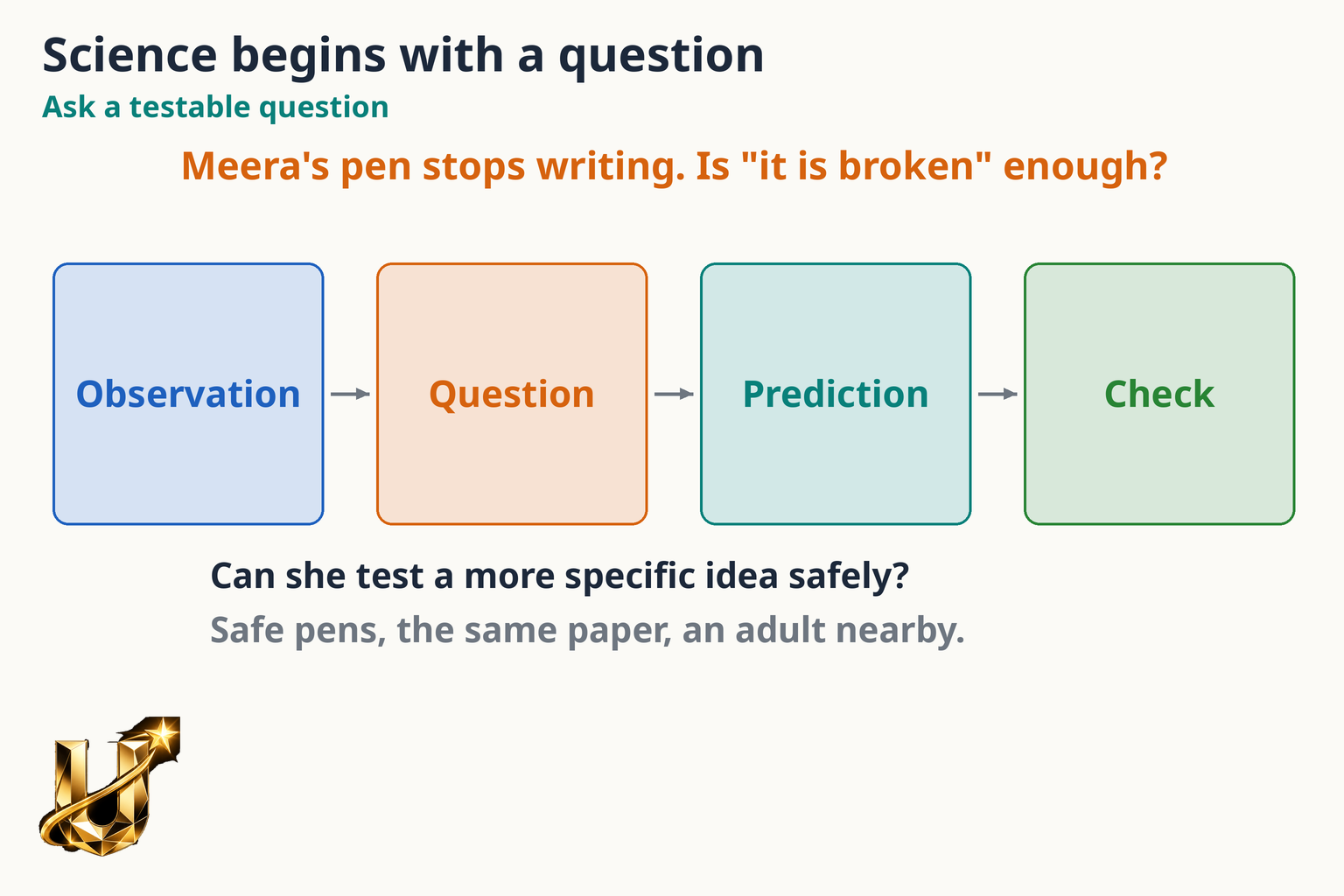
Meera's pen stops writing in Pune. Is saying 'it is broken' enough, or can she test a more specific idea safely?
Working review group 1; official unit label pending
Meera's pen stops writing in Pune. Is saying 'it is broken' enough, or can she test a more specific idea safely?
A record of what is noticed or measured.
Review lesson not available yet.
Meera's pen stops writing in Pune. Is saying 'it is broken' enough, or can she test a more specific idea safely?
An observation describes what is noticed or measured. An explanation proposes why it happens. 'No mark appears' is an observation; 'the ink is finished' is one possible explanation that needs evidence.
Aarav says, 'This pen leaves no mark, so it must be empty.' Which part is observed?
An observation is:
A testable question can be investigated with suitable observations. A prediction states what you expect. Check one idea at a time where possible and use safe equipment rather than dangerous tests.
Two safe pens are available. One writes on the same paper and one does not. What does this comparison suggest?
A prediction is:
Compare results with predictions. A different result is useful evidence, not failure to hide. Scientists may revise explanations and repeat checks. Science is not only a list of facts; it is also a way to investigate.
Priya predicts a sample will dissolve, but particles remain after the planned observation. What next?
Use a fictional stopped-pen scenario. State an observation, one possible explanation and a safe check. No pen dismantling or unknown-substance testing.
Science uses questions, observations, predictions and checks. Results guide explanations and may lead to revision.