
A question from everyday life
Enlarge image
Aarav sees an approved chart joining stars into a familiar pattern. Are those drawn lines real structures joining the stars in space?
Working review group 6; official unit label pending
Aarav sees an approved chart joining stars into a familiar pattern. Are those drawn lines real structures joining the stars in space?
The Sun and its associated bodies, including planets and their moons.
Review lesson not available yet.
Aarav sees an approved chart joining stars into a familiar pattern. Are those drawn lines real structures joining the stars in space?
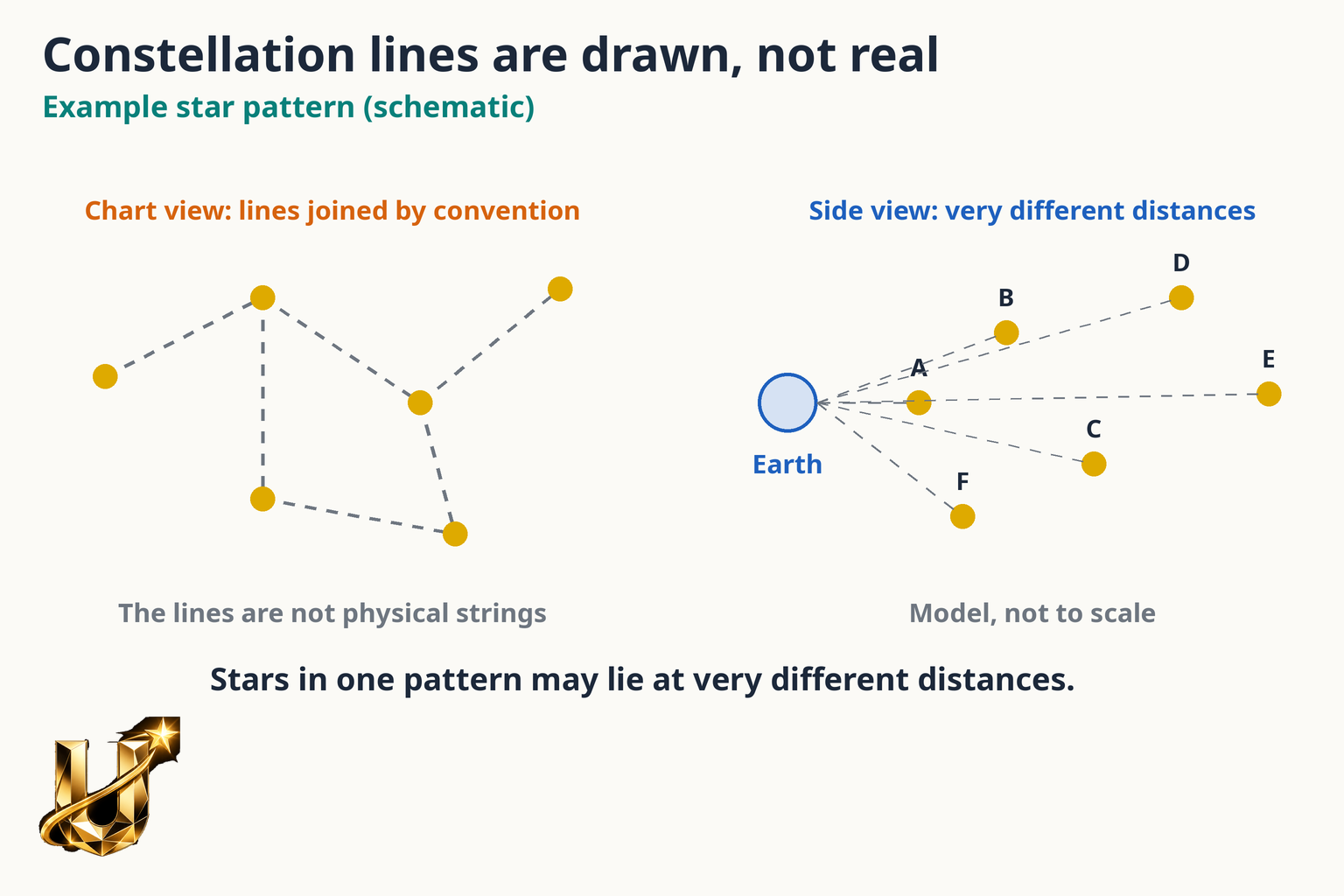
Constellation patterns are ways of recognising regions or apparent arrangements in the sky. Drawn connecting lines are not physical strings, and stars in one pattern may lie at very different distances. Use a chart appropriate to time and place.
A chart links several stars with lines. What do the lines mean?
Lines joining stars on a chart are:
The Sun is one star in the Milky Way galaxy. Galaxies contain many stars and other matter; the Universe includes galaxies and more. A diagram of these scales is a model, not necessarily a true-size picture.
Is the Solar System the same thing as the whole Milky Way?
The Sun belongs to the:
Record date, time, place and what was visible or obscured. Clouds and light conditions affect observations. Use approved images or adult-guided safe sites; never stare at the Sun, aim unapproved optical equipment at it or climb roofs for the activity.
A chart predicts a visible object but clouds cover the area. What should Meera record?
Use an approved sky chart and fictional visibility card. Explain a constellation line, place the Solar System within the galaxy and record an obscured view honestly.
Sky patterns are representations, our Solar System lies within a galaxy, and observations need conditions and safety.
The Big Dipper is a seven-star pattern within the constellation Ursa Major. On a suitable northern-sky chart, the two stars at the outer edge of its bowl point approximately towards Polaris, the Pole Star. Polaris lies close to the direction of Earth’s north rotation axis and appears nearly fixed while other stars appear to move around it. It is not necessarily the brightest star. A pattern is an apparent view: its stars can lie at different distances. Visibility depends on place, time and sky conditions.
On a labelled chart, trace the outer two bowl stars of the Big Dipper away from the bowl to the labelled Polaris. What direction does Polaris approximately indicate?
Polaris appears nearly fixed because it is close to the direction of: