
A question from everyday life
Enlarge image
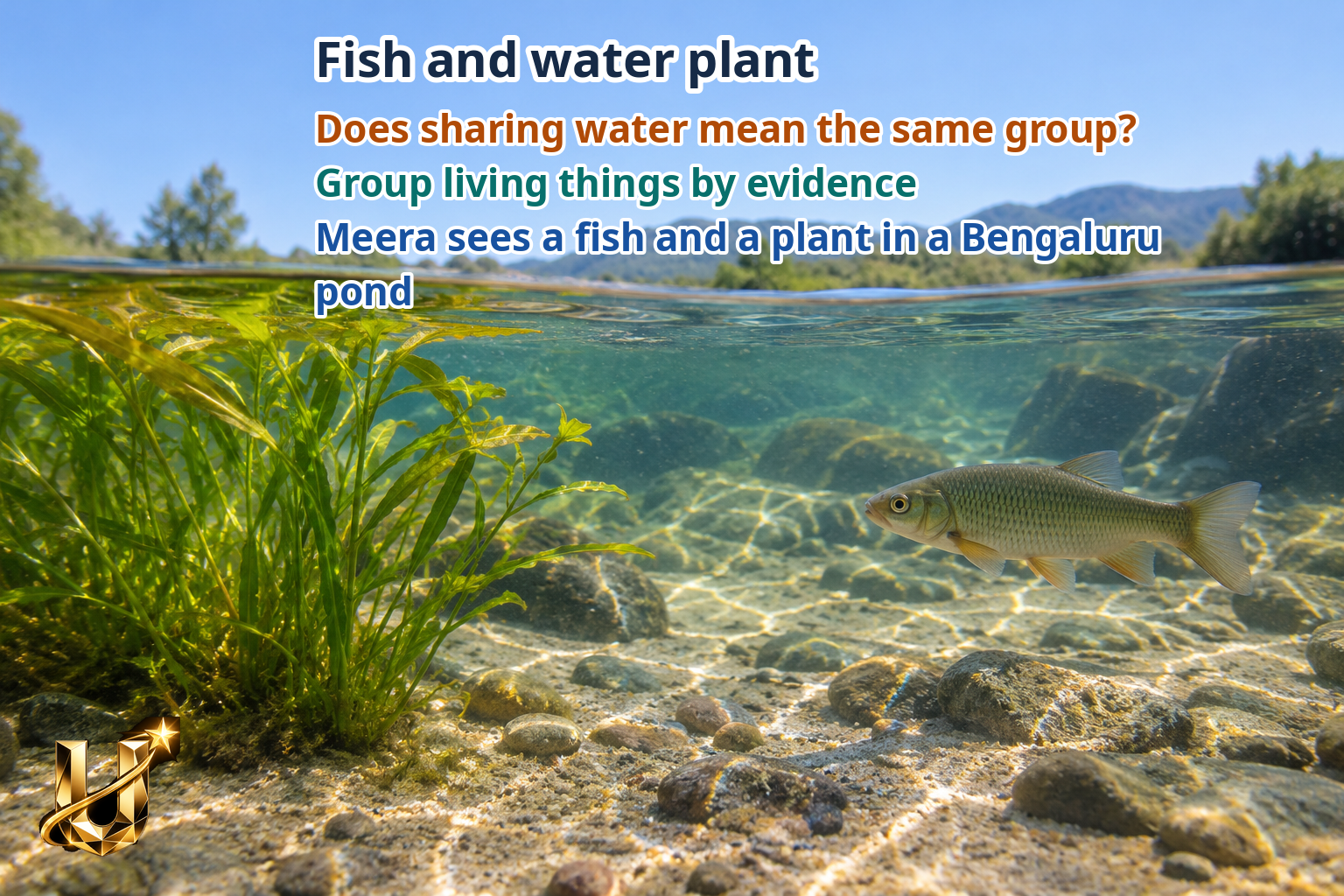
Meera sees a fish and an aquatic plant in a Bengaluru pond. Does sharing water put them in the same biological group?
Working review group 1; official unit label pending
Meera sees a fish and an aquatic plant in a Bengaluru pond. Does sharing water put them in the same biological group?
Organising organisms using stated shared features.
Review lesson not available yet.
Meera sees a fish and an aquatic plant in a Bengaluru pond. Does sharing water put them in the same biological group?
Living things differ in structures, feeding and other characteristics. Classification groups them using chosen relevant features. Sharing colour or habitat alone does not establish that two organisms belong to the same biological group.
A fish and green aquatic plant live in one pond. Why are they different groups?
Sharing a habitat alone:
Trees usually have a main woody trunk; shrubs branch with woody stems near the ground; herbs have softer stems. Climbers need support, while creepers spread along the ground. These are useful form groups rather than complete ancestry classifications.
A plant has several woody stems branching near the ground. Which form fits?
A butterfly is:
Animals can be grouped by features such as a backbone, body covering or observed movement. A butterfly lacks a backbone; a fish has one. One visible feature may not reveal every relationship, so use several reliable clues.
A bird and butterfly both fly. Are both vertebrates?
Use approved plant and animal cards. State a grouping rule, make groups and explain one case where a shared habitat is insufficient.
Diversity includes many forms and features. Group by relevant evidence, not habitat or colour alone.