
A question from everyday life
Enlarge image
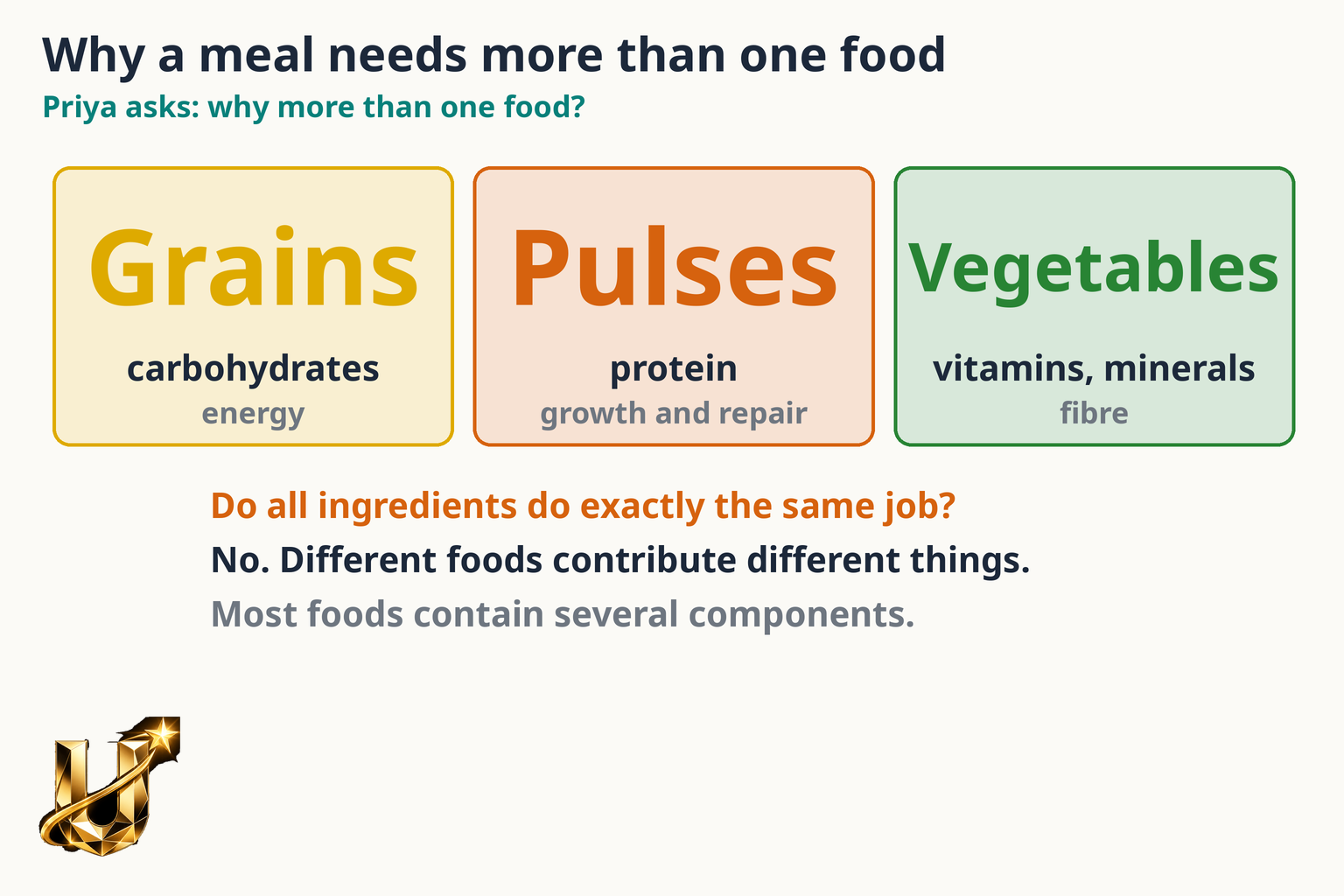
Priya in Chennai asks why a meal needs more than one food. Do all ingredients do exactly the same job?
Working review group 2; official unit label pending
Priya in Chennai asks why a meal needs more than one food. Do all ingredients do exactly the same job?
A food component used for energy,growth,repair or regulation.
Review lesson not available yet.
Priya in Chennai asks why a meal needs more than one food. Do all ingredients do exactly the same job?
Carbohydrates and fats are important energy sources. Proteins help growth and repair. Vitamins and minerals support many body functions. Foods often contain several components, not just one.
Aarav calls a pulse 'only protein'. What is more accurate?
Proteins contribute to:
Water is essential, and dietary fibre supports normal digestive function. A suitable varied diet includes different foods in proportions appropriate to the person. Needs differ with age, activity and individual circumstances; a classroom chart is not a personal prescription.
Meera plans a grain food with pulses and vegetables instead of only more of the same grain. What improves?
A food usually:
Too little of particular nutrients over time can cause deficiency problems. School examples link vitamin C deficiency with scurvy and vitamin D deficiency with rickets. A symptom alone cannot diagnose a deficiency, and children should not self-prescribe supplements.
A pupil feels tired and says it must prove one vitamin deficiency. Is that justified?
Use fictional meal cards. Identify two different food contributions and one limit of a classroom diet chart. No tasting, diagnosis or supplement use.
Foods contribute several components. Variety and individual needs matter, while deficiency examples are educational associations rather than diagnoses.