
A question from everyday life
Enlarge image
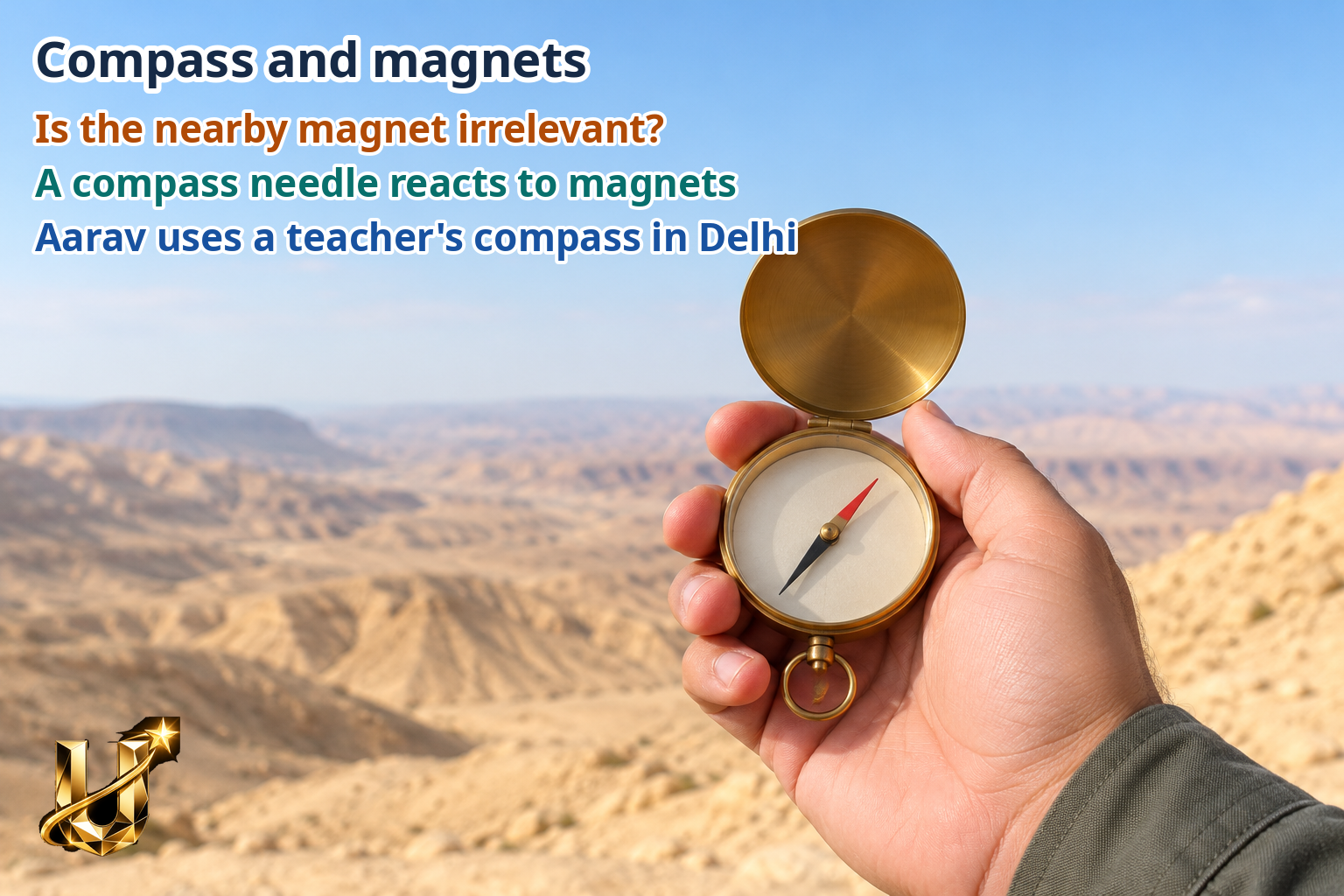
Aarav uses a teacher's compass in Delhi, then notices its reading change near another magnet. Is the nearby magnet irrelevant?
Working review group 2; official unit label pending
Aarav uses a teacher's compass in Delhi, then notices its reading change near another magnet. Is the nearby magnet irrelevant?
An object with magnetic effects and north and south poles.
Review lesson not available yet.
Aarav uses a teacher's compass in Delhi, then notices its reading change near another magnet. Is the nearby magnet irrelevant?
Its needle aligns with the local magnetic field when it can move freely. Earth's field helps provide a direction reference. Magnetic north and geographic north are not exactly identical, so a classroom compass is not a perfect map of every direction condition.
A compass turns when a bar magnet is placed nearby. What can explain it?
A compass needle is:
Magnets and some iron objects can disturb the needle. Keep the compass away from unsuitable interference and let it settle. Adult-supervised map tasks remain classroom models, not real navigation instructions.
A metal piece is attracted to either pole of a known magnet. Is attraction alone enough to label its own north pole?
A nearby bar magnet can:
In an ordinary school kit, repulsion between a known pole and an object's end supports that end being a magnet pole. Attraction alone can involve unmagnetised iron. If a bar magnet is cut in a specialist setting, each part still has both poles; children must not attempt this.
A pupil says cutting a magnet produces one north-only part. What is wrong?
Interpret two prepared compass pictures: one away from interference and one near a magnet. Explain a possible difference without using it for actual travel.
Compasses respond to local magnetic fields. Interference and evidence limits matter, and ordinary magnet pieces retain both poles.