
A question from everyday life
Enlarge image
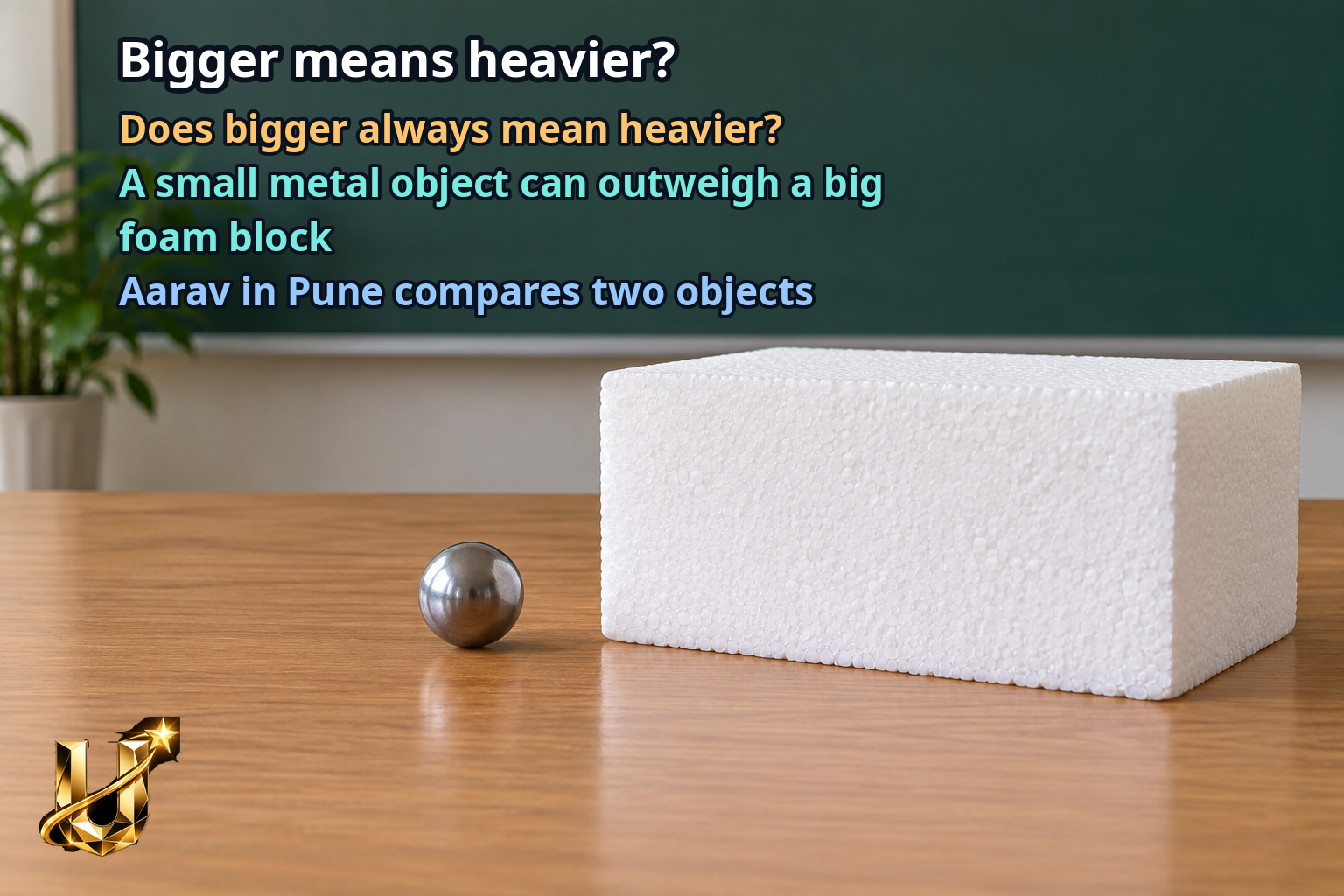
Aarav sees a small metal object and a large foam block in Pune. Does bigger always mean heavier, and does an invisible substance in water always mean it is gone?
Working review group 3; official unit label pending
Aarav sees a small metal object and a large foam block in Pune. Does bigger always mean heavier, and does an invisible substance in water always mean it is gone?
What objects are made from.
Review lesson not available yet.
Aarav sees a small metal object and a large foam block in Pune. Does bigger always mean heavier, and does an invisible substance in water always mean it is gone?
Mass describes the amount of matter in the school model; volume describes the space occupied. Bigger volume does not always mean greater mass when materials differ. Air is matter even though it is often invisible.
A large foam block and a small metal piece are shown without masses. Can size alone settle which is heavier?
Matter has:
A solid has its own shape under ordinary conditions unless forces deform it. A liquid takes a container's shape while retaining a definite volume for the sample. A gas spreads to fill available space. Flexible solids remain solids.
Water is poured from a narrow cup into a wide bowl. Has it become a new material?
A larger object is always more massive:
Some substances dissolve in water under stated conditions; others remain as particles. Dissolved material does not cease to exist. Compare amounts, temperature and observation time fairly, using teacher-prepared data or safe approved materials without tasting.
Salt crystals disappear from view after stirring. What is careful?
Interpret supplied mass/volume cards and prepared dissolving pictures. State what can and cannot be concluded from size or visibility alone.
Mass and volume differ, flexible solids remain solid, and dissolved matter remains present. Fair comparisons need stated conditions.