
A question from everyday life
Enlarge image
Aarav sees stones mixed with grains and flour containing larger particles in a Pune classroom picture. Should every mixture be separated by the same method?
Working review group 5; official unit label pending
Aarav sees stones mixed with grains and flour containing larger particles in a Pune classroom picture. Should every mixture be separated by the same method?
Two or more substances combined without a fixed chemical ratio.
Review lesson not available yet.
Aarav sees stones mixed with grains and flour containing larger particles in a Pune classroom picture. Should every mixture be separated by the same method?
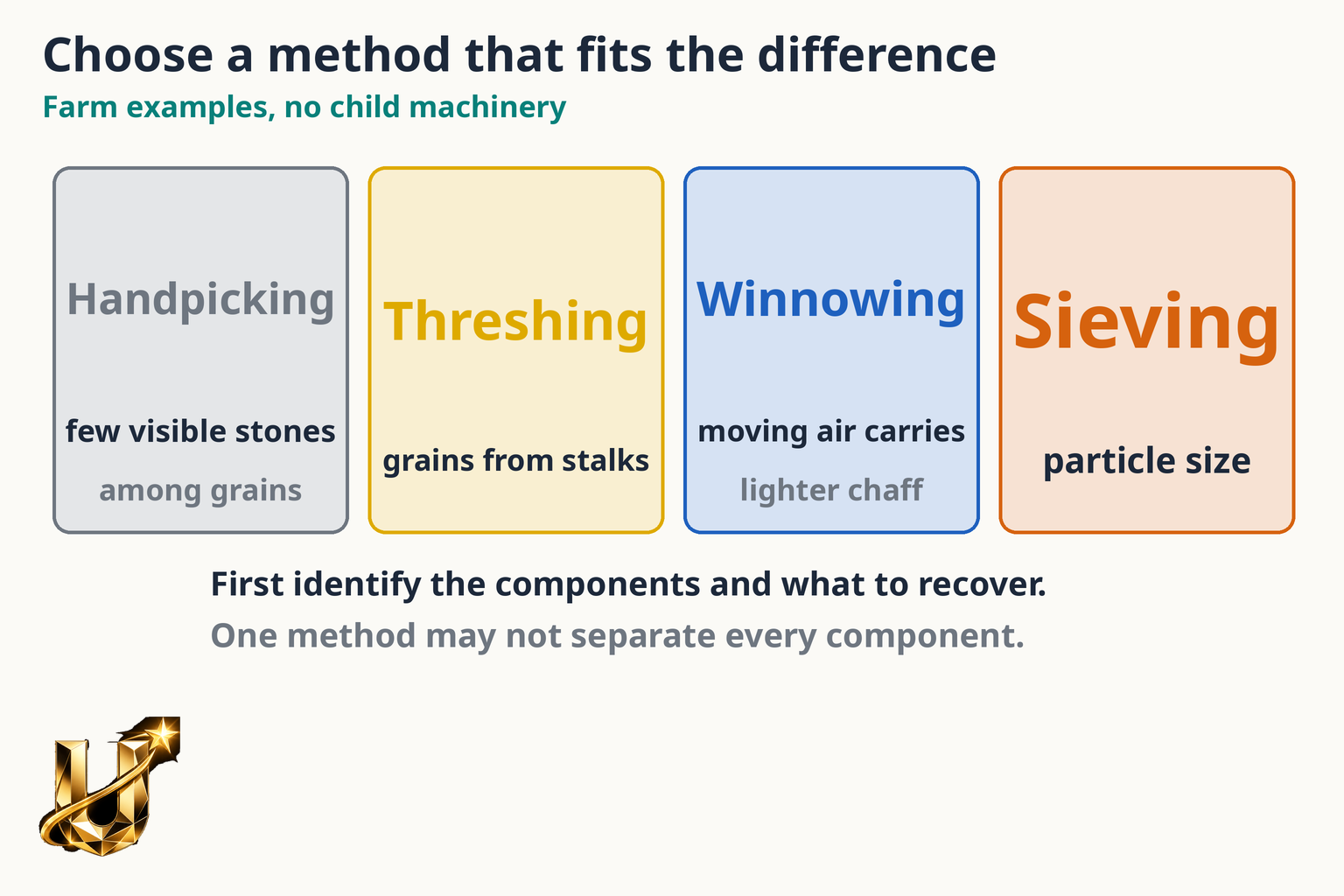
Separation uses differences such as particle size, mass in airflow, magnetism or solubility. First identify the components and what needs to be recovered. One method may not separate every component.
A picture shows a few large stones among many grains. Which simple principle fits?
A suitable separation method depends on:
Handpicking suits a small number of easily visible unwanted pieces in safe materials. Threshing separates grains from stalks. Winnowing uses differences in how moving air carries lighter chaff and heavier grains. Real farm machinery is not a child experiment.
Fine flour and larger dry particles are shown. What difference is used?
Sieving mainly uses:
A sieve separates suitable particle sizes through its openings. A magnet can separate suitable magnetic material from a non-magnetic mixture. Neither method removes every dissolved substance or certifies food safety.
Prepared data show iron pieces mixed with dry sand. What property can help?
Match four prepared mixture cards to a method and name the property used. No food tasting, machinery or unknown samples.
Separation methods exploit specific differences. Choose by the components and purpose, and recognise each method's limits.