
A question from everyday life
Enlarge image
Aarav sees a green plant growing in Pune without eating a prepared meal. Where can its food material come from?
Working review group 5; official unit label pending
Aarav sees a green plant growing in Pune without eating a prepared meal. Where can its food material come from?
Use of light energy to make organic food from carbon dioxide and water in suitable cells.
Review lesson not available yet.
Aarav sees a green plant growing in Pune without eating a prepared meal. Where can its food material come from?
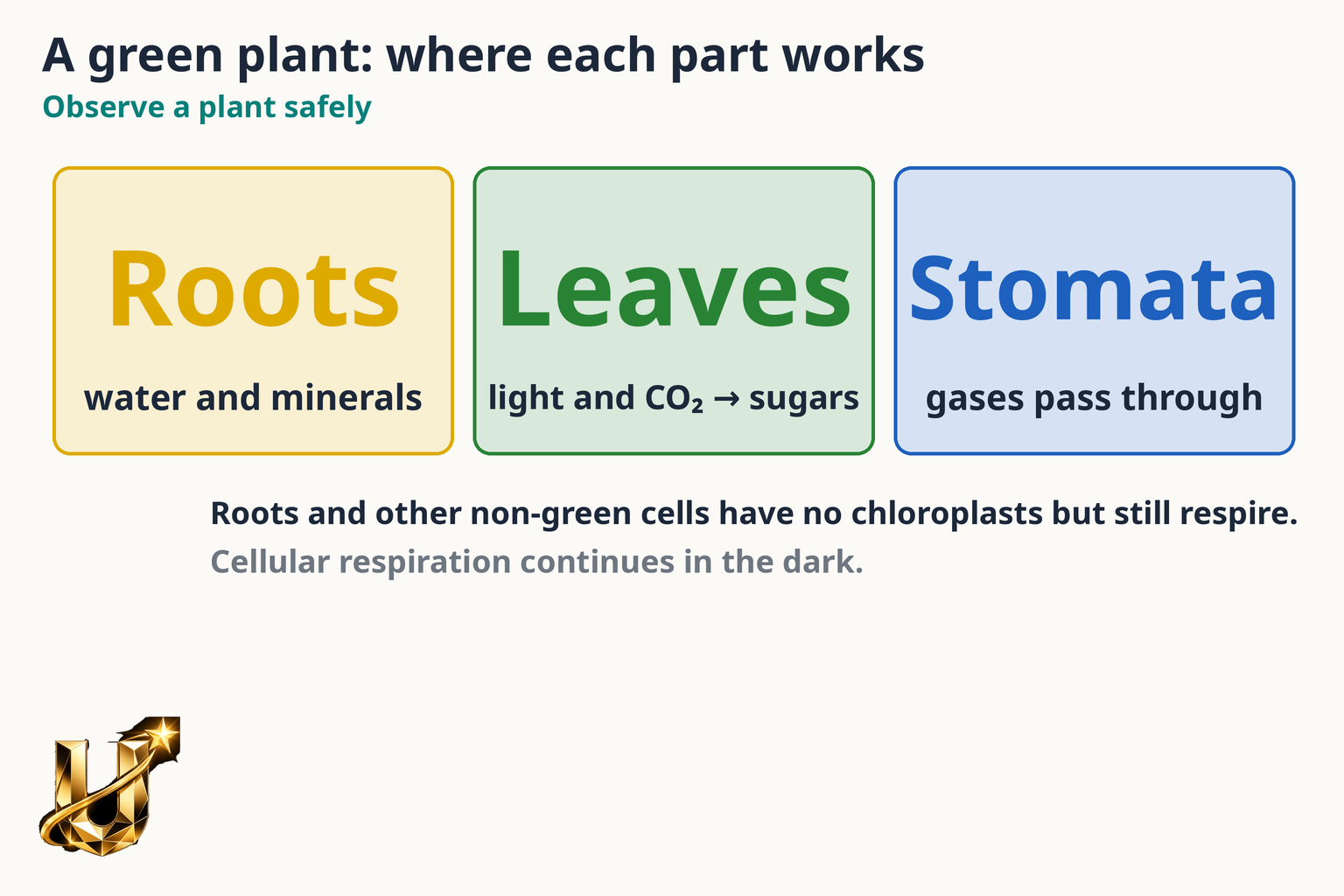
Green photosynthetic tissues use light energy to make sugars from carbon dioxide and water, releasing oxygen. Chlorophyll helps capture light. Not every plant cell contains chloroplasts; roots and other tissues may differ.
A prepared photosynthesis diagram shows light, water and carbon dioxide. Is soil the prepared sugar source?
Photosynthesis uses:
Roots take in water and minerals; minerals are not a ready-made meal. Xylem transports water and minerals through the plant. Gases pass through suitable exchange surfaces, often stomata in leaves, whose distribution varies.
A diagram tracks water from roots upward. Which transport tissue is relevant?
A major gas product is:
Sugars can be used, transported or stored, for example as starch. Phloem transports sugars between sources and places where needed or stored; it is not simply always downward. Plants also carry out cellular respiration, including when photosynthesis is not occurring.
At night a plant is not photosynthesising in darkness. Does cellular respiration necessarily stop?
Use a precise input/output diagram and trace water versus sugar transport. No chemicals, live gas collection or plant damage.
Photosynthesis makes sugars using light, water and carbon dioxide. Transport tissues have distinct roles, and plants also respire.