
A question from everyday life
Enlarge image
Aarav sees a dark region behind an opaque object in a prepared Delhi classroom diagram. What arrangement is needed for a shadow?
Working review group 6; official unit label pending
Aarav sees a dark region behind an opaque object in a prepared Delhi classroom diagram. What arrangement is needed for a shadow?
A line perpendicular to a surface at the point a light ray meets it.
Review lesson not available yet.
Aarav sees a dark region behind an opaque object in a prepared Delhi classroom diagram. What arrangement is needed for a shadow?
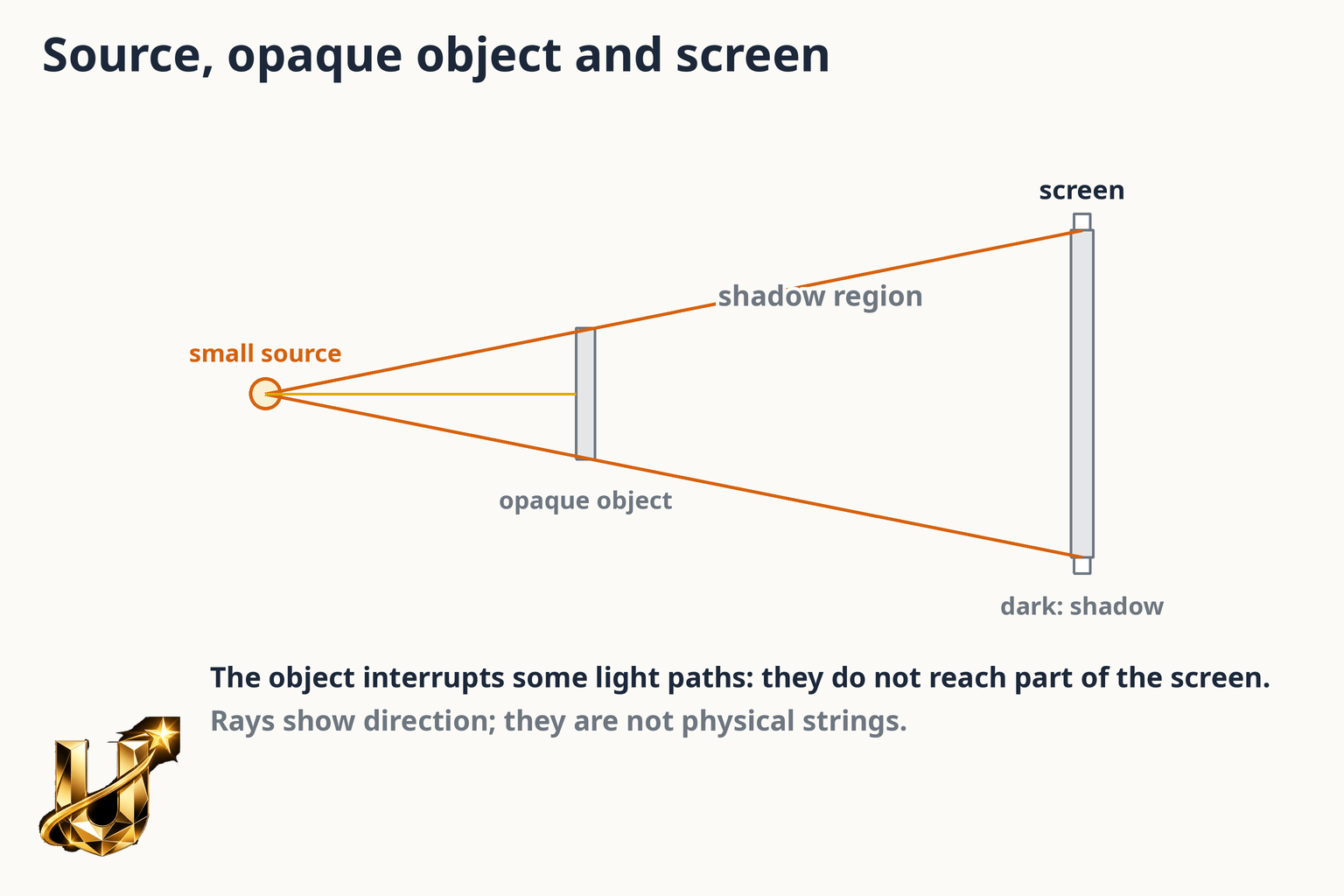
In a uniform transparent medium, light is modelled as travelling along straight lines. Rays are diagram representations of direction, not physical strings. A shadow forms where an object blocks light from reaching a receiving surface.
A diagram shows source, opaque object and screen in order. What causes the dark area?
A shadow involves:
Opaque objects block direct transmission strongly. Transparent and translucent materials transmit light differently, so effects depend on the material and arrangement. Shadow shape and sharpness also depend on source size and geometry.
In a small-source model, the same object moves toward the fixed source while the screen stays fixed. What happens?
Rays in diagrams are:
For a small-source model with source and screen fixed, moving an object nearer the source generally makes a larger shadow on the screen. Extended sources can make blurred edges. Use approved diagrams, not bright-light or Sun experiments.
A larger source gives a less sharp shadow edge in prepared images. Is the edge shape determined only by object colour?
Trace rays on a prepared source–object–screen diagram and predict one shadow change under stated fixed positions.
Shadows follow light-blocking geometry. Material, source and arrangement matter, and ray lines are a model.