
A question from everyday life
Enlarge image
Priya sees a crescent Moon on an approved image and later studies a lunar eclipse diagram in Chennai. Are ordinary phases and eclipses the same process?
Working review group 6; official unit label pending
Priya sees a crescent Moon on an approved image and later studies a lunar eclipse diagram in Chennai. Are ordinary phases and eclipses the same process?
Changes in the visible sunlit portion of the Moon as it orbits Earth.
Review lesson not available yet.
Priya sees a crescent Moon on an approved image and later studies a lunar eclipse diagram in Chennai. Are ordinary phases and eclipses the same process?
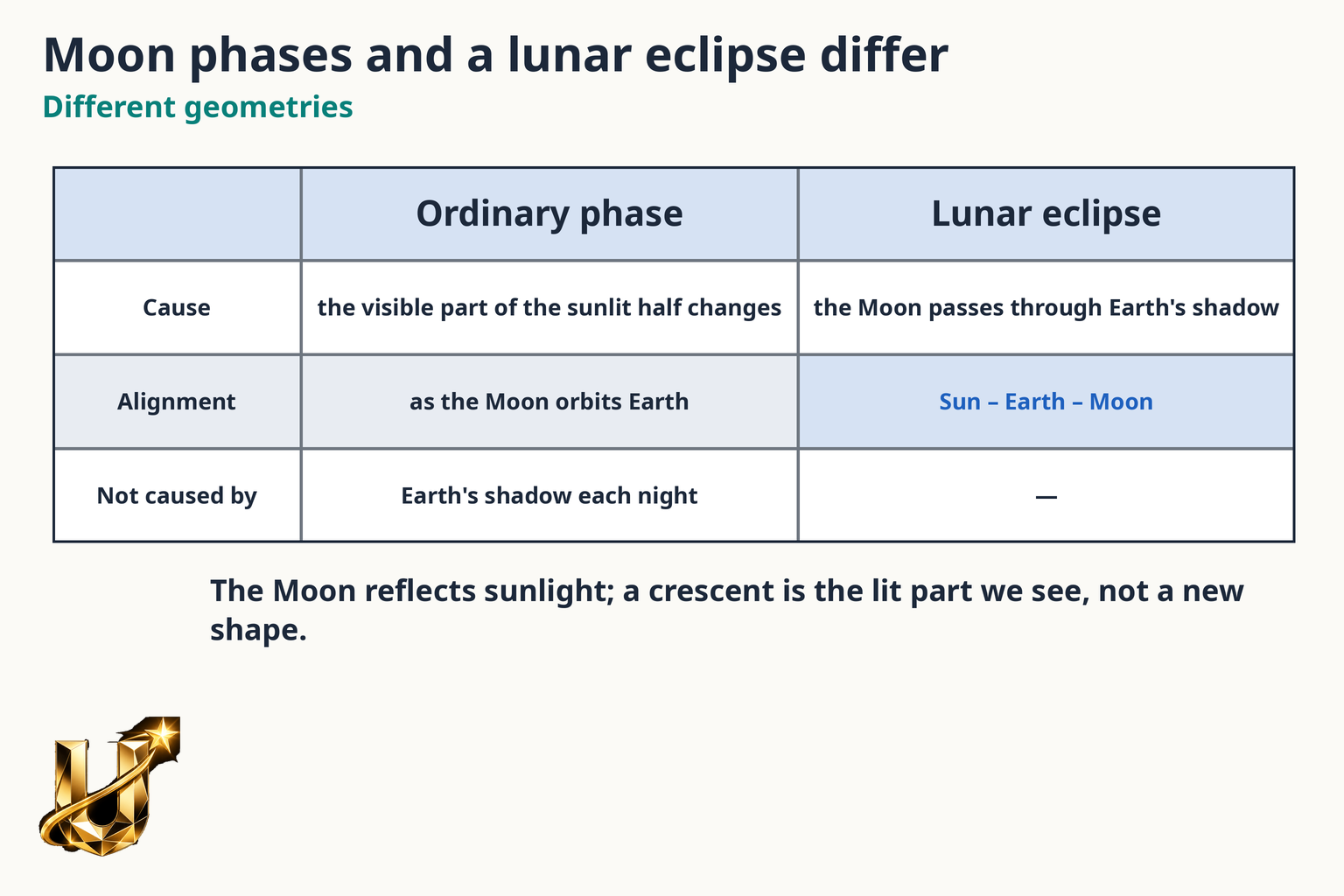
The Moon reflects sunlight. As it orbits Earth, the visible portion of its sunlit half changes, producing phases. This ordinary pattern is not caused by Earth's shadow covering the Moon every night.
A crescent appears in an ordinary phase image. Has the solid Moon become a crescent-shaped body?
Ordinary phases are changes in:
A lunar eclipse occurs when the Moon passes through Earth's shadow in suitable alignment: Sun–Earth–Moon. A solar eclipse occurs when the Moon blocks the Sun for a location on Earth: Sun–Moon–Earth. The Moon's orbit is tilted, so suitable eclipses do not occur at every new or full Moon.
A diagram places Earth between Sun and Moon, with Moon in Earth's shadow. Which eclipse?
Sun–Earth–Moon with Moon in Earth's shadow describes:
Eclipses can be partial or total depending on geometry; a model may exaggerate sizes and distances. Use approved images and safe indoor models. Do not look at the Sun directly or through unapproved optical devices, including during a solar eclipse.
Why is there not a solar eclipse at every new Moon?
Classify approved phase, lunar-eclipse and solar-eclipse diagrams. Name the alignment and one safety/model limit. No outdoor Sun viewing.
Ordinary phases differ from eclipses. Suitable alignment and orbital tilt explain why eclipses are special events, and safe resources are essential.