
A question from everyday life
Enlarge image
Enlarge image
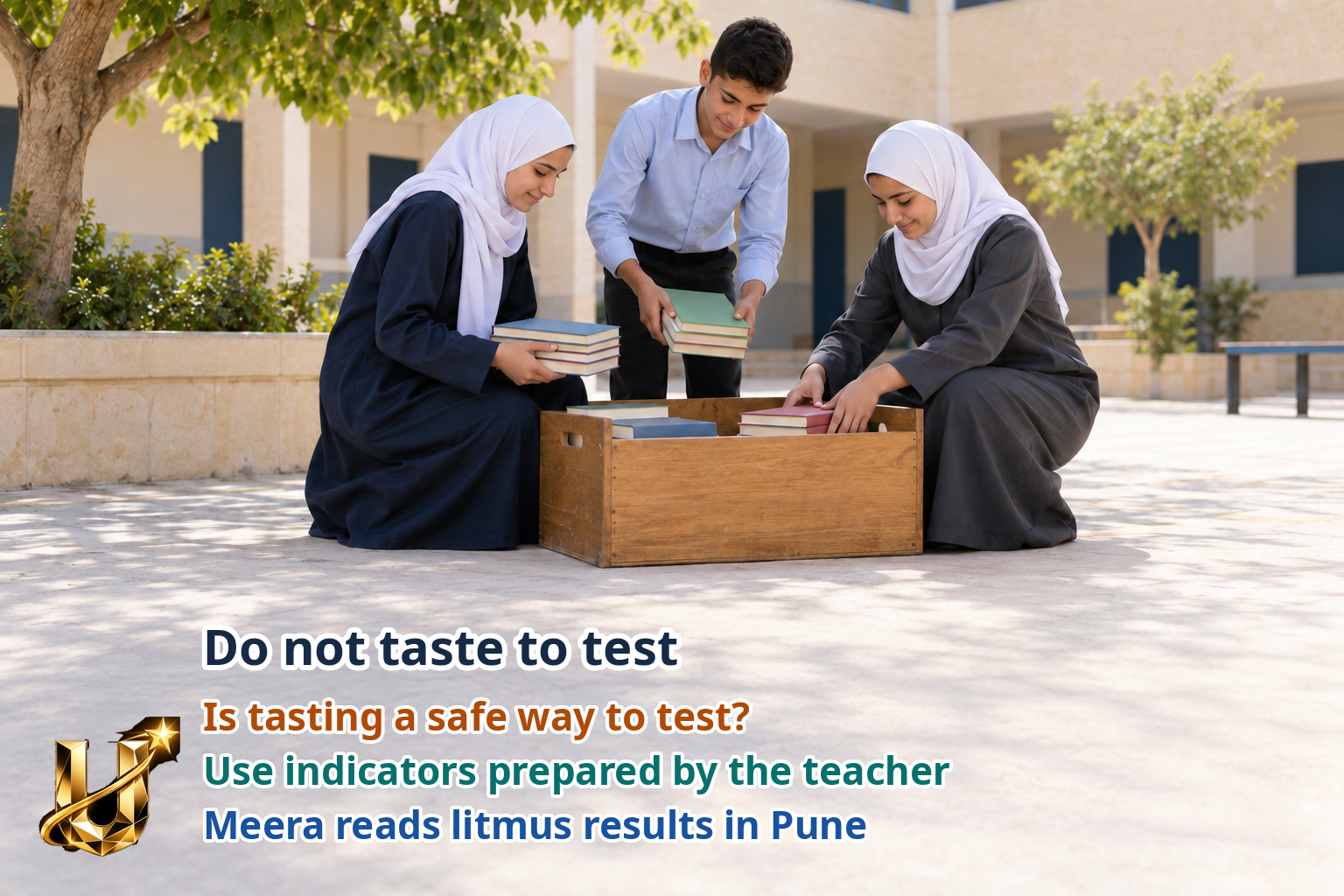
Meera reads teacher-prepared litmus results in Pune. Is tasting an unknown liquid a safe way to decide whether it is acidic?
Working review group 1; official unit label pending
Meera reads teacher-prepared litmus results in Pune. Is tasting an unknown liquid a safe way to decide whether it is acidic?
A substance whose response provides evidence about a chemical environment.
Review lesson not available yet.
Meera reads teacher-prepared litmus results in Pune. Is tasting an unknown liquid a safe way to decide whether it is acidic?
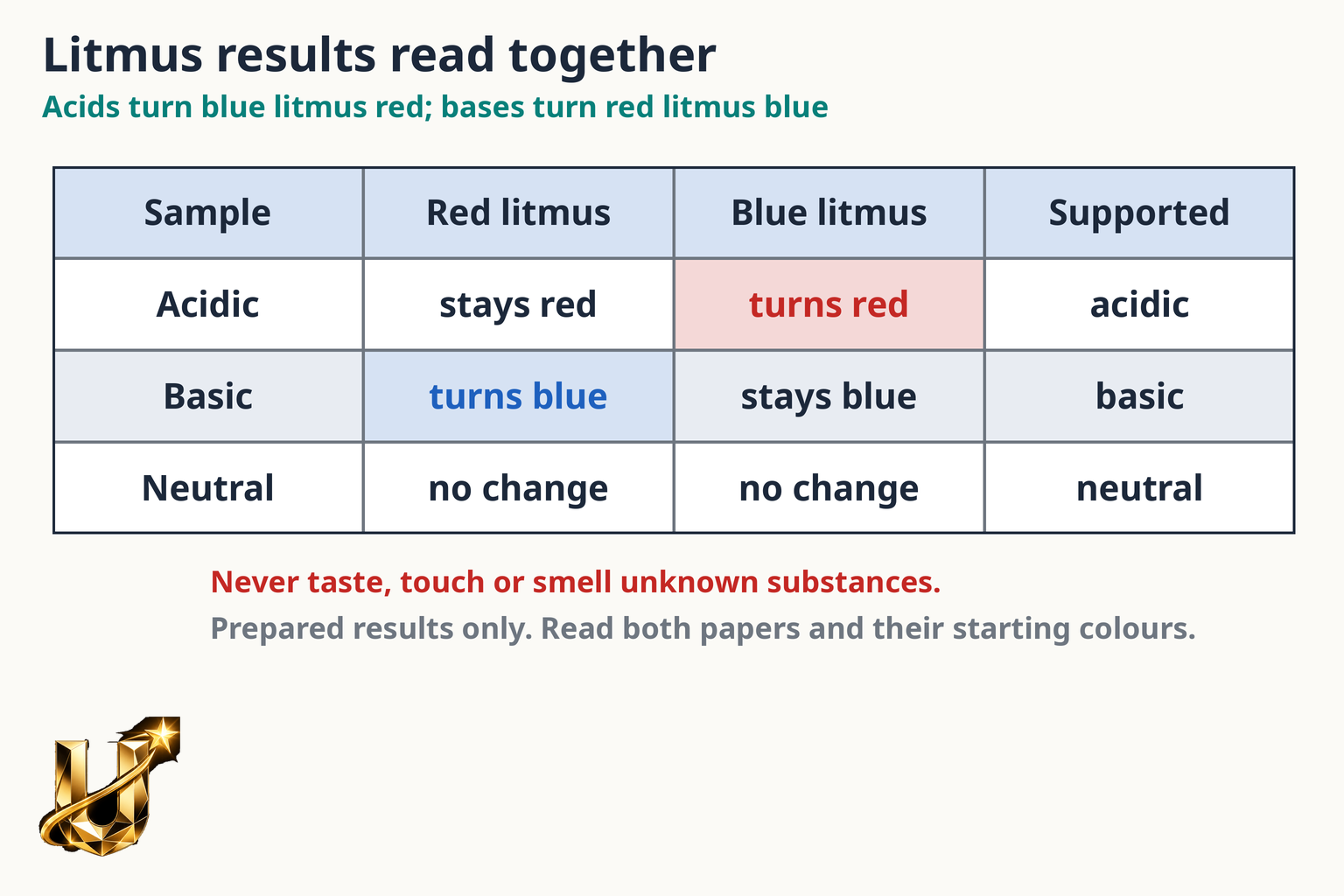
In suitable aqueous school examples, acids turn blue litmus red and bases turn red litmus blue. Neutral samples do not produce those changes. Unknown substances must not be tasted, touched or smelled to classify them.
A supplied liquid turns blue litmus red. What is supported in the stated school test?
An acid in the stated litmus test turns:
An indicator changes colour under particular conditions. A test needs a suitable fresh indicator, sample and comparison. One unchanged paper may not be enough if its starting colour or condition is unknown.
Red litmus becomes blue while blue litmus stays blue. Which classification fits?
A base turns:
Acidic/basic labels do not by themselves specify concentration or safety. Even familiar substances can require careful handling in experiments. Use prepared data rather than mixing cleaners or testing unknown chemicals.
A paper stays red, but the pupil does not know whether it began red or blue. Is the result sufficient?
Interpret prepared paired red/blue litmus cards and state one supported classification and one limit. No chemical handling.
Indicators support classification when conditions are known. Do not taste unknown substances or treat a label as a safety guarantee.