
A question from everyday life
Enlarge image
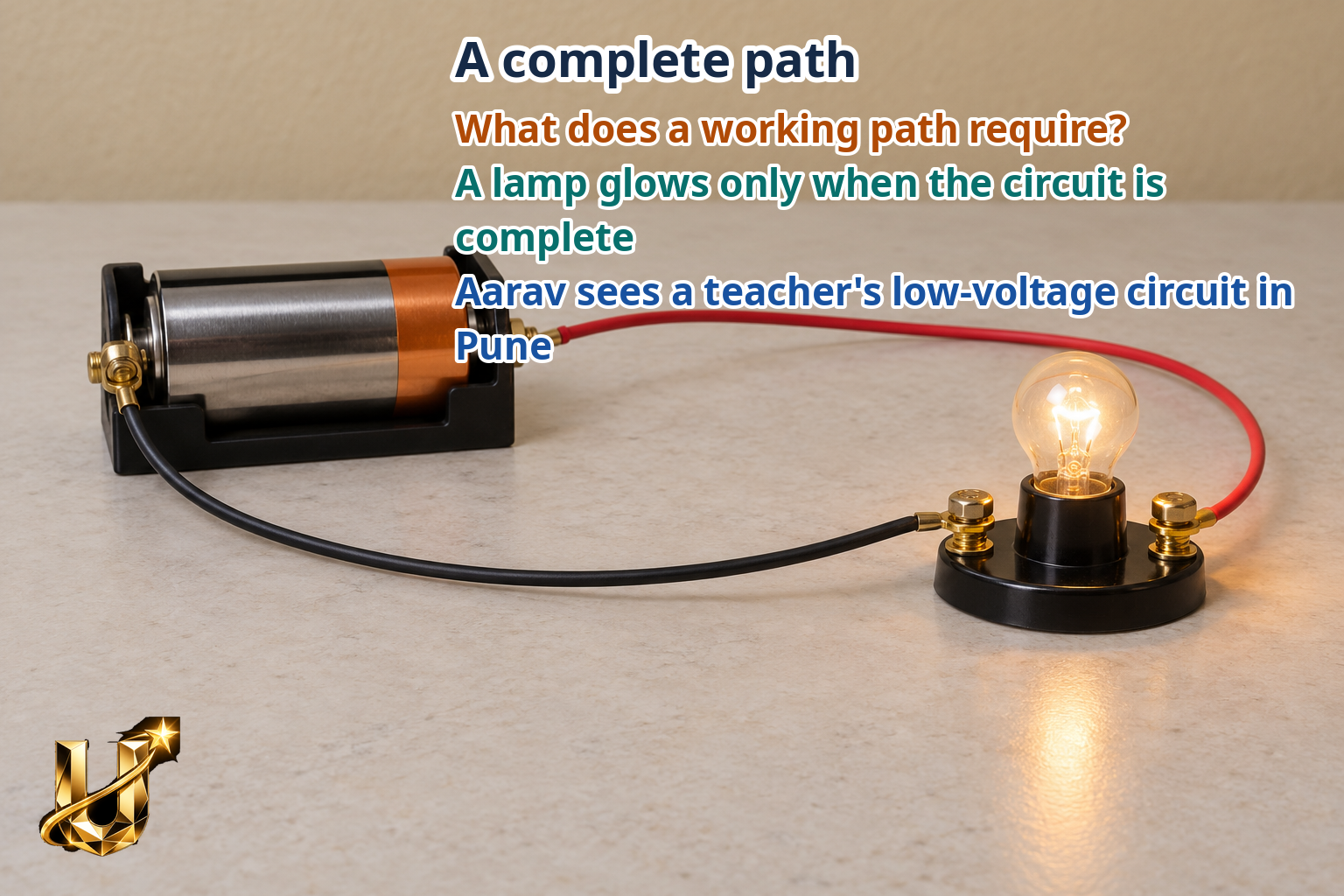
Aarav sees a teacher's low-voltage lamp circuit in Pune. One wire is disconnected and the lamp does not glow. What does a working path require?
Working review group 2; official unit label pending
Aarav sees a teacher's low-voltage lamp circuit in Pune. One wire is disconnected and the lamp does not glow. What does a working path require?
The rate of flow of electric charge through a circuit section.
Review lesson not available yet.
Aarav sees a teacher's low-voltage lamp circuit in Pune. One wire is disconnected and the lamp does not glow. What does a working path require?
A simple circuit includes a suitable cell or battery, conducting connections and a component such as a lamp. The path must connect both source terminals through the component. A drawing is a model; a cell is not an unlimited energy supply.
A diagram shows a lamp and cell but an open switch. Why is current interrupted?
A suitable simple circuit needs:
A closed suitable circuit allows current. An open switch or broken connection interrupts the path. A closed-looking drawing alone does not guarantee a working lamp if the cell, connections or component are faulty.
A lamp is connected to only one cell terminal. Is one connection enough?
An open switch:
Circuit symbols represent components, not their exact appearance. A cell symbol has unequal parallel lines for its terminals. Use teacher-prepared diagrams or approved low-voltage kits only. Never connect mains electricity or join battery terminals directly without a suitable load.
A cell is drawn using one longer and one shorter parallel line. Are these the physical dimensions of the actual cell?
Trace a prepared diagram from one source terminal through a lamp and back to the other. Identify one intentional gap. No home wiring.
A working simple circuit needs a suitable source, component and complete path. Symbols represent components and safety limits remain essential.