
A question from everyday life
Enlarge image
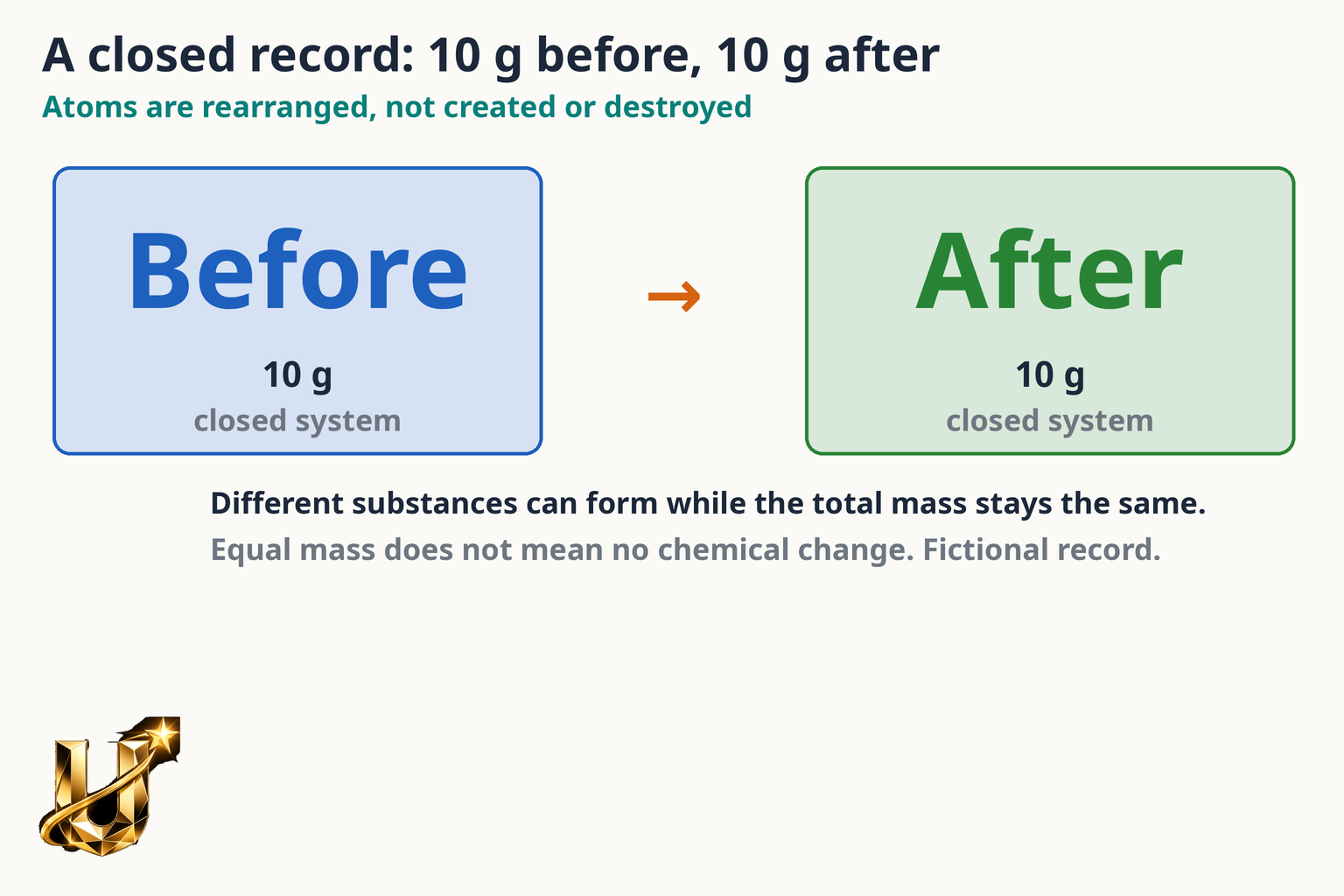
Meera reads a closed-system reaction record in Pune: total mass is 10 grams before and 10 grams after, although substances change. Is this contradictory?
Working review group 3; official unit label pending
Meera reads a closed-system reaction record in Pune: total mass is 10 grams before and 10 grams after, although substances change. Is this contradictory?
A change forming different substances.
Review lesson not available yet.
Meera reads a closed-system reaction record in Pune: total mass is 10 grams before and 10 grams after, although substances change. Is this contradictory?
In an ordinary closed chemical system, atoms are rearranged rather than created or destroyed. Total mass is conserved within suitable measurement limits. The substances can differ even when the total mass stays the same.
A stated closed-system sample is 10 grams before and 10 grams after. Can a reaction still have happened?
Equal mass before and after a closed reaction:
A measured container may gain or lose gas or other matter if open. A changing measured mass does not automatically overturn conservation; identify what entered or left the chosen system.
An open sample loses measured mass as a gas escapes. What must be considered?
An open container can:
Cooking, photosynthesis and other useful processes involve chemical changes; corrosion can damage objects. Chemical does not simply mean harmful. Adults manage heat, fuels and chemicals, and pupils interpret prepared evidence.
Aarav says every chemical change is dangerous. What is a correction?
Compare fictional open and closed mass records. Name the system boundary and a possible matter transfer. No gas collection or reaction.
Chemical identity can change while matter is conserved. Open-system records need exchanges accounted for, and chemical changes can be useful.