
A question from life
Enlarge image
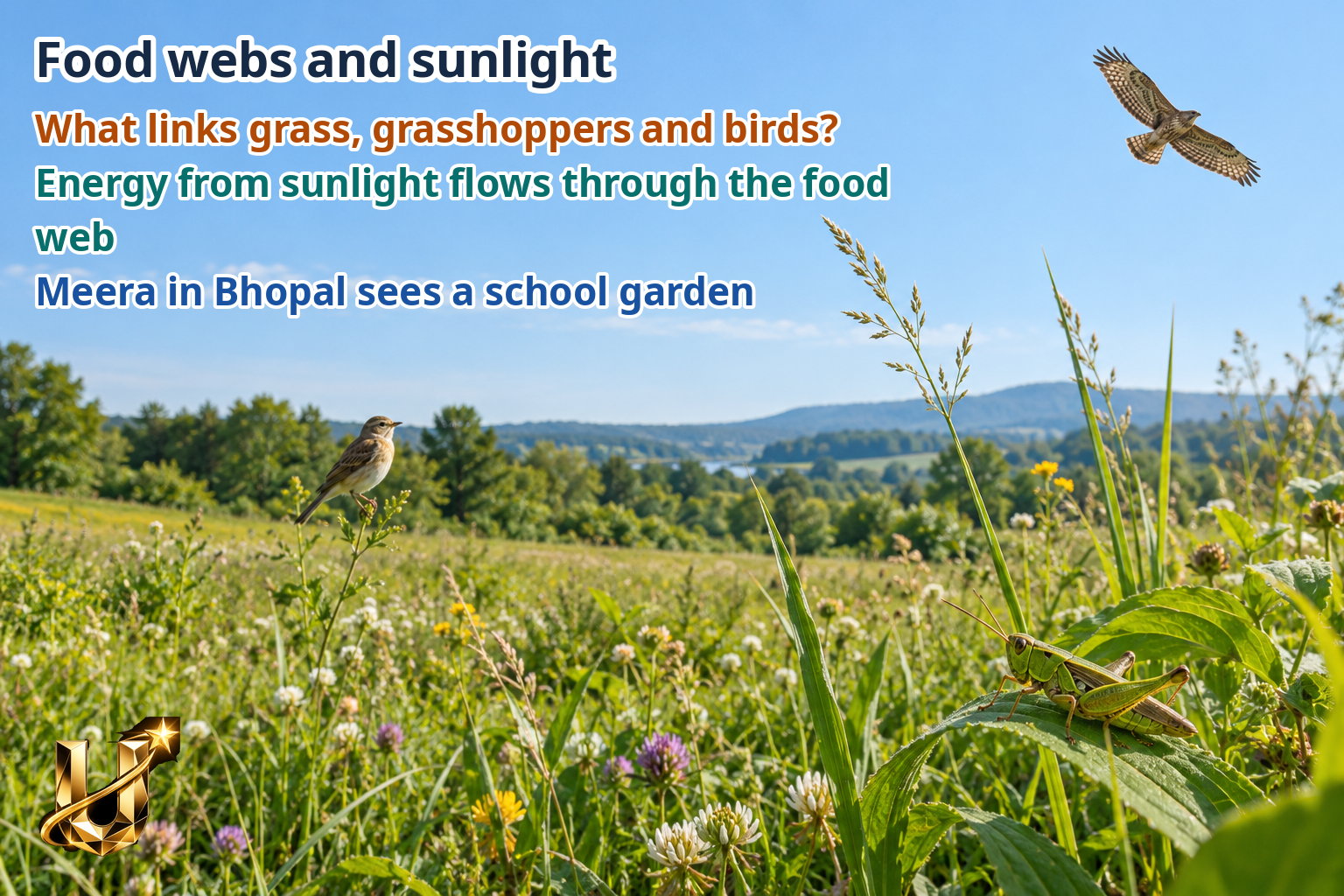
Meera in Bhopal sees grass, grasshoppers and birds in a school garden. What connects them to sunlight and to the microbes in the soil?
Working review group 6; official unit label pending
Meera in Bhopal sees grass, grasshoppers and birds in a school garden. What connects them to sunlight and to the microbes in the soil?
An organism that makes organic food from inorganic inputs, supplying chemical energy to a food web.
Review lesson not available yet.
Meera in Bhopal sees grass, grasshoppers and birds in a school garden. What connects them to sunlight and to the microbes in the soil?
Green plants use light energy to make sugars from carbon dioxide and water during photosynthesis, releasing oxygen. Producers provide chemical energy that many consumers depend on. Roots absorb water and minerals; soil is not the plant's main source of food energy.
A model chain is grass → grasshopper → bird.
What does a food-chain arrow conventionally show?
A food-chain arrow points from a food source to the organism that consumes it, showing a direction of energy transfer. Several connected chains form a food web. Real organisms often have more than one food source and more than one consumer.
A bird eats both insects and seeds in a simplified record.
Which is a producer in the garden model?
Consumers obtain matter and energy through feeding. Decomposers break down dead material and wastes, helping return nutrients. Matter is recycled, while energy is progressively transferred and dissipated as heat; it is not recycled in the same way.
A fallen leaf breaks down through fungal and bacterial activity.
Use prepared garden organism cards to build two connected food chains. Add decomposers and explain why arrows show food-to-consumer energy transfer. Do not feed or collect wildlife.
Producers capture light energy, feeding transfers it through webs, and decomposers return nutrients. Energy flow and matter cycling are different.