
A question from life
Enlarge image
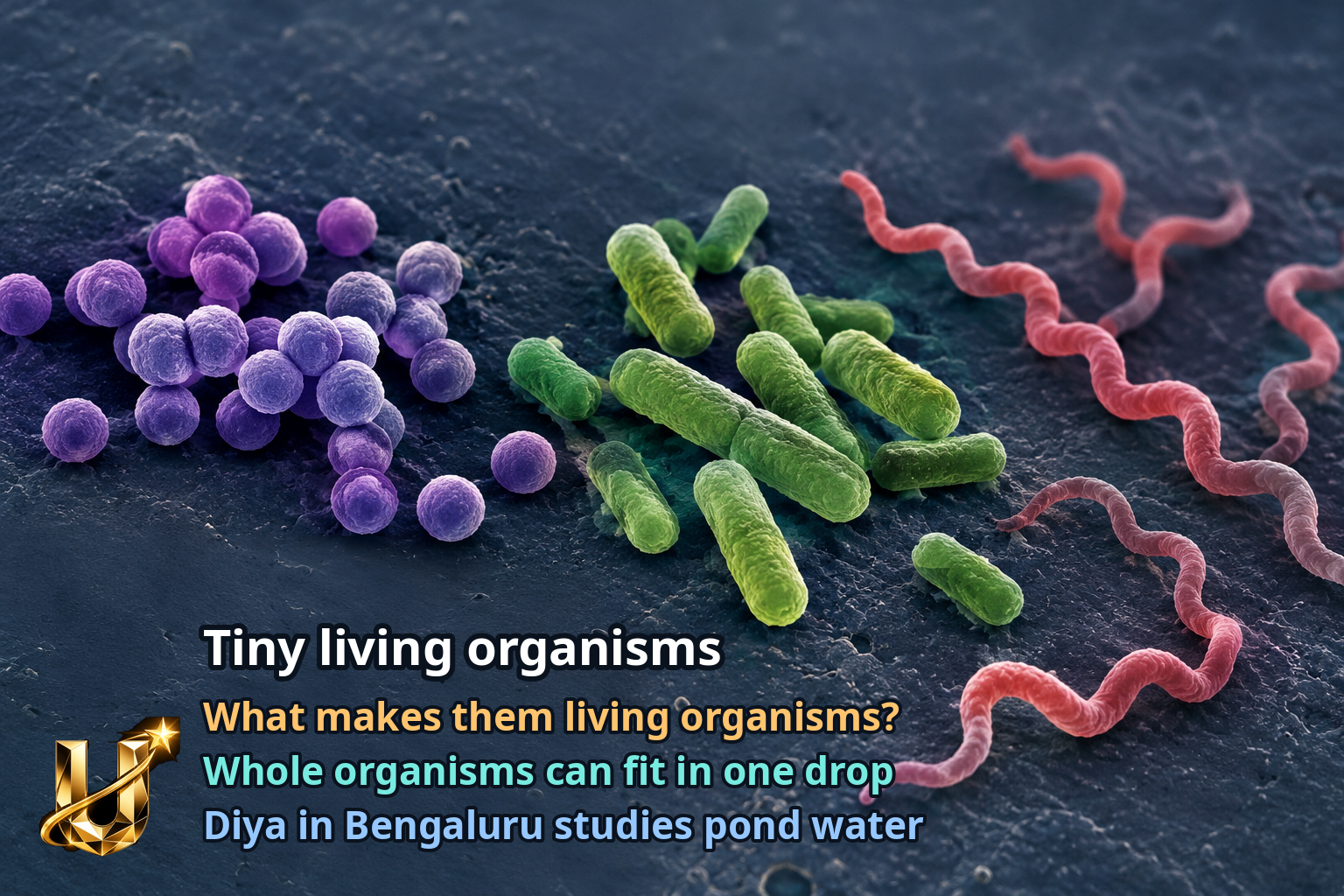
Diya in Bengaluru studies a prepared picture of pond water. Some whole organisms fit inside a tiny drop. What makes them living organisms?
Working review group 1; official unit label pending
Diya in Bengaluru studies a prepared picture of pond water. Some whole organisms fit inside a tiny drop. What makes them living organisms?
The smallest unit able to carry out the basic activities of life, either as an organism or as part of one.
Review lesson not available yet.
Diya in Bengaluru studies a prepared picture of pond water. Some whole organisms fit inside a tiny drop. What makes them living organisms?
A cell is the basic structural and functional unit of a living organism. Some organisms, such as many bacteria and Amoeba, consist of one cell. A person or a neem tree has many specialised cells.
A prepared Amoeba image shows one cell moving and taking in food.
What is the basic living unit?
All cells have a cell membrane and cytoplasm. Typical plant and animal cells have a membrane-bound nucleus; bacterial cells do not. Specialised exceptions exist: mature human red blood cells lack a nucleus. Absence of a nucleus alone therefore does not identify every cell as bacterial. Plant cells have a cell wall; many green leaf cells also have chloroplasts. Not all plant cells contain chloroplasts.
A cell has cytoplasm and DNA but no membrane-bound nucleus.
Which structure is absent in a bacterial cell?
Bacteria commonly reproduce by binary fission: one cell divides into two. A doubling calculation is a simplified model under suitable conditions. Real populations do not double forever because space, nutrients and other conditions become limiting.
A model population starts with 3 bacteria and doubles twice.
Use teacher-provided micrographs to compare an onion cell, a cheek cell and a bacterium. Point to the indicated boundaries and nucleus where present. Do not prepare cheek swabs or culture pond water yourself.
Life is organised in cells. Unicellular organisms carry out life processes in one cell; bacterial cells lack a membrane-bound nucleus. Growth models have limits.