
A question from life
Enlarge image
Kabir in Ahmedabad compares aluminium foil and pure water. Both may be pure substances, so why is only one an element?
Working review group 4; official unit label pending
Kabir in Ahmedabad compares aluminium foil and pure water. Both may be pure substances, so why is only one an element?
The smallest unit of an element that retains its chemical identity.
Review lesson not available yet.
Kabir in Ahmedabad compares aluminium foil and pure water. Both may be pure substances, so why is only one an element?
An element contains one type of atom, identified by its proton number. Aluminium and oxygen are elements. An atom need not display the bulk appearance or conductivity of a large sample; 'one kind of atom' describes composition.
The comparison is pure aluminium versus pure water.
Which describes an element?
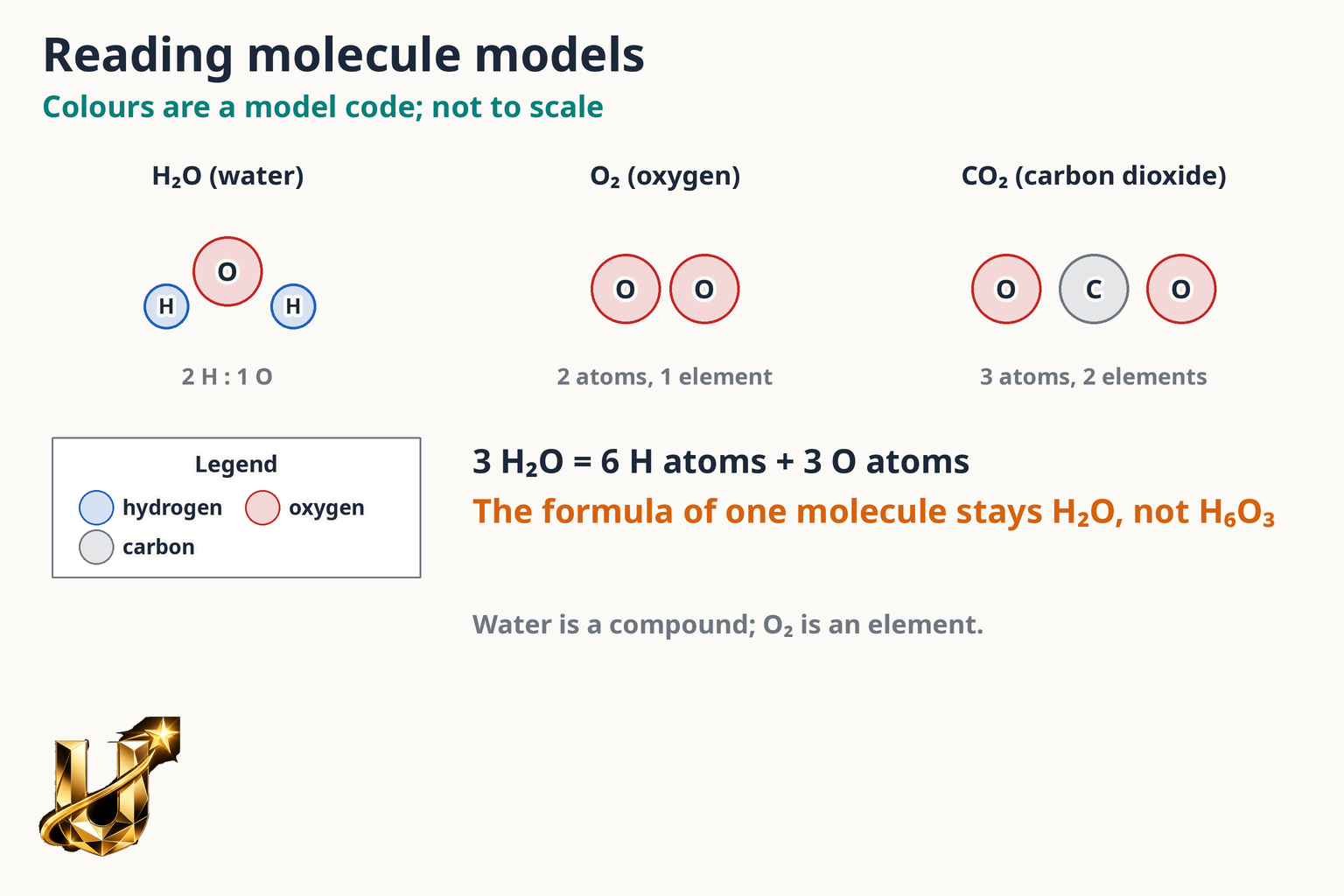
A compound contains atoms of different elements chemically combined in a fixed ratio. Water is a compound with hydrogen and oxygen in a two-to-one atomic ratio. Its properties differ from those of the separate elements.
A carbon dioxide molecule has formula CO₂.
Why is water a compound?
Symbols identify elements and small subscripts show atom counts in a formula. H₂O represents two hydrogen atoms for each oxygen atom in a water molecule. An element can form molecules too: O₂ contains two oxygen atoms but only one element.
Three water molecules are represented as 3 H₂O.
Use coloured atom-model cards to build H₂O, O₂ and CO₂. Name the elements and atom counts, then explain why the colours and balls are only a model.
Elements contain one kind of atom. Compounds contain different elements chemically combined in fixed ratios. Formulas encode composition, not sample size.
Many metals conduct well and can be shaped; many non-metals conduct poorly, with exceptions such as graphite. Metalloids, such as silicon, combine some metallic and non-metallic properties. Silicon’s semiconducting behaviour is useful in electronics. These are patterns of bulk properties, not claims that all elements in a category behave identically.
A prepared table identifies silicon as a semiconductor with some metal-like and some non-metal-like properties. Which school category fits?
Silicon is commonly classified as a: