
A question from life
Enlarge image
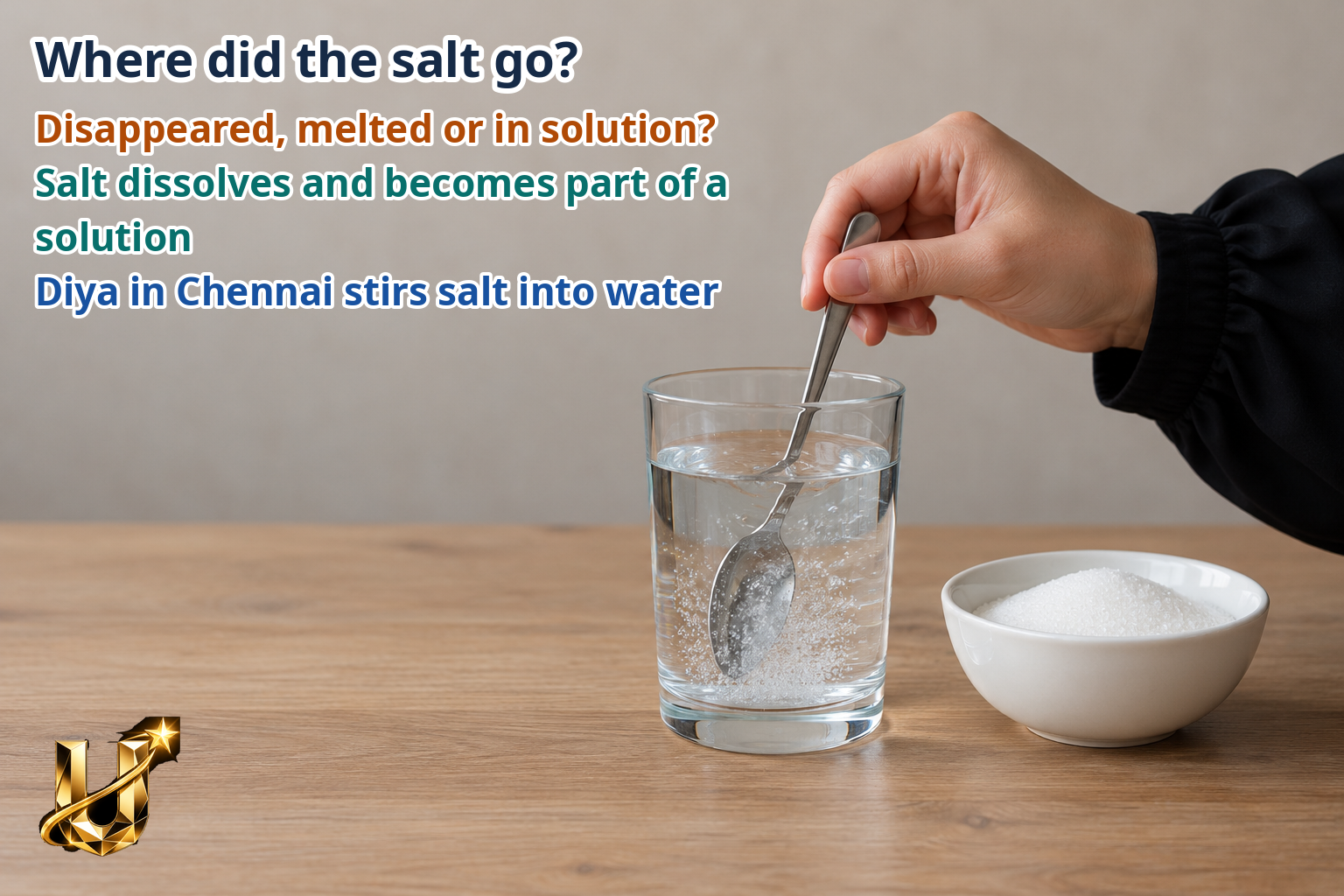
Diya in Chennai stirs salt into water and can no longer see the grains. Has the salt disappeared, melted or become part of a solution?
Working review group 5; official unit label pending
Diya in Chennai stirs salt into water and can no longer see the grains. Has the salt disappeared, melted or become part of a solution?
A homogeneous mixture in which a solute is dispersed in a solvent at the molecular or ionic scale.
Review lesson not available yet.
Diya in Chennai stirs salt into water and can no longer see the grains. Has the salt disappeared, melted or become part of a solution?
A solution is a homogeneous mixture. The solute is the component dissolved; the solvent is the dissolving medium. In an ordinary salt-in-water example, salt is the solute and water the solvent. A solvent is not always water.
A model mixture contains 5 g of salt dissolved in 95 g of water.
In salt water, what is the salt?
Dissolved particles are distributed through the solvent at a scale too small to see individually. They remain present. In a closed system with no loss, the mass of solution equals the combined masses of its components.
The same components are combined without spillage or evaporation.
What mass results from 8 g salt and 92 g water with no loss?
Solutions can contain solid, liquid or gaseous solutes. Oxygen dissolved in water supports aquatic organisms. Ordinary filters do not trap dissolved salt particles; recovering salt or solvent requires an appropriate separation method. Dissolving is not the same process as melting a solid by heating.
One record shows ice melting; another shows sugar dissolving in water.
Label components on prepared solution cards and use counters to account for component masses. Do not taste solutions or use unfamiliar solvents.
A solute dissolves in a solvent to form a solution. Dissolved matter remains present; mass is conserved when no material enters or leaves.