
A question from life
Enlarge image
Aarav in Pune records a trolley travelling 6 metres in 3 seconds. A friend writes only '6 in 3'. Why does scientific language need more precision?
Working review group 1; official unit label pending
Aarav in Pune records a trolley travelling 6 metres in 3 seconds. A friend writes only '6 in 3'. Why does scientific language need more precision?
A comparison of a quantity with a defined unit using a stated procedure.
Review lesson not available yet.
Aarav in Pune records a trolley travelling 6 metres in 3 seconds. A friend writes only '6 in 3'. Why does scientific language need more precision?
A scientific question should identify quantities that can be observed or measured. State the object, reference point and conditions. 'How far does the trolley travel in three seconds?' is more testable than 'Is the trolley good?'.
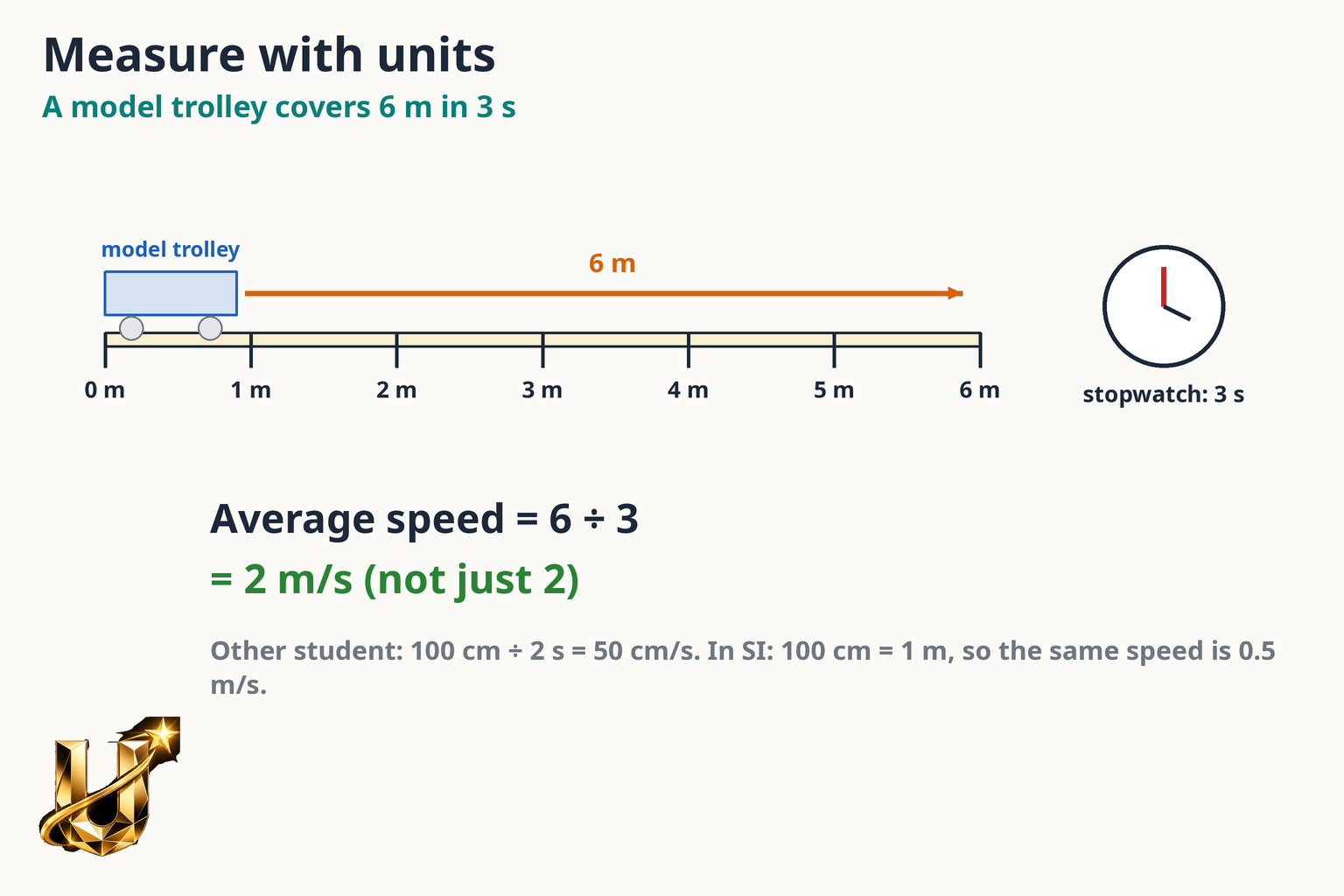
A model trolley covers 6 m in 3 s.
Which record is interpretable?
A measured value combines a number and a unit. Distance may be measured in metres and time in seconds. Average speed is total distance divided by total elapsed time. State units in both the data and result.
One student divides 100 cm by 2 s.
What is average speed for 12 m in 4 s?
An instrument has a finite scale and a measurement procedure. Repeated readings help assess variation, but repeating a biased method does not remove its bias. Report a sensible number of digits and explain relevant limitations.
Every timing begins a little late because of reaction delay.
Interpret three prepared motion records and repair missing labels or units orally. Identify one source of timing uncertainty without operating moving vehicles.
Scientific measurements define quantities, references and units. Calculations preserve their meaning, and methods need stated limits.