
A question from life
Enlarge image
Diya in Chennai hears a low drum note and a higher flute note. Which wave property mainly relates to pitch, and which helps explain loudness?
Working review group 5; official unit label pending
Diya in Chennai hears a low drum note and a higher flute note. Which wave property mainly relates to pitch, and which helps explain loudness?
The number of complete oscillations or wave cycles per second.
Review lesson not available yet.
Diya in Chennai hears a low drum note and a higher flute note. Which wave property mainly relates to pitch, and which helps explain loudness?
Sound is a mechanical disturbance produced by vibration. In air it travels through compressions and rarefactions as a longitudinal wave. Particles oscillate while the disturbance transfers energy. Sound does not travel through a vacuum.
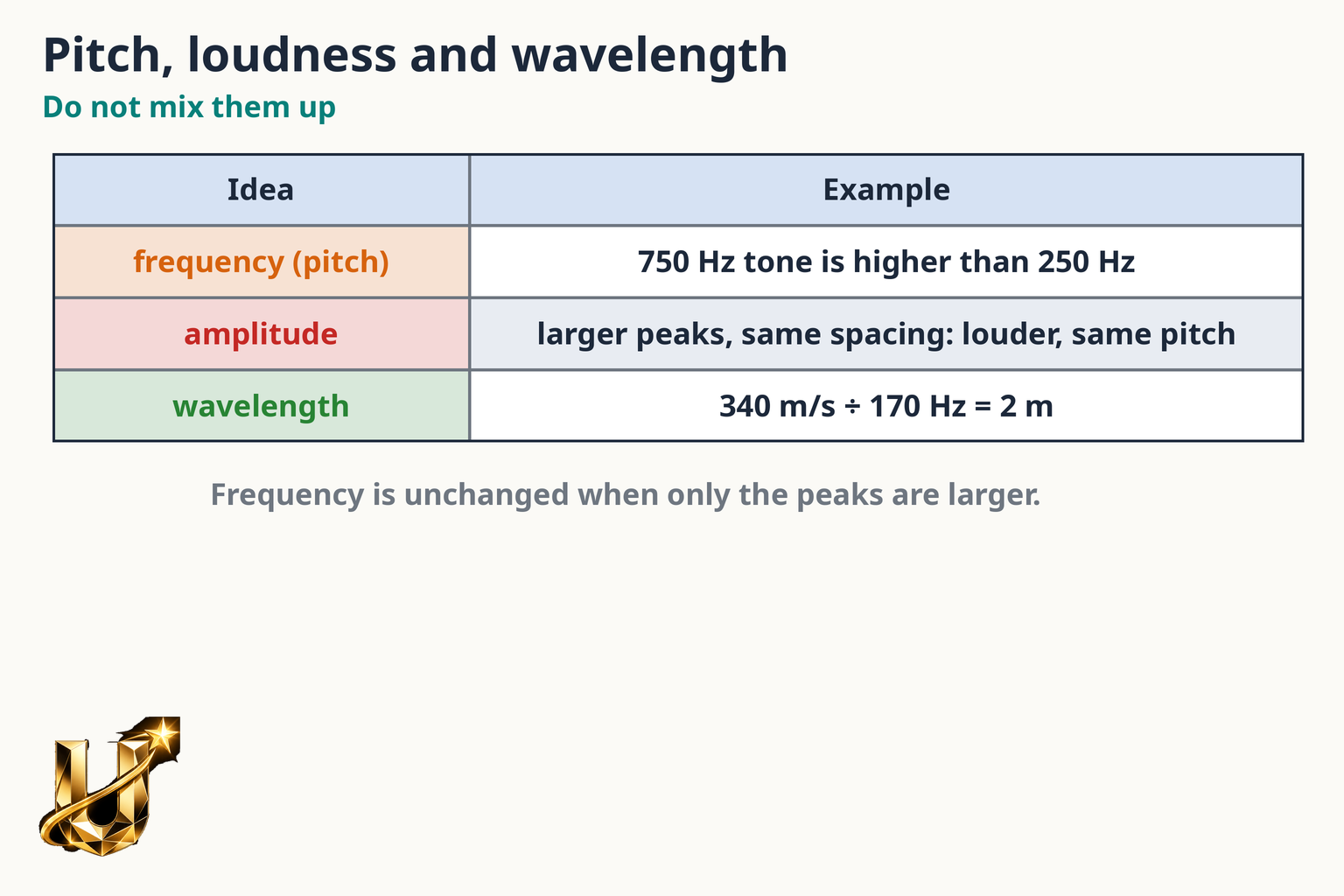
Prepared tones have frequencies 250 Hz and 750 Hz.
Why does sound not travel through a vacuum?
Frequency is the number of cycles per second, measured in hertz. Higher frequency generally corresponds to higher pitch for simple tones. Wavelength is the distance between corresponding parts of successive cycles. Wave speed v = fλ.
Use sound speed 340 m/s and frequency 170 Hz.
Which tone has higher pitch in a simple comparison?
Amplitude relates to the size of oscillations; larger amplitude generally gives greater intensity under comparable conditions. Perceived loudness also depends on frequency and the listener. Decibels express a logarithmic sound level, not intensity measured directly in watts per square metre.
A prepared trace has the same cycle spacing but larger peaks.
Interpret recorded wave traces instead of making loud sounds. Compare frequency and amplitude separately, using safe low-volume teacher audio if available.
Sound transfers energy through a medium. Frequency relates to pitch, amplitude to intensity, and speed, frequency and wavelength obey v = fλ.