
A question from life
Enlarge image
Enlarge image
A fictional school in Kochi replaces wasteful taps and plants suitable native species. How can it tell whether these actions helped rather than relying only on photographs?
Working review group 7; official unit label pending
A fictional school in Kochi replaces wasteful taps and plants suitable native species. How can it tell whether these actions helped rather than relying only on photographs?
A part of an environmental system in which matter is stored for a time.
Review lesson not available yet.
A fictional school in Kochi replaces wasteful taps and plants suitable native species. How can it tell whether these actions helped rather than relying only on photographs?
Solar and wind energy are renewable resources; fossil fuels form over very long times and are non-renewable on human timescales. Water renews through cycles, but a local supply can be depleted or polluted faster than it recovers. Resource management must consider place and rate.
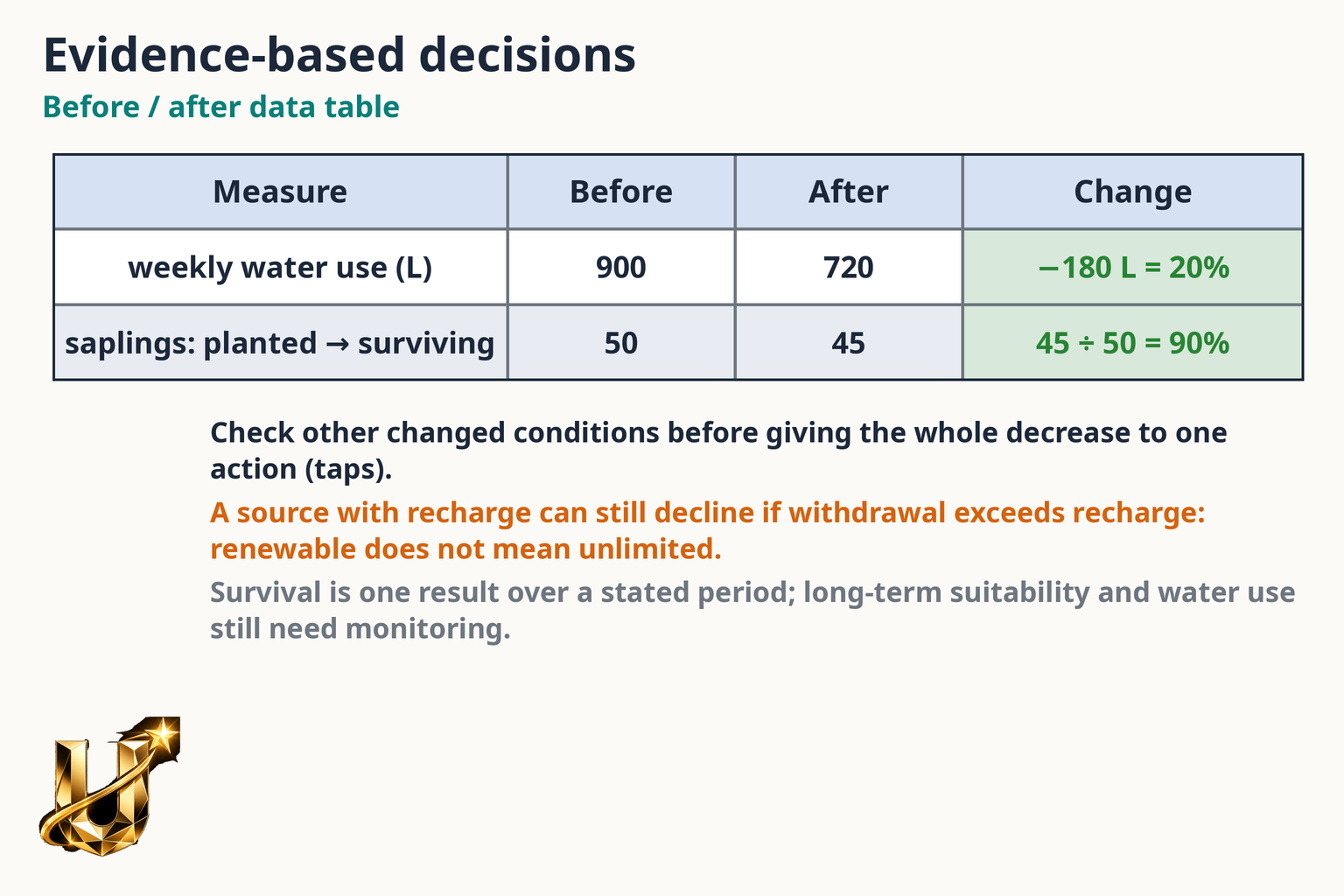
Comparable weekly water use falls from 900 L to 720 L.
Which is non-renewable on human timescales?
Air, water, soil and noise pollution can affect organisms and people. Pollution can move between systems, so removing visible litter alone does not remove every pollutant. Aquatic organisms depend on suitable dissolved oxygen and habitat conditions.
A water source receives recharge but withdrawal exceeds recharge.
Why can a renewable local water supply decline?
Define a measurable goal, baseline and comparison period. Check relevant factors such as attendance or weather. Evaluate benefits, costs and unintended effects, then monitor and revise. No technology or planting project has automatically zero impact.
A class records 45 surviving plants from 50 suitable local saplings.
Compare two hypothetical school resource plans with stated costs, water use and survival data. Explain one benefit, one uncertainty and one follow-up measurement. Do not enter polluted water or handle hazardous waste.
Resources depend on recovery rates and local conditions. Pollution connects systems, and environmental decisions need fair measurements, trade-off assessment and follow-up.