
A question from life
Enlarge image
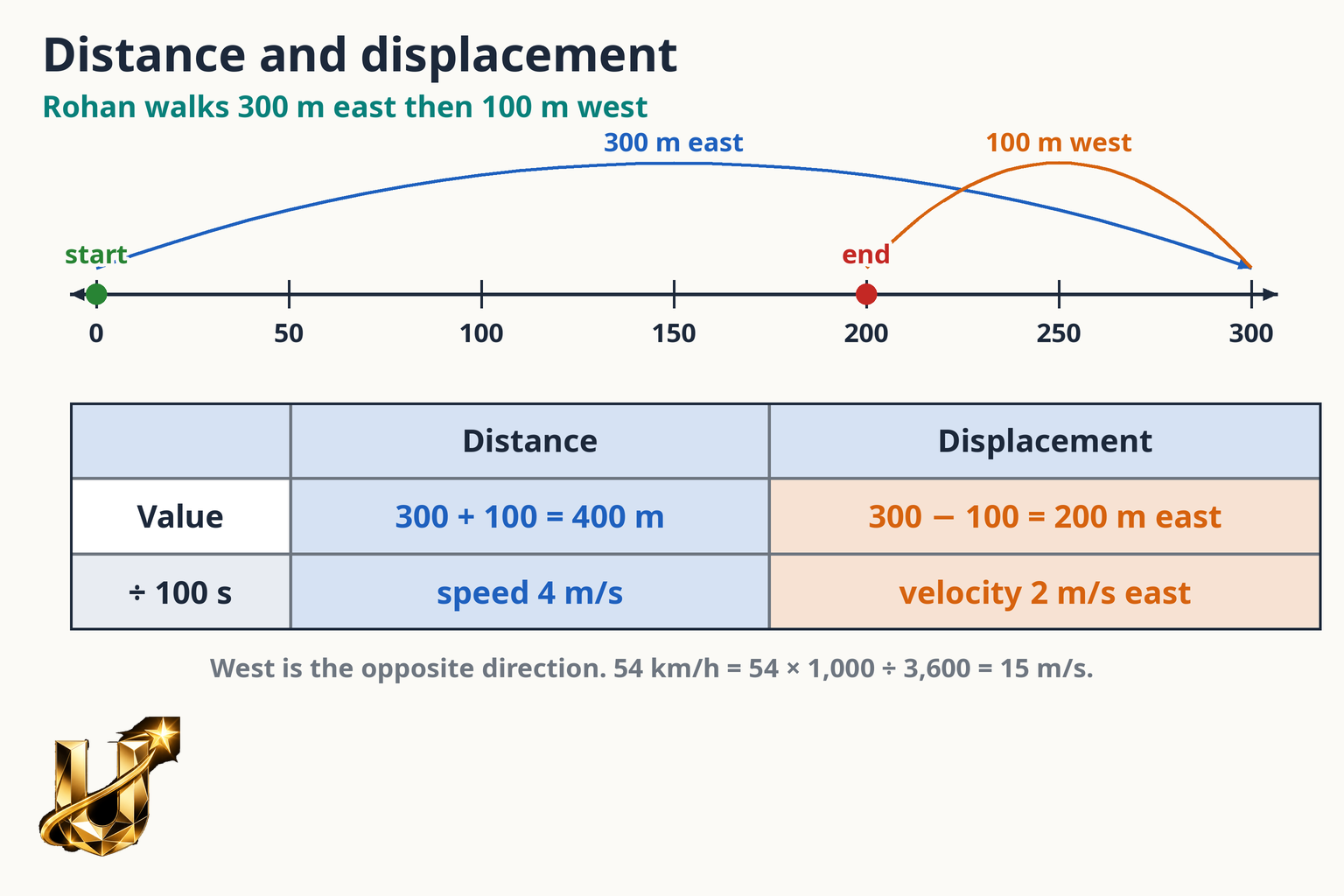
Rohan walks 300 m east from home in Lucknow and then 100 m west. Has he travelled 200 m or 400 m?
Working review group 2; official unit label pending
Rohan walks 300 m east from home in Lucknow and then 100 m west. Has he travelled 200 m or 400 m?
The directed change from initial to final position.
Review lesson not available yet.
Rohan walks 300 m east from home in Lucknow and then 100 m west. Has he travelled 200 m or 400 m?
An object moves when its position changes relative to a chosen reference. A passenger can be at rest relative to a seat while moving relative to the road. State the reference before describing motion.
Rohan walks 300 m east then 100 m west.
What is the distance for 40 m east then 10 m west?
Distance is total path length and has no direction. Displacement is the change in position from start to finish, with direction. A return to the starting point can have nonzero distance and zero displacement.
That journey takes 100 s.
What is the displacement for the same trip?
Average speed is total distance divided by total elapsed time. Average velocity is displacement divided by total elapsed time. Use consistent units and include stops in the elapsed journey time when calculating whole-journey averages.
A model train travels at 54 km/h.
Trace prepared routes on a simple map with a stated east direction. Calculate distance and displacement aloud before comparing average speed and velocity.
State a reference. Distance measures path length, displacement measures position change, and their time averages give speed and velocity respectively.