
A question from life
Enlarge image
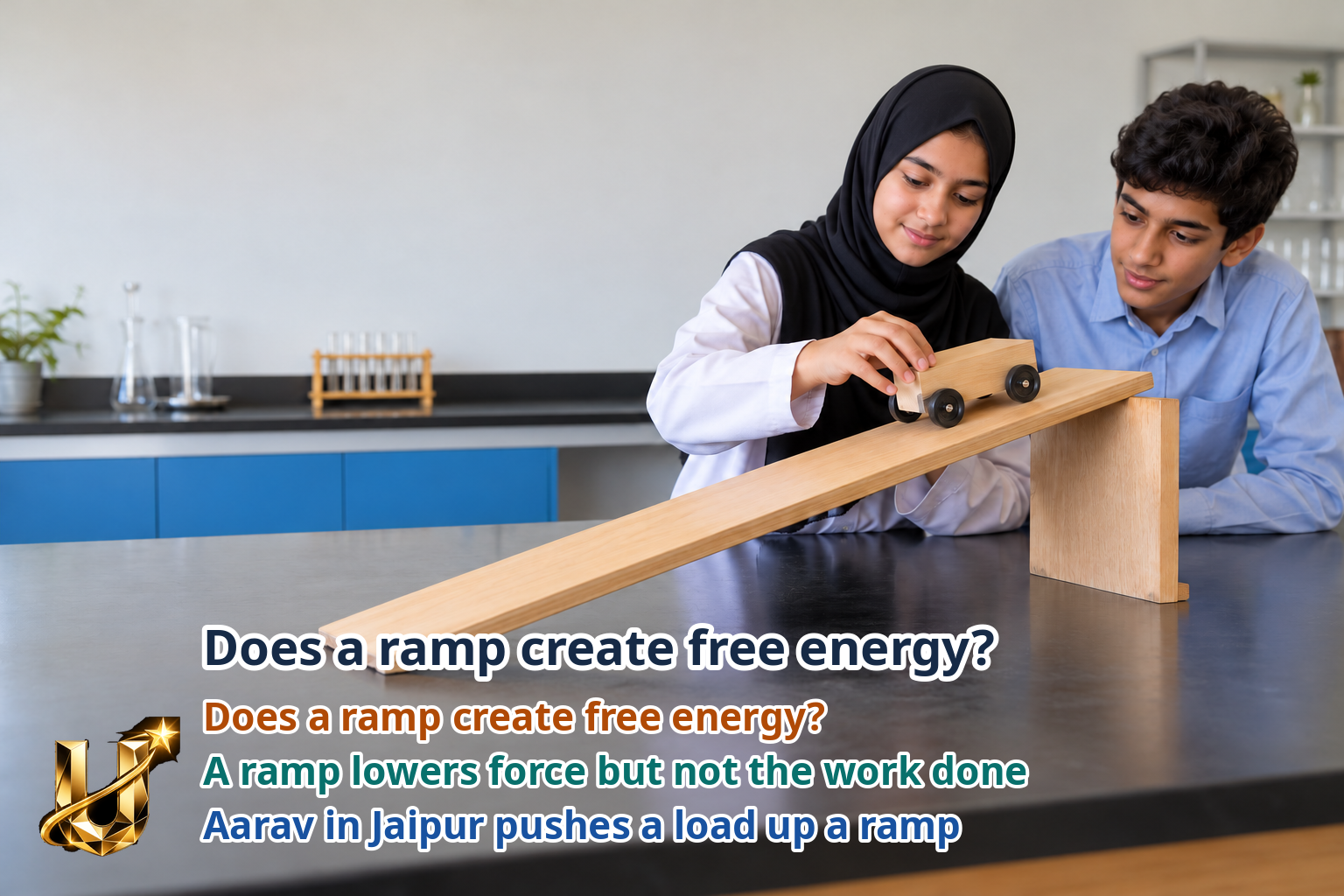
Aarav in Jaipur can push a load up a gentle ramp using less force than lifting it directly. Does the ramp create free energy?
Working review group 4; official unit label pending
Aarav in Jaipur can push a load up a gentle ramp using less force than lifting it directly. Does the ramp create free energy?
The ratio of load force to effort force in a machine.
Review lesson not available yet.
Aarav in Jaipur can push a load up a gentle ramp using less force than lifting it directly. Does the ramp create free energy?
Near Earth's surface, raising mass m through height h increases gravitational potential energy by mgh for approximately constant g. State the reference height. The stored energy can later transfer into motion or other forms.
A 3 kg load rises 2 m; use g = 10 m/s².
What is the energy increase for 2 kg raised 3 m at g = 10 m/s²?
A simple machine such as a lever or ramp can change the force needed or its direction. In an ideal loss-free machine, reduced effort force is balanced by greater effort distance. The machine does not create energy. Mechanical advantage is load force divided by effort force. For an ideal lever in equilibrium, effort * effort arm = load * load arm, using perpendicular arms. For an ideal pulley system with n equally tensioned rope segments supporting the moving load, effort = load/n and the effort end moves n times the load's rise. A fixed pulley alone has n = 1 and changes force direction without force multiplication; a simple movable pulley with two supporting segments has n = 2.
A 100 N load is raised 1 m using a 5 m ideal ramp.
What does an ideal machine conserve in the work comparison?
Real machines transfer some input energy to warming, sound or deformation. Efficiency is useful output energy divided by input energy, often expressed as a percentage. Define the useful task and compare like quantities.
An ideal massless movable-pulley model supports a 100 N load with two equally tensioned vertical rope segments. The load rises 0.5 m. Find effort and effort distance.
Use prepared ramp and lever diagrams to compare effort distance and force. Explain an energy budget with counters; do not lift heavy loads or balance on levers.
Raising a load stores gravitational potential energy. Simple machines trade force and distance; real devices have energy transfers beyond the useful task.