
A question from life
Enlarge image
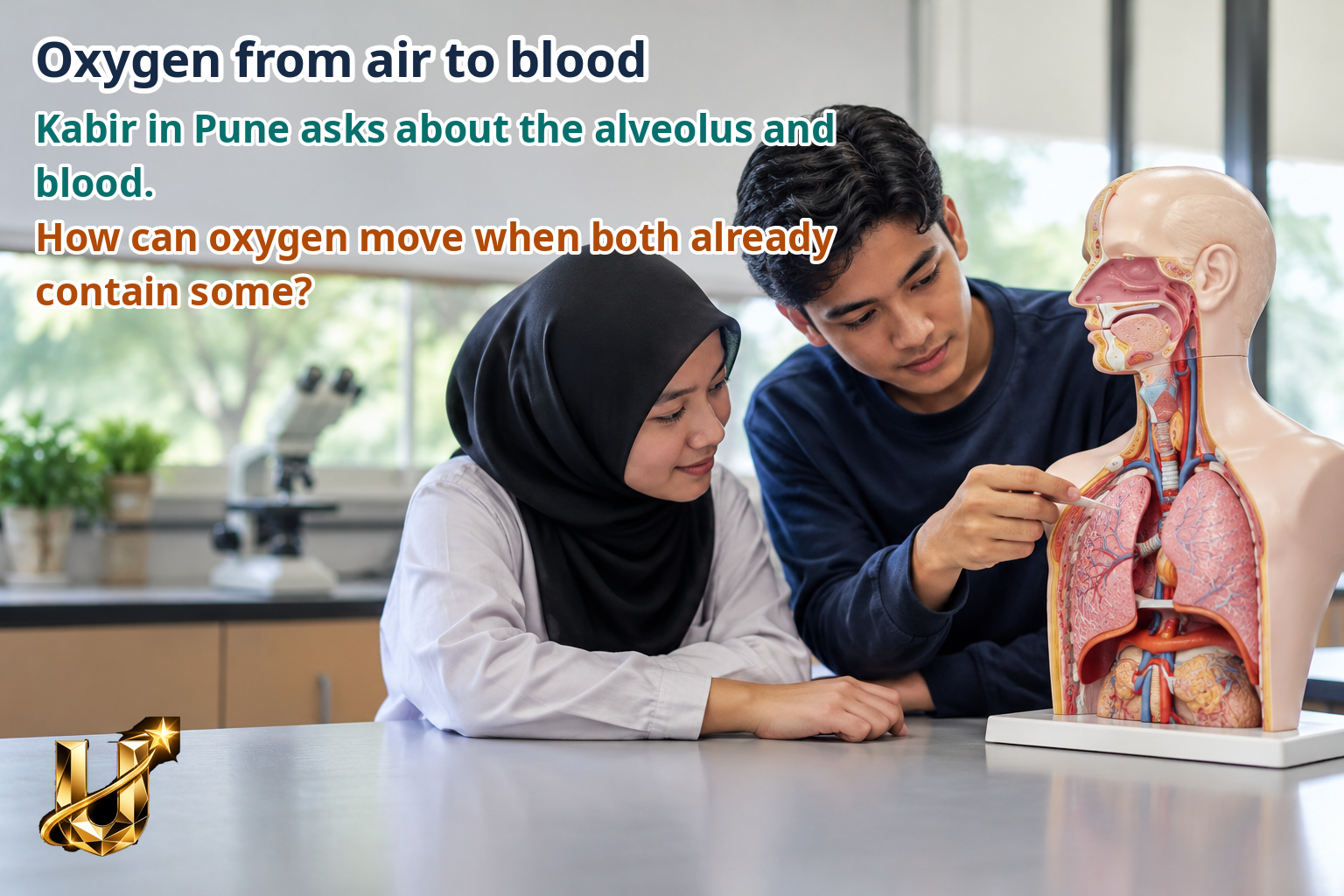
Kabir in Pune asks how oxygen can move from an alveolus into blood even when both contain some oxygen already.
Working review group 7; official unit label pending
Kabir in Pune asks how oxygen can move from an alveolus into blood even when both contain some oxygen already.
The pressure contribution of a gas component in a mixture under the stated model.
Review lesson not available yet.
Kabir in Pune asks how oxygen can move from an alveolus into blood even when both contain some oxygen already.
Gas exchange follows relevant partial-pressure gradients across thin surfaces. Alveoli provide large area, short distance and close blood supply. Oxygen moves toward blood under usual lung conditions and carbon dioxide toward alveolar gas; gradients reverse at active tissues.
A supplied model has higher O₂ partial pressure in alveolar gas than incoming blood.
What gradient directly describes gas diffusion in this lesson?
Most oxygen is carried reversibly bound to haemoglobin, with a smaller dissolved fraction. Carbon dioxide is carried in several forms, including bicarbonate, dissolved gas and protein-bound forms. Binding and release depend on local conditions rather than one fixed carrying amount for every situation.
A blood diagram shows oxygen bound to haemoglobin and dissolved.
What feature reduces alveolar diffusion distance?
Brainstem networks and chemical sensing help regulate ventilation, responding importantly to CO₂-related acid-base changes and other signals. Neural and circulatory responses interact during changing demand. A symptom or one gas reading is not enough for a personal diagnosis. Curriculum examples show how exchange can be impaired. Asthma involves inflamed, narrowed airways, increasing resistance to airflow. Emphysema damages alveolar walls and reduces effective exchange area; tobacco-smoke exposure is a major risk factor. Some occupational dust exposures can cause chronic inflammation and fibrosis, reducing lung function. These mechanisms differ and cannot be diagnosed from a classroom symptom list.
Three labelled educational models show A: narrowed inflamed bronchioles, B: damaged alveolar walls with less exchange area, and C: dust-associated fibrotic lung tissue. Compare the mechanisms.
Use supplied lung/tissue partial-pressure arrows and transport-form cards. Trace gases through the model without measuring classmates' breathing.
Gas exchange follows partial-pressure gradients; blood carries gases in several forms, and feedback coordinates breathing with body conditions.