
A question from life
Enlarge image
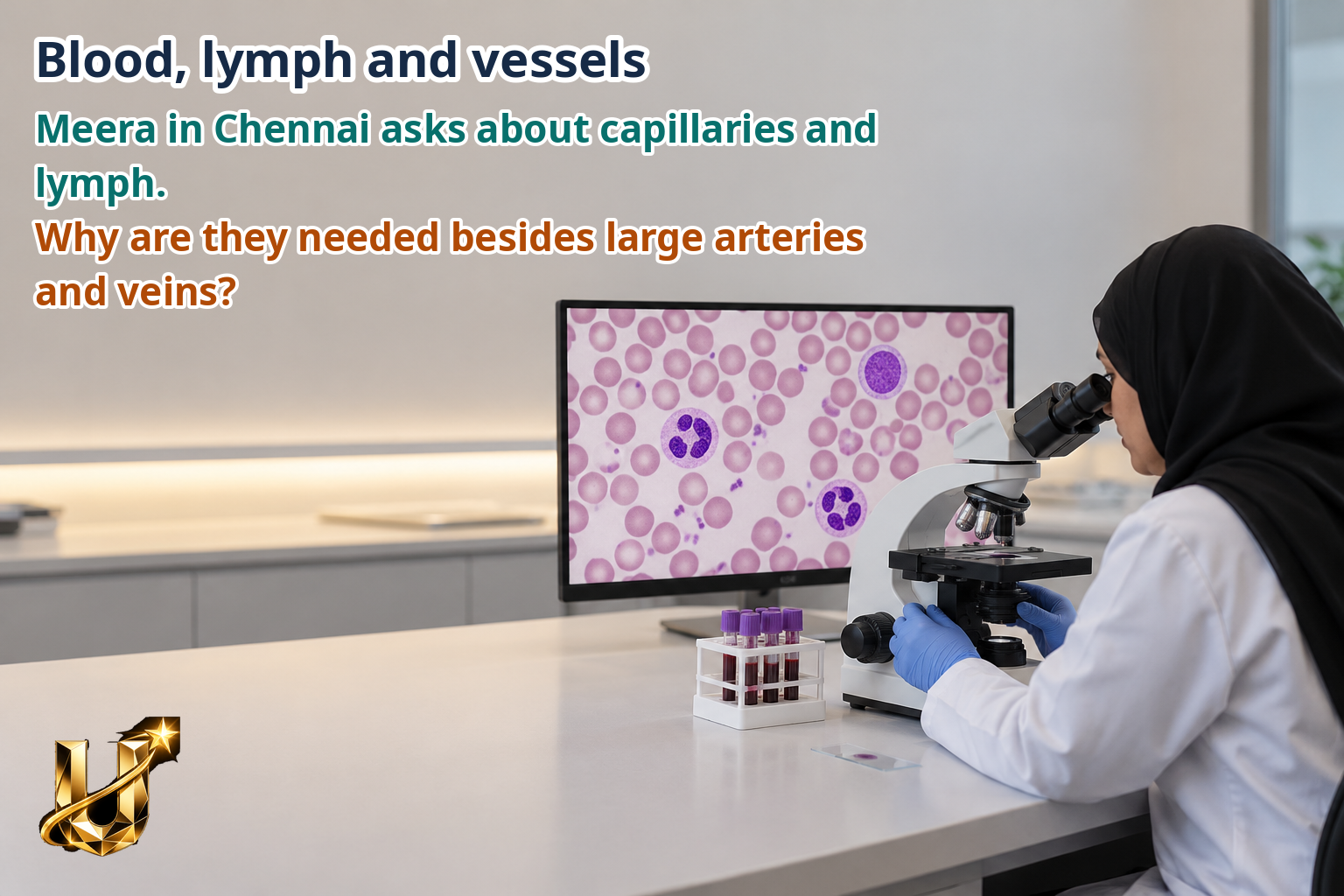
Meera in Chennai asks why a tissue needs capillaries and lymph drainage as well as large arteries and veins.
Working review group 8; official unit label pending
Meera in Chennai asks why a tissue needs capillaries and lymph drainage as well as large arteries and veins.
The blood volume pumped by a ventricle per unit time.
Review lesson not available yet.
Meera in Chennai asks why a tissue needs capillaries and lymph drainage as well as large arteries and veins.
Plasma carries dissolved substances; red cells and haemoglobin support oxygen transport; white cells have diverse defence roles; platelets participate in clotting. Not every blood cell has the same structure or function, and cell fragments differ from whole nucleated cells.
A prepared diagram shows a thin wall near tissue cells.
What is plasma?
Arteries carry blood away from the heart and veins toward it. Capillaries provide exchange surfaces. Oxygen content is not the defining artery/vein criterion; pulmonary vessels illustrate the exception to a simple oxygen-label shortcut.
A vessel leaves the right ventricle toward lungs.
Which component participates in clotting?
Fluid exchange links plasma and tissues. Lymphatic vessels return excess interstitial fluid and participate in immune traffic and lipid transport in relevant regions. Blood-group antigens are useful educational models, but real transfusion compatibility needs professional testing beyond a classroom table.
A supplied tissue diagram shows excess interstitial fluid entering a lymphatic capillary.
Sort blood-component and vessel cards, then trace tissue-fluid return on a prepared diagram. No blood collection, typing or personal compatibility decisions.
Blood and vessels have specialised roles, while lymph supports fluid return and other functions. Direction defines vessel type; clinical use needs more than a class model.