
A question from life
Enlarge image
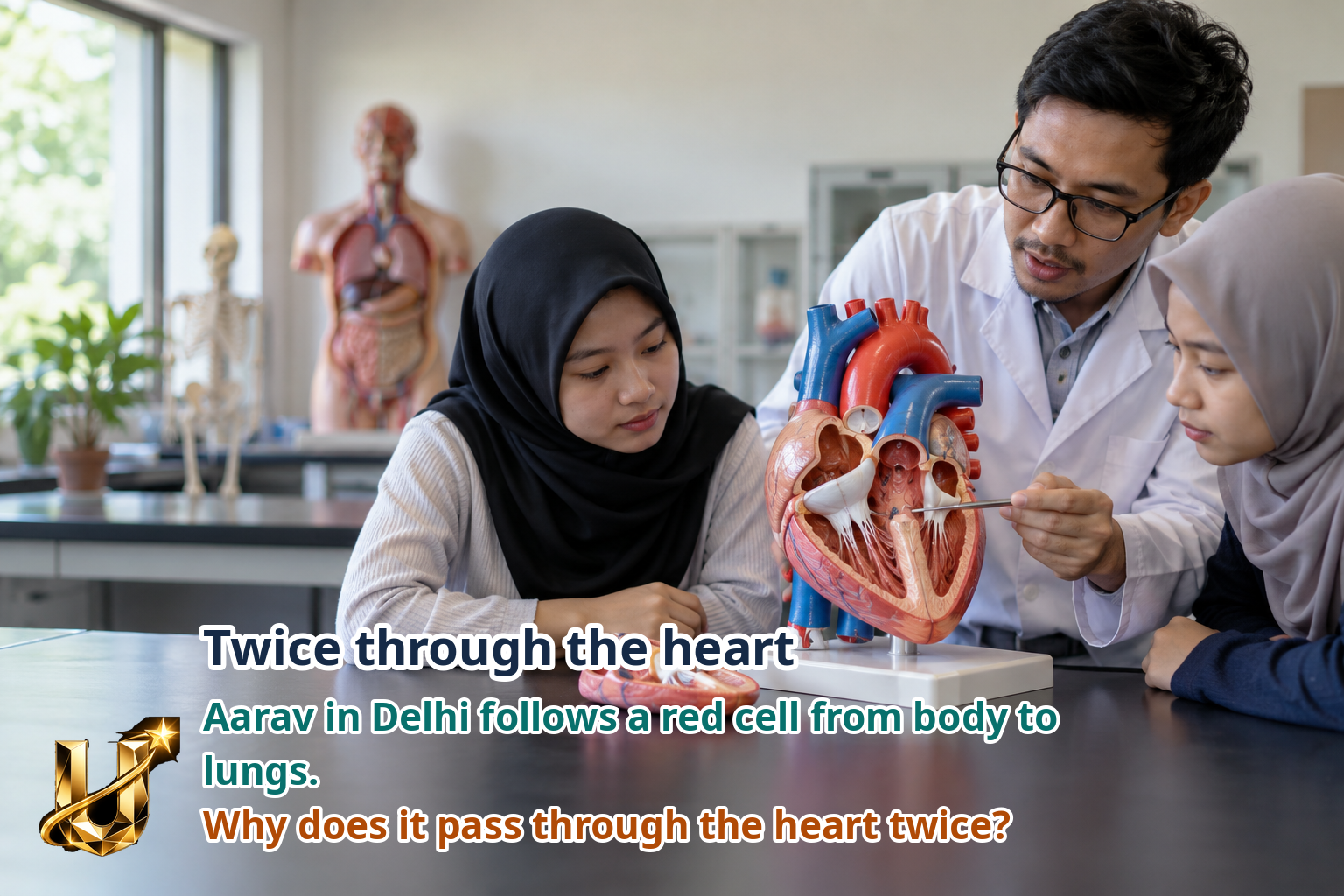
Aarav in Delhi follows one model red cell from the body to lungs and back to the body. Why does it pass through the heart twice along that full route?
Working review group 8; official unit label pending
Aarav in Delhi follows one model red cell from the body to lungs and back to the body. Why does it pass through the heart twice along that full route?
The blood volume pumped by a ventricle per unit time.
Review lesson not available yet.
Aarav in Delhi follows one model red cell from the body to lungs and back to the body. Why does it pass through the heart twice along that full route?
The right side sends blood toward lungs and the left toward body tissues. Atria receive and ventricles eject in the usual four-chambered model. Valves open and close with pressure relationships, limiting backflow rather than actively pulling blood through.
Body return → right atrium → right ventricle → lungs → left atrium → left ventricle → body.
Which chamber ejects toward the body in the usual human circuit?
The heart's intrinsic conduction system normally initiates and distributes activation through sinoatrial, atrioventricular and ventricular pathways. Systole and diastole describe contraction/relaxation phases with changing pressure and volume. Nervous and hormonal signals modulate activity.
A hypothetical heart rate is 60/min and stroke volume 80 mL.
What opens a normal heart valve in the model?
Cardiac output equals heart rate times stroke volume. An ECG records electrical potential differences associated with cardiac activation, not a direct image of valves or a standalone guarantee of mechanical function. Interpretations for people require qualified assessment.
A supplied trace records electrical activity.
Arrange chamber/vessel cards and calculate hypothetical output. Compare an activation diagram with a flow diagram so electrical and mechanical concepts remain distinct.
Double circulation links lung and body supply. Conduction coordinates the cardiac cycle, while output and ECG are different measurements with limits.
Hypertension means persistently elevated arterial pressure under the relevant clinical criteria. Coronary artery disease can reduce blood supply to heart muscle. Angina is discomfort associated with inadequate oxygen-rich supply to heart muscle; it is not identical to every chest symptom. Heart failure means the heart cannot pump or fill adequately to meet body needs; it does not mean the heart has necessarily stopped. These mechanisms are educational distinctions,not diagnoses from one value or symptom.
Two labelled cards describe inadequate coronary oxygen delivery and inadequate overall pumping. Must they name the same mechanism?
Heart failure means: