
A question from life
Enlarge image
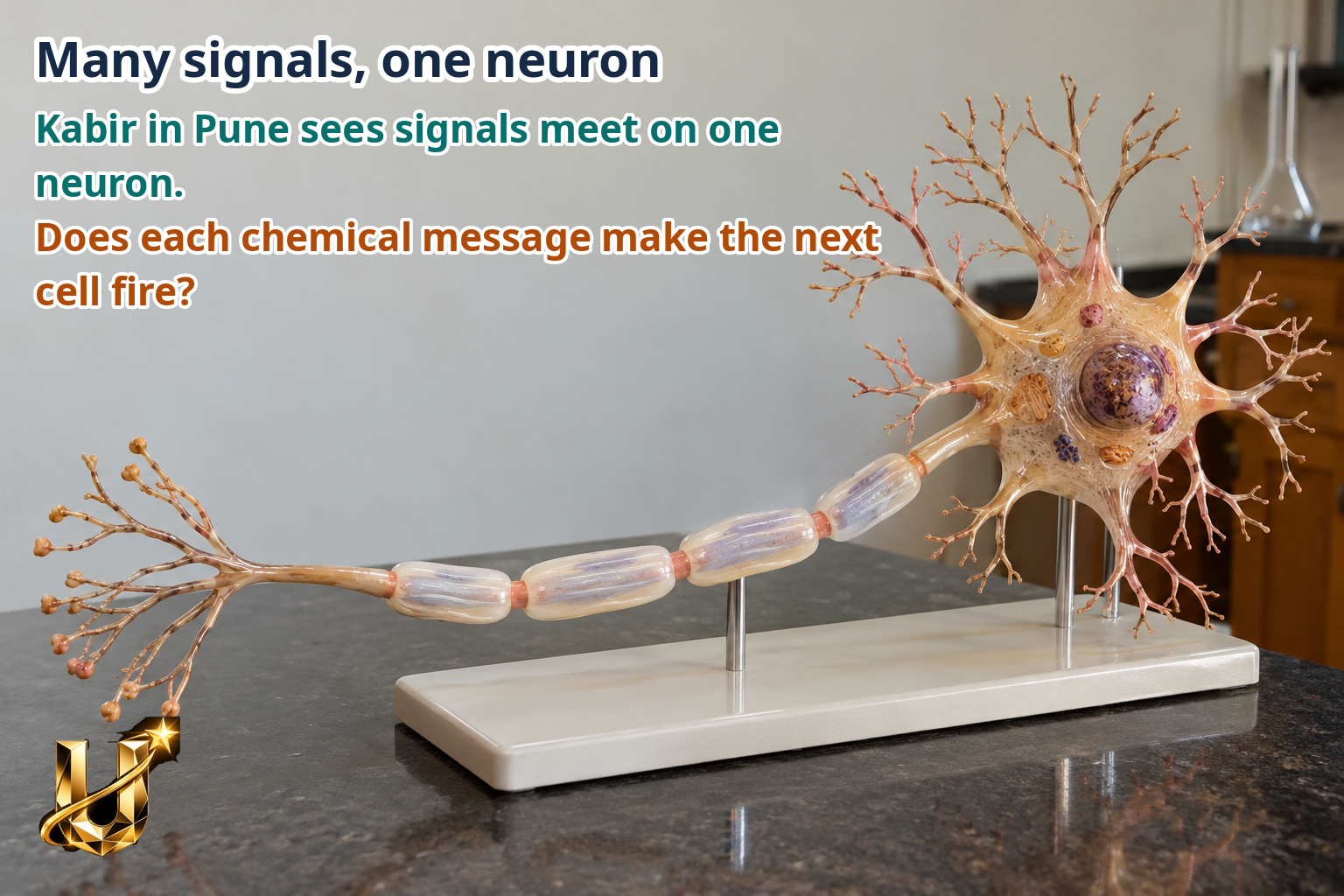
Kabir in Pune sees several signals converge on one neuron in a prepared diagram. Does each incoming chemical message necessarily make the next cell fire?
Working review group 9; official unit label pending
Kabir in Pune sees several signals converge on one neuron in a prepared diagram. Does each incoming chemical message necessarily make the next cell fire?
A rapidly regenerated change in membrane voltage that propagates along an excitable membrane.
Review lesson not available yet.
Kabir in Pune sees several signals converge on one neuron in a prepared diagram. Does each incoming chemical message necessarily make the next cell fire?
At many chemical synapses a presynaptic ending releases neurotransmitter, which binds receptors and changes the receiving cell's activity. Effects can be excitatory, inhibitory or modulatory depending on receptor and context. Electrical synapses are a different connection type.
A neurotransmitter binds two receptor types in different cells.
Does every transmitter always excite every target?
Brain and spinal cord form the central nervous system; peripheral pathways link receptors and effectors. Different brain regions participate in movement, sensing, autonomic regulation and cognition through networks, not one isolated function per region in every situation.
A supplied pathway has receptor → sensory neuron → central circuit → motor neuron → effector.
What forms the central nervous system?
Somatic and autonomic pathways coordinate different effectors and tasks; sympathetic/parasympathetic influences often differ but are not identical opposites at every target. Reflex circuits provide rapid automatic responses, with central processing and brain information depending on the circuit.
A model shows different sympathetic and parasympathetic effects on an organ.
Trace supplied neural pathways and compare excitatory/inhibitory examples with receptor labels. Discuss fictional responses without personal tests or diagnoses.
Synapses and networks integrate varied signals. Central/peripheral and voluntary/autonomic descriptions are useful when circuit and target differences remain explicit.