
A question from life
Enlarge image
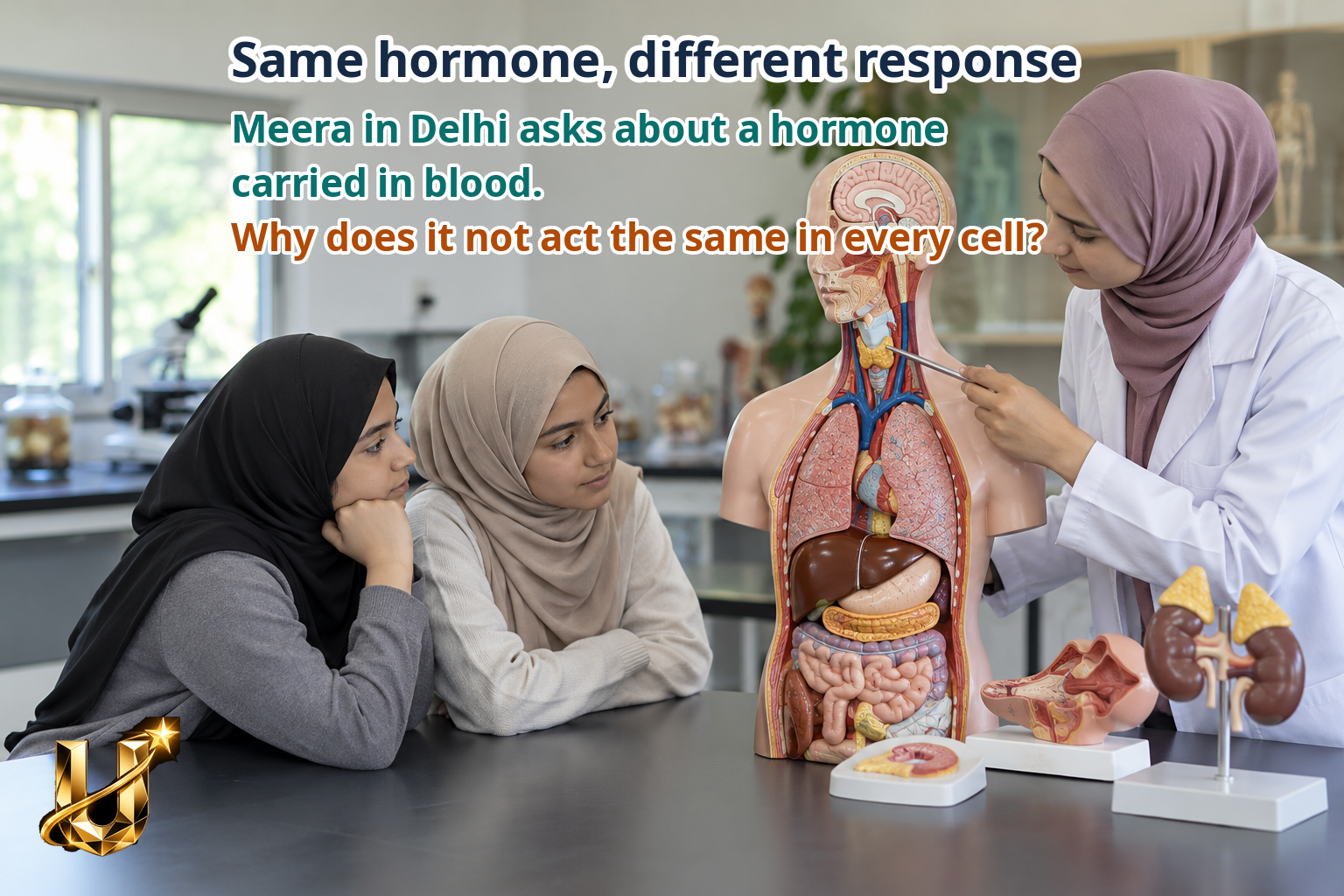
Meera in Delhi asks why a hormone carried in blood does not produce the same response in every cell it passes.
Working review group 10; official unit label pending
Meera in Delhi asks why a hormone carried in blood does not produce the same response in every cell it passes.
A regulatory response that opposes the change that initiated it.
Review lesson not available yet.
Meera in Delhi asks why a hormone carried in blood does not produce the same response in every cell it passes.
Endocrine hormones enter circulation and influence cells with appropriate receptors and signalling machinery. Different cells can respond differently. Hormonal and neural timescales overlap, so 'all hormones slow, all nerves fast' is only a rough comparison.
A hormone reaches cells A and B; only A has the supplied receptor.
What determines whether a cell responds through a hormone pathway?
Hypothalamic signals and pituitary hormones coordinate several endocrine axes with other glands. Thyroid hormones, adrenal signals, pancreatic hormones and gonadal hormones have varied roles. The pituitary is not an independent controller of every gland and all metabolism.
A supplied diagram shows thyroid hormone reducing upstream stimulation.
Are hormone effects always slower than every neural effect?
Negative feedback opposes a deviation through coordinated pathways. Insulin/glucagon regulation and hypothalamic-pituitary-thyroid feedback are useful models. Their diagrams show mechanisms, not a diagnosis from body size or one blood measurement.
A model variable rises and a response tends to lower it.
Trace supplied feedback arrows and match glands with broad functions. Use fictional variables without personal hormone, growth or blood data.
Endocrine response depends on targets and feedback networks. Major glands cooperate, and simplified axes do not diagnose individuals.