
A question from life
Enlarge image
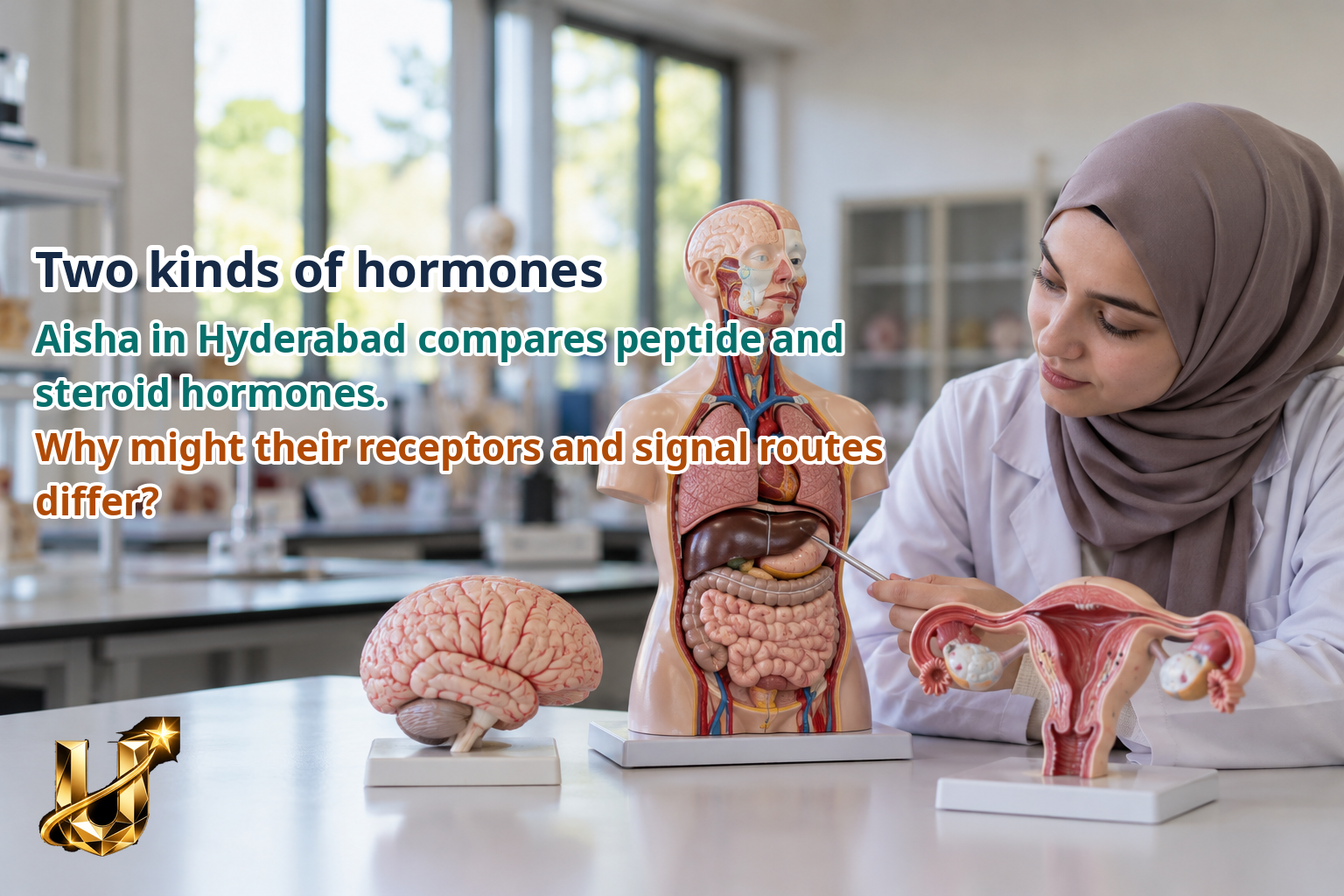
Aisha in Hyderabad compares a peptide hormone with a steroid hormone in a prepared cell diagram. Why might their receptors and signal routes differ?
Working review group 10; official unit label pending
Aisha in Hyderabad compares a peptide hormone with a steroid hormone in a prepared cell diagram. Why might their receptors and signal routes differ?
A regulatory response that opposes the change that initiated it.
Review lesson not available yet.
Aisha in Hyderabad compares a peptide hormone with a steroid hormone in a prepared cell diagram. Why might their receptors and signal routes differ?
Many peptide hormones act through membrane receptors and intracellular relay systems. Many steroid hormones act through intracellular receptors affecting gene expression; thyroid hormones also use intracellular receptor pathways despite being amino-acid derived. Hormone class is a guide, not one universal location rule.
A supplied peptide-hormone model binds a membrane receptor.
Where do many peptide hormones bind in the usual model?
ADH and oxytocin are synthesised in hypothalamic neurons and released through the posterior pituitary pathway in the usual account. An organ releasing a hormone need not be its synthesis site. Receptors, feedback and physiological state shape the final response.
A card places ADH synthesis in hypothalamus and release via posterior pituitary.
Where do many steroid-hormone receptors act?
Parathyroid and related signals regulate calcium balance; gonadal hormones participate in reproductive development and function. Adrenal and other signals interact with circulation and metabolism. These are integrated physiological roles, with individual development varying and personal information deserving privacy. Altered hormone production or action explains required disorder examples. Low growth-hormone secretion in childhood can cause pituitary growth deficiency (the syllabus's historical term is dwarfism); excess before growth-plate closure can cause gigantism, and excess later can cause acromegaly. Congenital hypothyroidism can impair early growth and neural development (the syllabus uses the historical term cretinism). Iodine deficiency can contribute to hypothyroidism and thyroid enlargement, or goitre; Graves' disease is an autoimmune hyperthyroid condition associated with exophthalmic goitre. Diabetes mellitus involves inadequate insulin production and/or action. Addison's disease is primary adrenal-cortex insufficiency, with deficient cortisol and often aldosterone. Mechanisms and development vary; terminology never ranks a person's worth and these descriptions are not symptom-based diagnoses.
Prepared labelled models show A: growth-hormone excess after growth-plate closure, B: inadequate insulin production/action, and C: primary adrenal-cortex hormone deficiency. Compare the endocrine disturbances.
Match hormone-route cards and distinguish synthesis, transport, release and target action. Explain one exception to a broad class rule without personal disclosures.
Hormones use varied receptor routes and coordinated controls. Synthesis is distinct from release, and physiological effects depend on targets and context.