
A question from life
Enlarge image
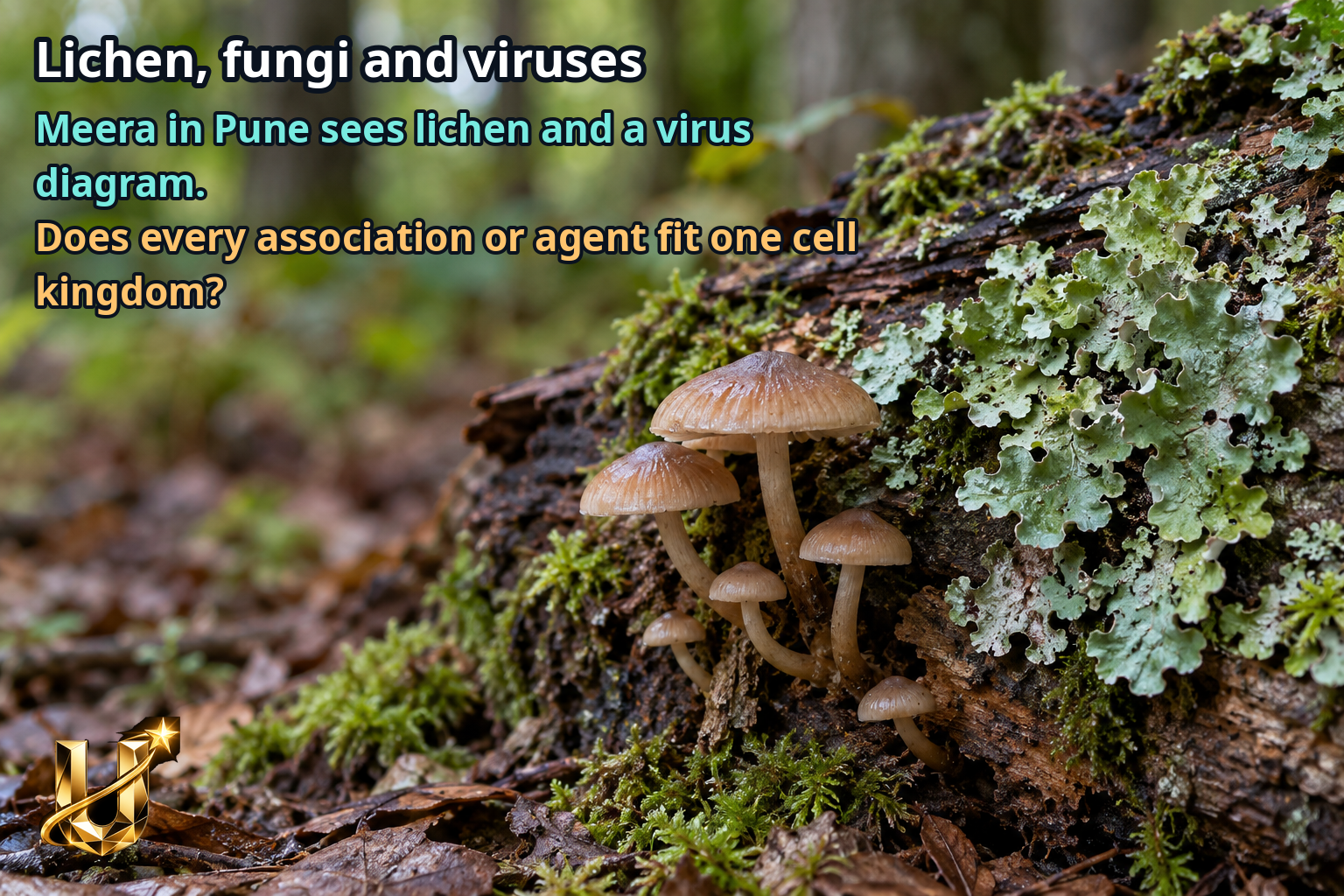
Meera in Pune sees a lichen on a rock and a virus diagram in a book. Does every biological association or infectious agent fit the same cellular kingdom?
Working review group 1; official unit label pending
Meera in Pune sees a lichen on a rock and a virus diagram in a book. Does every biological association or infectious agent fit the same cellular kingdom?
An organism whose cells have a nucleus and membrane compartments in their typical organisation.
Review lesson not available yet.
Meera in Pune sees a lichen on a rock and a virus diagram in a book. Does every biological association or infectious agent fit the same cellular kingdom?
Fungi are eukaryotic heterotrophs that commonly digest externally and absorb nutrients. Many have hyphae forming mycelium, while yeasts can be unicellular. Fungal cell walls commonly contain chitin; fungi are not plants simply because many remain fixed in place.
A supplied yeast model shows a nucleus and budding.
How do fungi commonly obtain nutrients?
A lichen is an association involving a fungus and photosynthetic partners such as an alga or cyanobacterium. Mycorrhiza links fungi with plant roots and can affect nutrient exchange. Benefits and interactions depend on partners and conditions, rather than every association being identical.
A diagram shows fungal threads around photosynthetic cells.
What is a mycelium?
Viruses are acellular agents with genetic material and protective structures, multiplying through host cells. Viroids are small infectious RNA agents without a protein coat, associated with certain plant diseases. These are not ordinary cells placed simply alongside cellular kingdoms.
One card describes RNA without a protein coat; another a viral particle with a coat.
Compare prepared fungus, lichen, virus and viroid diagrams. State what is cellular and what is an association or acellular agent, without handling unknown samples.
Fungi are diverse cellular eukaryotes and can form associations. Viruses and viroids are acellular agents with different structures and host dependence.