
A question from life
Enlarge image
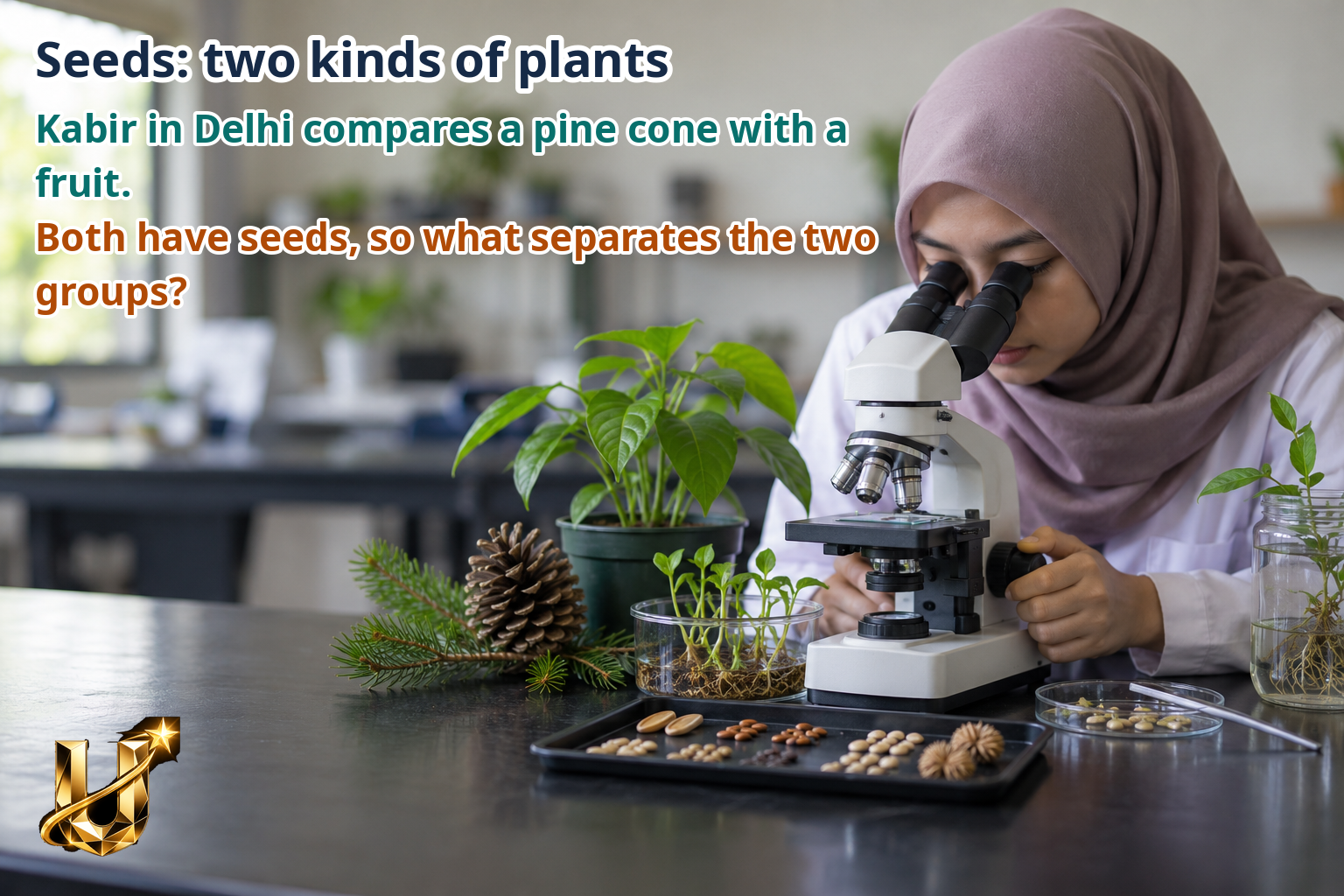
Kabir in Delhi compares a pine cone with a flowering plant's fruit. Both involve seeds, so what distinguishes gymnosperms and angiosperms?
Working review group 2; official unit label pending
Kabir in Delhi compares a pine cone with a flowering plant's fruit. Both involve seeds, so what distinguishes gymnosperms and angiosperms?
The haploid generation that produces gametes in a plant life cycle.
Review lesson not available yet.
Kabir in Delhi compares a pine cone with a flowering plant's fruit. Both involve seeds, so what distinguishes gymnosperms and angiosperms?
Seed plants have a dominant vascular sporophyte and greatly reduced gametophytes. Pollen supports male gametophyte function and ovules contain female reproductive structures. Heterospory means microspores and megaspores have different developmental roles; a pollen grain is not simply a sperm cell.
A supplied pine diagram shows ovules without an enclosing ovary.
What distinguishes gymnosperm ovules here?
Gymnosperm ovules are not enclosed in an ovary as in angiosperms; 'naked' refers to this enclosure distinction, not absence of every protective covering. Angiosperms produce flowers and usually fruits developing from the ovary with possible contributions from other structures.
A diploid sporophyte undergoes meiosis.
What does a plant sporophyte produce by meiosis in the usual cycle?
Alternation of generations links haploid gametophytes and diploid sporophytes. Meiosis in the sporophyte produces spores; gametophytes produce gametes by mitosis in the usual plant cycle. Fertilisation restores diploidy. The relative size and independence of phases vary.
A card labels pollen as a reduced male gametophyte.
Arrange phase-labelled cards for spore, gametophyte, gamete, zygote and sporophyte. Compare cone and flower diagrams without opening or collecting wild specimens.
Seed plants share reduced gametophytes and dominant sporophytes. Ovary enclosure distinguishes gymnosperms and angiosperms, while meiosis and fertilisation connect generations.