
A question from life
Enlarge image
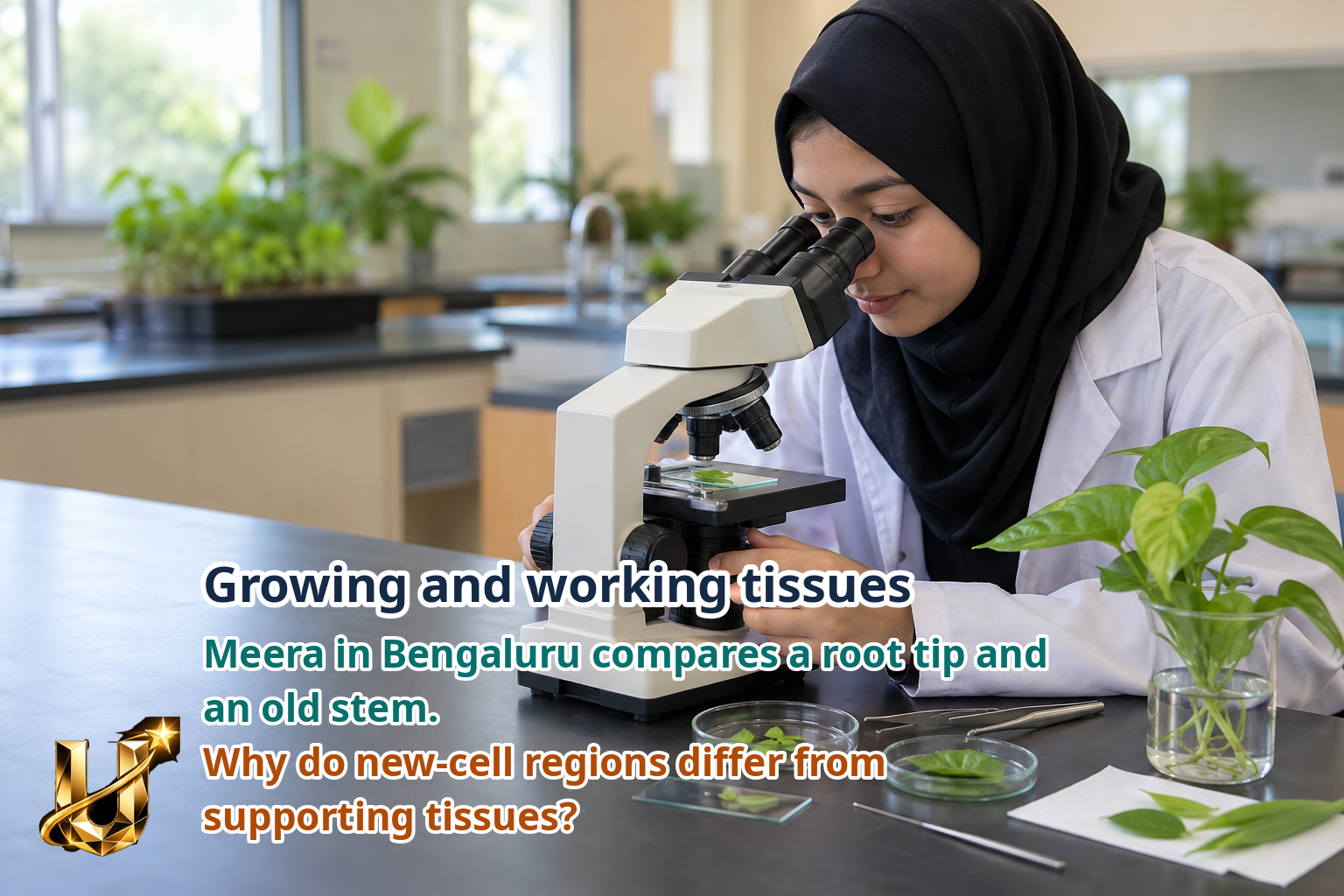
Meera in Bengaluru compares the tip of a root with an older stem. Why do regions that make new cells differ from tissues transporting water or supporting the plant?
Working review group 3; official unit label pending
Meera in Bengaluru compares the tip of a root with an older stem. Why do regions that make new cells differ from tissues transporting water or supporting the plant?
A plant region containing cells that actively divide to support growth.
Review lesson not available yet.
Meera in Bengaluru compares the tip of a root with an older stem. Why do regions that make new cells differ from tissues transporting water or supporting the plant?
Meristems contain actively dividing cells. Apical, intercalary and lateral meristems support different growth patterns in suitable plants. Cells can differentiate into mature tissues with specialised structures; location and function are linked but not identical in every plant.
A prepared root-tip section contains many dividing cells.
Which tissue contains actively dividing cells?
Parenchyma commonly supports metabolism and storage; collenchyma flexible support; sclerenchyma strong support with thickened walls and often dead mature cells. Avoid saying every living support tissue is identical or every plant tissue is dead.
A young petiole bends without permanent damage in the example.
Which simple tissue commonly supports storage and metabolism?
Xylem and phloem contain more than one cell type and perform transport with support roles. Epidermal and associated structures protect surfaces and regulate exchange. Stomata include guard cells; they are not simply holes with no cellular control.
A xylem diagram includes several cell types.
Sort labelled tissue micrographs by growth, storage, support, transport and protection. Use prepared images; no sectioning with blades.
Plant tissues divide labour. Meristems generate cells, mature tissues specialise, and complex/protective systems support transport and regulated exchange.