
A question from life
Enlarge image
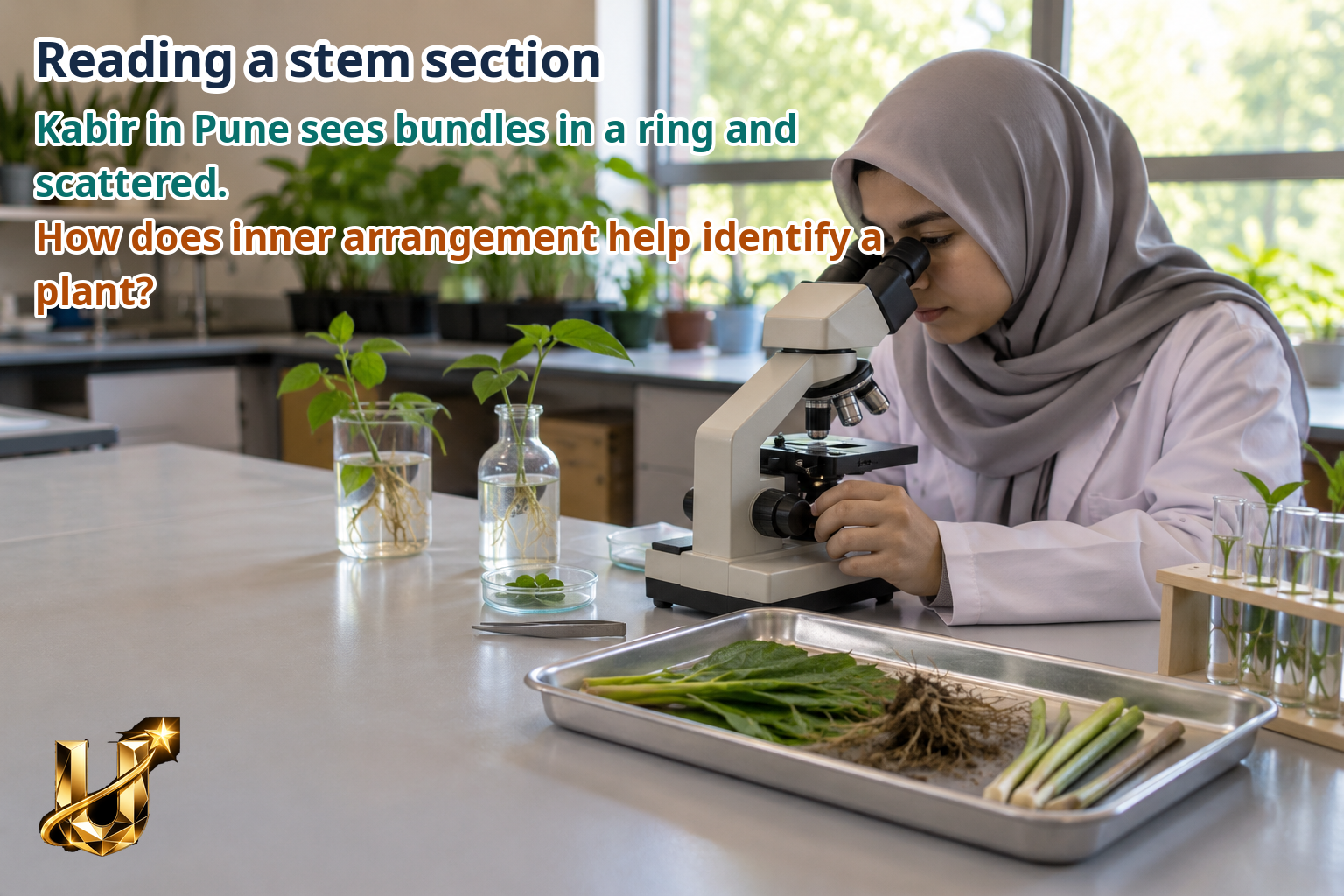
Kabir in Pune sees vascular bundles arranged in a ring in one stem section and scattered in another. How can internal arrangement help identify a typical anatomical pattern?
Working review group 3; official unit label pending
Kabir in Pune sees vascular bundles arranged in a ring in one stem section and scattered in another. How can internal arrangement help identify a typical anatomical pattern?
A plant region containing cells that actively divide to support growth.
Review lesson not available yet.
Kabir in Pune sees vascular bundles arranged in a ring in one stem section and scattered in another. How can internal arrangement help identify a typical anatomical pattern?
A root section can show epidermis, cortex, endodermis, pericycle and central vascular tissues. In usual school comparisons xylem and phloem occur on different radial positions. Endodermal barriers regulate entry toward the vascular region; they are not merely decorative boundaries.
A supplied typical section has a ring of open vascular bundles.
Which layer commonly regulates entry toward root vascular tissues?
A typical eudicot stem model has vascular bundles in a ring, often with cambium in open bundles. A typical monocot stem has scattered closed bundles. These are comparison models with plant and developmental variation, not infallible identification from any single damaged section.
A diagram places xylem and phloem in alternating radial positions.
What arrangement fits the typical eudicot stem comparison?
A typical dorsiventral leaf has differentiated palisade/spongy mesophyll and an upper/lower organisation; many monocot leaves have an isobilateral pattern. Vascular bundles support supply and export. Stomatal distribution and mesophyll patterns vary, so 'all stomata below' is not universal.
A prepared leaf image has stomata on both surfaces.
Compare prepared root, stem and leaf sections with a labelled key. State the typical pattern and one limitation without cutting live samples.
Internal anatomy reveals organised transport and support. Typical root, stem and leaf comparisons are useful when combined with species and developmental context.