
A question from life
Enlarge image
Meera in Delhi compares a skin lining, blood and muscle. How can cells cooperate in such different structures?
Working review group 4; official unit label pending
Meera in Delhi compares a skin lining, blood and muscle. How can cells cooperate in such different structures?
An organised collection of cells and associated material working together for a function.
Review lesson not available yet.
Meera in Delhi compares a skin lining, blood and muscle. How can cells cooperate in such different structures?
Epithelial tissues form sheets at surfaces and cavities. Their shapes, layers and specialisations support protection, absorption or secretion depending on site. A one-layer exchange surface and a multilayer protective surface solve different problems.
A prepared diagram shows a thin epithelial layer beside capillaries.
Which tissue forms surface sheets?
Connective tissues include cells and extracellular matrix, which may be fluid, flexible or mineralised. Blood, cartilage and bone differ. Muscle tissues contract: skeletal, smooth and cardiac types have distinct structures and control.
Blood has plasma while bone has mineralised matrix.
Which connective tissue has a fluid matrix?
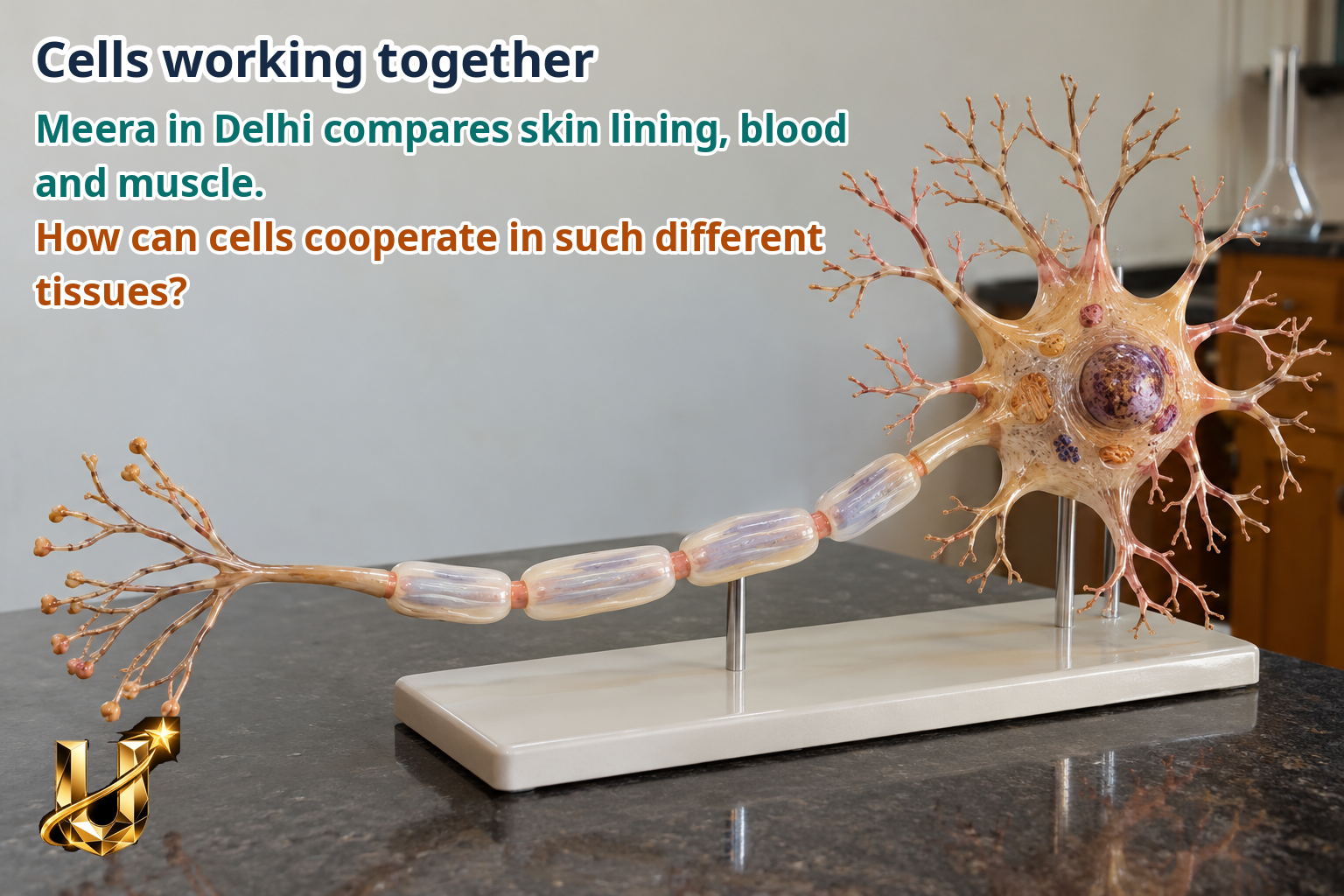
Neurons receive and transmit signals using specialised processes; glial cells support and regulate the environment in varied ways. Tissue organisation combines cell types rather than one identical unit performing every function.
A cell diagram has branched receiving regions and a long axon.
Sort prepared tissue images by covering, connection, contraction and coordination. Explain one structural feature without diagnosing real tissue or using specimens.
Animal tissues organise cells and matrix for covering, support, transport, movement and coordination. Tissue type and local structure matter.
Formative extension: human food passes from mouth through oesophagus,stomach,small intestine and large intestine. Peristalsis propels it. Salivary amylase begins starch digestion; pepsin acts on proteins in suitable acidic stomach conditions. Bile aids fat emulsification,and pancreatic and intestinal enzymes complete much digestion. Villi support absorption; assimilation uses absorbed material in cells,and egestion removes unabsorbed residues. Gastrin,secretin and cholecystokinin help coordinate digestive activity. Carbohydrates and proteins provide roughly four kilocalories per gram,and fat about nine in the common food-energy model; these are approximate nutritional values. Protein-energy malnutrition concerns inadequate energy/protein supply; constipation,diarrhoea,vomiting,indigestion and jaundice describe different problems rather than one mechanism. This overview is not a diagnosis or treatment guide.
A labelled model compares intestinal nutrient absorption with undigested residue leaving the gut.
Use of absorbed nutrients by cells is called: