
A question from life
Enlarge image
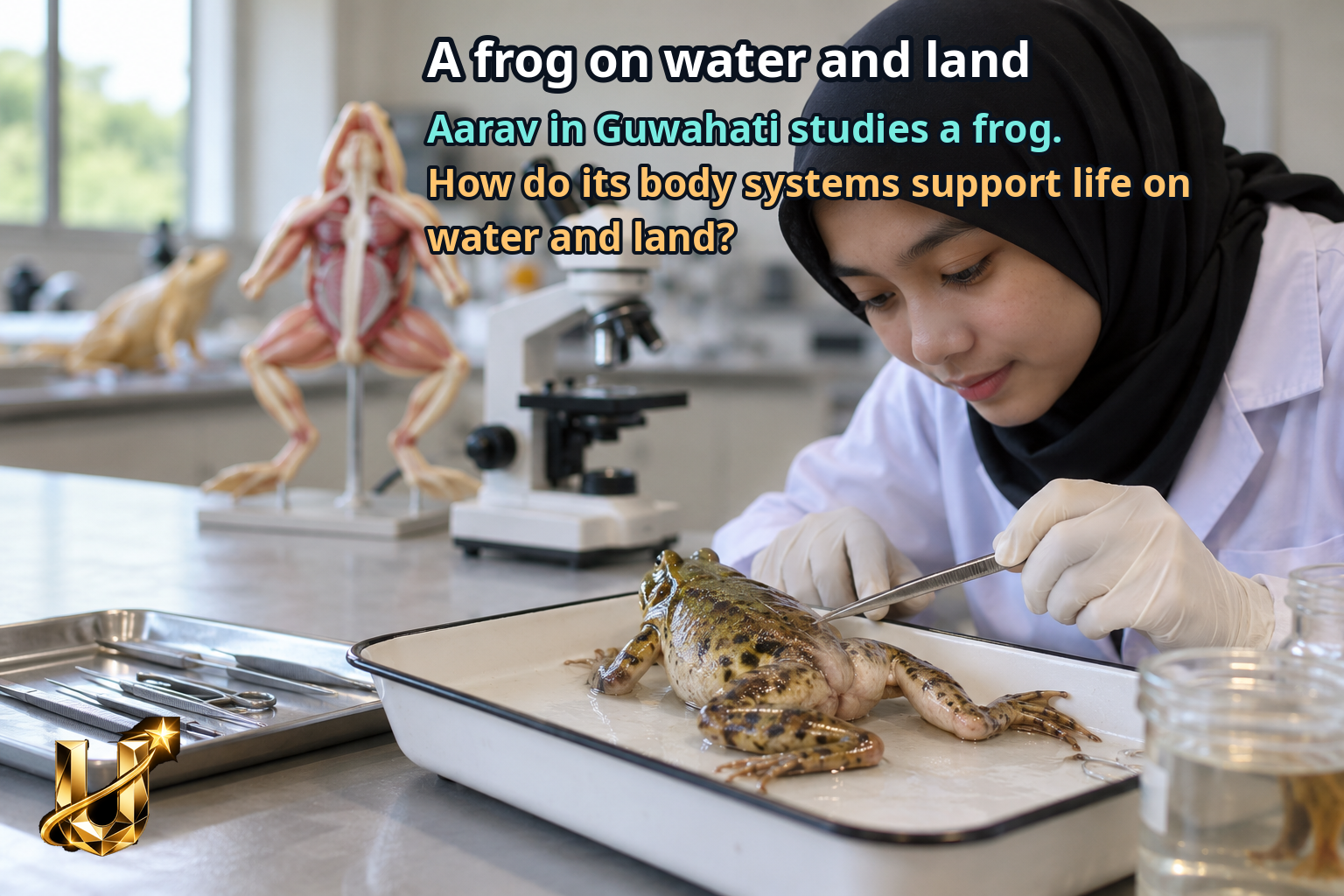
Aarav in Guwahati studies a frog diagram. How do limbs, skin, lungs, heart and reproductive structures contribute to life across water and land?
Working review group 4; official unit label pending
Aarav in Guwahati studies a frog diagram. How do limbs, skin, lungs, heart and reproductive structures contribute to life across water and land?
An organised collection of cells and associated material working together for a function.
Review lesson not available yet.
Aarav in Guwahati studies a frog diagram. How do limbs, skin, lungs, heart and reproductive structures contribute to life across water and land?
A typical adult frog has a head and trunk, forelimbs and powerful hindlimbs, with adaptations for movement and a moist skin. External features should be described from the supplied specimen/model; not every amphibian has identical form.
A model shows long muscular hindlimbs.
Which is a typical adult-frog heart count?
Adult frogs can exchange gases through lungs and suitable moist skin, with conditions affecting the contributions. The typical adult heart has two atria and one ventricle. This differs from the four-chambered mammalian model and does not mean the circulations are identical.
A diagram shows two atria and one ventricle.
Why does moist skin matter in the exchange model?
Digestive, excretory, nervous and reproductive systems have distinct organs that work together. Many frogs have external fertilisation and a larval stage with metamorphosis, with variation among species. A tadpole's structures and physiology should not be assumed identical to the adult's.
A supplied tadpole and adult have different exchange structures.
Trace air, blood and food routes on supplied frog diagrams. Compare larva/adult cards and label model limits. No animal collection, manipulation or dissection.
A frog model links external form with interacting systems and developmental change. Typical adult features differ from mammalian and larval patterns.
In the typical adult frog model,food passes through mouth,buccal cavity,oesophagus,stomach,intestine,rectum and cloaca. Liver and pancreas supply digestive secretions. Paired kidneys drain through ureters; the cloaca is a shared terminal chamber for several systems. The brain,spinal cord and nerves coordinate activity. Males have testes and sperm ducts; females have ovaries and oviducts,with eggs released for external fertilisation in the common school model. These are labelled anatomical relationships,not instructions for handling animals.
A labelled frog diagram shows a cloaca receiving the terminal digestive route. Is it simply the same as a human urinary bladder?
The common terminal chamber in the standard adult frog model is the: