
A question from life
Enlarge image
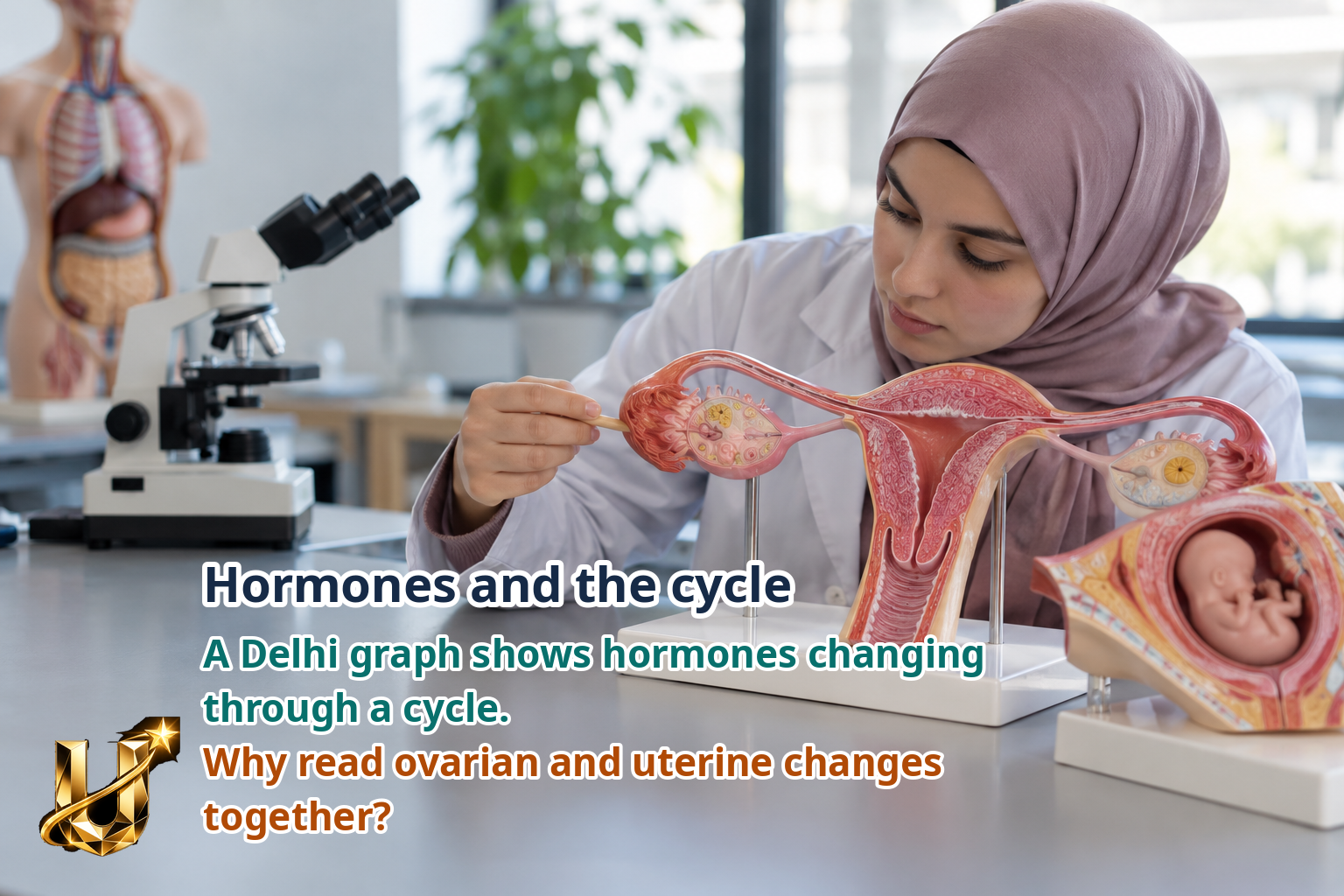
A Delhi classroom graph shows hormone concentrations changing through a reproductive cycle. Why must ovarian events and uterine-lining changes be read together?
Working review group 1; official unit label pending
A Delhi classroom graph shows hormone concentrations changing through a reproductive cycle. Why must ovarian events and uterine-lining changes be read together?
Embedding of the developing conceptus in the uterine lining.
Review lesson not available yet.
A Delhi classroom graph shows hormone concentrations changing through a reproductive cycle. Why must ovarian events and uterine-lining changes be read together?
GnRH from the hypothalamus helps regulate pituitary FSH and LH. FSH supports follicular development; follicles produce oestrogens. Under the appropriate feedback conditions, an LH surge triggers ovulation. The corpus luteum then secretes progesterone and oestrogens supporting the endometrium. Without pregnancy support, the corpus luteum regresses and hormone decline contributes to menstruation. Cycle lengths and timing vary; the28-day graph is a teaching schematic, not a personal prediction.
A normal sperm and oocyte each contribute23chromosomes.
A sharp LH surge in the standard cycle model is associated with?
Sperm and oocyte interactions lead to fusion of haploid genetic contributions and formation ofa diploid zygote. Cleavage produces smaller cells without equivalent overall growth at first; the developing conceptus progresses through morula and blastocyst stages. A blastocyst includes an inner cell mass and trophoblast. Implantation occurs in the endometrium after transport into the uterus; fertilisation and implantation are distinct events.
A supplied graph has an LH surge followed by a progesterone rise.
The corpus luteum chiefly supports the uterine lining through?
The placenta mediates exchange and has endocrine functions; maternal and fetal blood normally remain in separate circulations across an exchange interface. Early hCG supports the corpus luteum. Parturition involves neuroendocrine feedback, including oxytocin-related contractions; prolactin supports milk production and oxytocin supports milk ejection. A positive feedback example does not describe every clinical event or prescribe treatment.
Order fertilisation, cleavage, blastocyst formation and implantation.
Arrange event and hormone cards against a clearly labelled schematic cycle. Identify feedback and stage sequences, and state where individual variation limits conclusions. No personal cycle tracking or health interpretation is requested.
Hormonal feedback coordinates ovarian and uterine events. Fertilisation, cleavage and implantation are different stages. Placental exchange, birth and lactation involve specialised physiological regulation.