
A question from life
Enlarge image
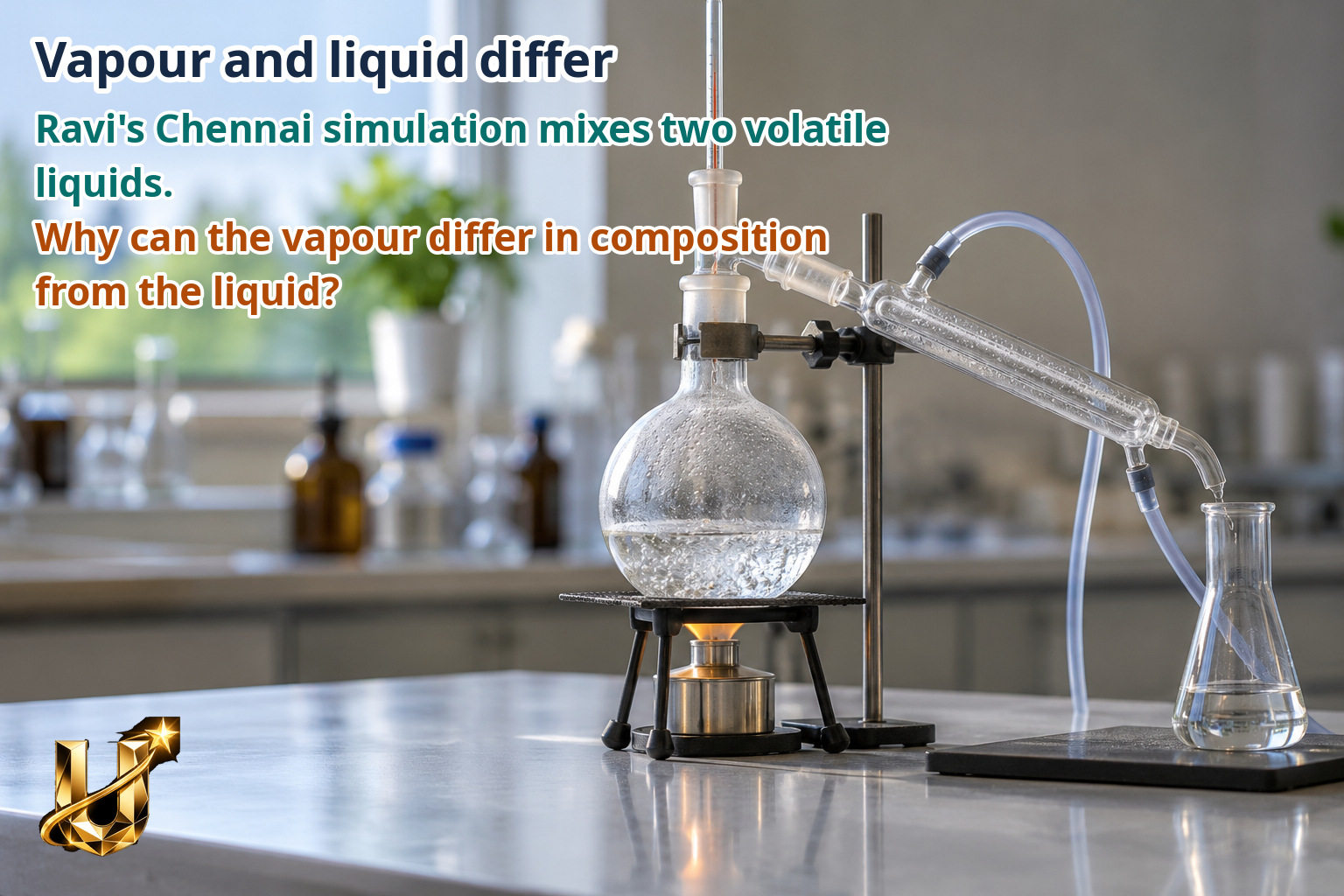
Ravi's Chennai simulation mixes two volatile liquids. Why need the vapour above them have a different composition from the liquid?
Working review group 1; official unit label pending
Ravi's Chennai simulation mixes two volatile liquids. Why need the vapour above them have a different composition from the liquid?
The change in Gibbs energy per added amount of a component under specified conditions.
Review lesson not available yet.
Ravi's Chennai simulation mixes two volatile liquids. Why need the vapour above them have a different composition from the liquid?
An ideal liquid solution obeys pi=xi pi° for every volatile component at the stated temperature; pi° is the pure-component vapour pressure. Total vapour pressure is the sum of partial pressures. The vapour mole fraction yi=pi/ptotal can differ from liquid xi. With a nonvolatile solute, only solvent contributes appreciably and p=xsolvent p°solvent in the ideal model.
An ideal binary liquid hasxA=0.40, xB=0.60, pA°=100kPa, pB°=50kPa.
Raoult's law for component A in an ideal solution is?
An ideal solution has similar unlike and like interactions,ΔH mix=0 andΔVmix=0 in the ideal description. Real solutions may deviate. Weaker unlike attractions often give positive vapour-pressure deviation and endothermic mixing; stronger unlike attractions often give negative deviation and exothermic mixing. Interaction comparisons require chemical context, not a universal rule from polarity alone.
Use that ideal mixture.
Total pressure for volatile components is?
For a nonvolatile solute, relative lowering(p°−p)/p° equals solute mole fraction in a binary ideal solution. A liquid boils when its vapour pressure matches external pressure. Strong nonideal deviations can produce azeotropes where vapour and liquid compositions match at a particular pressure; ordinary fractional distillation cannot cross that composition under those conditions.
A binary ideal model hasxsolute=0.020 and pure-solvent vapour pressure20.0kPa.
Calculate partial-pressure bars from prepared mole-fraction cards, then compare liquid and vapour compositions. Discuss ideal and positive/negative-deviation graphs without handling volatile liquids or heating mixtures.
Raoult's law predicts ideal partial pressures. Liquid and vapour compositions can differ. Real interactions cause deviations, and azeotropes require special composition/pressure conditions.
Formative extension: adsorption concentrates particles at a surface,while absorption concerns entry into the bulk. Physisorption is dominated by intermolecular interactions; chemisorption involves chemical bonding to the surface and can be more specific. A colloid disperses particles or droplets between typical solution and coarse-suspension scales. Lyophilic colloids interact favourably with the dispersion medium; lyophobic systems often need additional stabilisation. Coagulation aggregates suitable particles; an emulsion disperses one liquid in another. These processes do not automatically purify water for drinking.
A prepared diagram shows gas particles concentrated on the outside surface of a solid. Which process is illustrated?
Concentration at a surface is called: